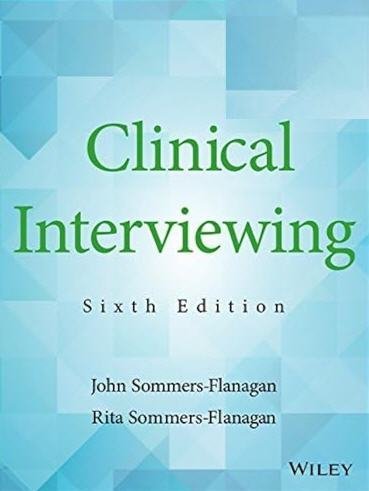
Clinical Interviewing 6th Edition by John Sommers-Flanagan, ISBN-13: 978-1119215585
Original price was: $50.00.$14.99Current price is: $14.99.
Safe & secure checkout
Description
Description
Clinical Interviewing 6th Edition by John Sommers-Flanagan, ISBN-13: 978-1119215585
[PDF eBook eTextbook] – Available Instantly
- Publisher: John Wiley & Sons Inc; 6th edition (January 1, 2016)
- Language: English
- 667 pages
- ISBN-10: 1119215587
- ISBN-13: 978-1119215585
Fully updated guide to proven, practical strategies for conducting effective interviews.
Clinical Interviewing is the essential guide to conducting initial interviews, suicide assessment, mental status examinations, and psychotherapy skill development. The Sixth Edition includes:
- Updates focusing on latest trends in clinical interviewing research and practice
- Updated information on technology-based interviewing
- Access to over 70 videos that show the authors discussing and demonstrating crucial interviewing techniques
- Online instructor’s manual and resources to facilitate teaching
- Fresh case examples to help apply interviewing skills and concepts
- New coverage of special populations and multicultural considerations
- Expanded skills coverage to help facilitate client insight and action
Table of Contents:
Cover
Title Page
Copyright
Dedication
Preface
Language Choices
What’s New in the Sixth Edition?
Access to Videos and Additional Content
Using the Online Instructor’s Manual and Ancillary Materials
Acknowledgments
About the Authors
Part One: Foundations of Clinical Interviewing
Chapter 1: An Introduction to the Clinical Interview
Learning Objectives
Chapter Orientation
Welcome to the Journey – Video 1.1
What Is a Clinical Interview? – Video 1.2
Clinical Interviewing versus Counseling and Psychotherapy – Video 1.3
A Learning Model for Clinical Interviewing – Video 1.4
Multicultural Competencies – Video 1.5
Multicultural Humility – Video 1.6
Summary
Suggested Readings and Resources
Chapter 2: Preparation
Learning Objectives
Chapter Orientation
The Physical Setting – Video 2.1
Professional and Ethical Issues – Video 2.2
Multicultural Preparation – Video 2.3
Stress Management and Self-Care – Video 2.4
Summary
Suggested Readings and Resources
Chapter 3: An Overview of the Interview Process
Learning Objectives
Chapter Orientation
Stages of a Clinical Interview – Video 3.1
The Introduction – Video 3.2
The Opening – Video 3.3
The Body – Video 3.4
The Closing – Video 3.5
Ending the Session (Termination) – Video 3.6
Summary
Suggested Readings and Resources
Part Two: Listening and Relationship Development
Chapter 4: Nondirective Listening Skills
Learning Objectives
Chapter Orientation
Listening Skills – Video 4.1
Adopting a Therapeutic Attitude – Video 4.2
Why Nondirective Listening Is Also Directive – Video 4.3
The Listening Continuum in Three Parts – Video 4.4
Nondirective Listening Behaviors: Skills for Encouraging Client Talk – Video 4.5
Ethical and Multicultural Considerations – Video 4.6
Not Knowing What to Say
Summary
Suggested Readings and Resources
Chapter 5: Directive Listening Skills
Learning Objectives
Chapter Orientation
Directive Listening Behaviors: Skills for Encouraging Insight – Video 5.1
Questions – Video 5.2
Ethical and Multicultural Considerations When Using Directive Listening Skills – Video 5.3
Summary
Suggested Readings and Resources
Chapter 6: Skills for Directing Clients Toward Action
Learning Objectives
Chapter Orientation
Readiness to Change – Video 6.1
Skills for Encouraging Action: Using Questions – Video 6.2
Using Educational and Directive Techniques – Video 6.3
Ethical and Multicultural Considerations When Encouraging Client Action – Video 6.4
Summary
Suggested Readings and Resources
Chapter 7: Evidence-Based Relationships
Learning Objectives
Chapter Orientation
The Great Psychotherapy Debate
Carl Rogers’s Core Conditions – Video 7.1
Other Evidence-Based Relationship Concepts – Video 7.2
Evidence-Based Multicultural Relationships – Video 7.3
Summary
Suggested Readings and Resources
Part Three: Structuring and Assessment
Chapter 8: Intake Interviewing and Report Writing
Learning Objectives
Chapter Orientation
What’s an Intake Interview? – Video 8.1
Three Overarching Objectives – Video 8.2
Factors Affecting Intake Interview Procedures – Video 8.3
Identifying, Evaluating, and Exploring Client Problems and Goals
Obtaining Background and Historical Information
Assessment of Current Functioning
Brief Intake Interviewing – Video 8.4
The Intake Report – Video 8.5
Do’s and Don’ts of Intake Interviews With Diverse Clients – Video 8.6
Summary
Suggested Readings and Resources
Chapter 9: The Mental Status Examination
Learning Objectives
Chapter Orientation
What Is a Mental Status Examination? – Video 9.1
Individual and Cultural Considerations – Video 9.2
The Generic Mental Status Examination – Video 9.3
When to Use Mental Status Examinations – Video 9.4
Summary
Suggested Readings and Resources
Chapter 10: Suicide Assessment
Learning Objectives
Chapter Orientation
Facing the Suicide Situation – Video 10.1
Suicide Risk Factors, Protective Factors, and Warning Signs – Video 10.2
Building a Theoretical and Research-Based Foundation – Video 10.3
Suicide Assessment Interviewing – Video 10.4
Suicide Interventions – Video 10.5
Ethical and Professional Issues – Video 10.6
Summary
Suggested Readings and Resources
Chapter 11: Diagnosis and Treatment Planning
Learning Objectives
Chapter Orientation
Modern Diagnostic Classification Systems – Video 11.1
Defining Mental Disorders – Video 11.2
Diagnostic Interviewing – Video 11.3
The Science of Clinical Interviewing: Diagnostic Reliability and Validity
Less Structured Diagnostic Clinical Interviews – Video 11.4
Treatment Planning – Video 11.5
Case Formulation and Treatment Planning: A Cognitive-Behavioral Example – Video 11.6
Additional Cultural Modifications and Adaptations – Video 11.7
Summary
Suggested Readings and Resources
Part Four: Special Populations and Situations
Chapter 12: Challenging Clients and Demanding Situations
Learning Objectives
Chapter Orientation
Challenging Clients – Video 12.1
Motivational Interviewing and Other Strategies for Working Through Resistance – Video 12.2
Assessment and Prediction of Violence and Dangerousness – Video 12.3
Demanding Situations: Crisis and Trauma – Video 12.4
Cultural Competencies in Disaster Mental Health – Video 12.5
Summary
Suggested Readings and Resources
Chapter 13: Interviewing Young Clients
Learning Objectives
Chapter Orientation
Considerations in Working With Young Clients – Video 13.1
The Introduction – Video 13.2
The Opening – Video 13.3
The Body of the Interview – Video 13.4
Closing and Termination – Video 13.5
Culture in Young Client Interviews – Video 13.6
Summary
Suggested Readings and Resources
Chapter 14: Interviewing Couples and Families
Learning Objectives
Chapter Orientation
Challenges and Ironies of Interviewing Couples and Families – Video 14.1
The Introduction – Video 14.2
The Opening – Video 14.3
The Body – Video 14.4
Closing and Termination – Video 14.5
Special Considerations – Video 14.6
Diversity Issues – Video 14.7
Summary
Suggested Readings and Resources
Chapter 15: Electronic and Telephonic Interviewing
Learning Objectives
Chapter Orientation
Technology as an Extension of the Self – Video 15.1
Definition of Terms and Communication Modalities – Video 15.2
Non-FtF Assessment and Intervention Research – Video 15.3
Ethical and Practical Issues: Problems and Solutions – Video 15.4
Conducting Online or Non-FtF Interviews – Video 15.5
Multicultural Issues: Culture and Online Culture – Video 15.6
Summary
Suggested Online Training Resources
Appendix: Extended Mental Status Examination Interview Protocol
Preparation
MSE Categories
Evaluating and Communicating Results
References
Author Index
Subject Index
End User License Agreement
JOHN SOMMERS-FLANAGAN, PHD, is a clinical psychologist and professor of counselor education at the University of Montana. He is a long-time member of both the American Counseling Association (ACA) and the American Psychological Association (APA).
RITA SOMMERS-FLANAGAN, PHD, is professor emeritus at the University of Montana. As a clinical psychologist, she has worked with youth, families, couples, and women for many years.
What makes us different?
• Instant Download
• Always Competitive Pricing
• 100% Privacy
• FREE Sample Available
• 24-7 LIVE Customer Support