

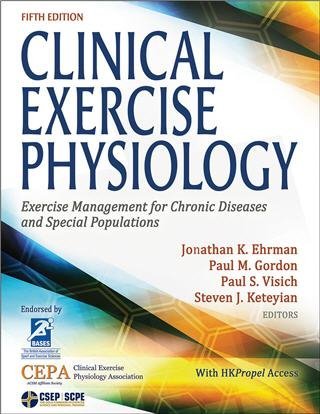
Clinical Exercise Physiology 5th Edition by Jonathan K. Ehrman, ISBN-13: 978-1718200449
Original price was: $50.00.$19.99Current price is: $19.99.
Safe & secure checkout
Description
Description
Clinical Exercise Physiology 5th Edition by Jonathan K. Ehrman, ISBN-13: 978-1718200449
[PDF eBook eTextbook]
- Publisher: Human Kinetics; Fifth edition (April 21, 2022)
- Language: English
- 656 pages
- ISBN-10: 1718200447
- ISBN-13: 978-1718200449
Clinical Exercise Physiology, Fifth Edition is a comprehensive guide to the clinical aspects of exercise physiology, investigating 24 chronic diseases and conditions and addressing a variety of populations. The text has been a mainstay in the field since its inception in 2003 and is an ideal resource for students preparing for clinical exercise certifications, including those offered by the American College of Sports Medicine (ACSM-CEP), American Council on Exercise (Medical Exercise Specialist), Canadian Society for Exercise Physiology (CSEP-CEP), and Exercise & Sports Science Australia (ESSA-AEP).
Clinical Exercise Physiology, Fifth Edition, employs a logical progression of content to provide greater coverage and depth of diseases than is typically found in most clinical exercise physiology textbooks. It examines the effects of exercise on 24 chronic conditions, with each chapter covering the epidemiology, pathophysiology, clinical considerations, drug and surgical therapies, and exercise testing and prescription issues for the chronic condition. Other chapters are devoted to examining exercise-related issues for four special populations.
Each chapter in this fifth edition is revised and updated to include the latest research, clinical guidelines, and position statements from professional organizations. In addition, it incorporates the following new elements:
- An upgrade to a full-color layout, for a more engaging learning experience and enhanced presentation of data
- New Clinical Exercise Bottom Line sidebars that highlight key information a clinical exercise physiologist needs when working with clinical populations
- A new chapter on clinical exercise programming that offers detailed recommendations for clinical populations
- A completely rewritten chapter on spinal cord injury and updates throughout each chapter to reflect the most up-to-date guidelines and position statements
- Expanded coverage of clinical exercise physiology certification options
In addition to practical application sidebars throughout the text, the fifth edition also has related online tools to support student learning. More than 60 case studies are presented in a SOAP note format so students can explore clinical evaluations, looking closely at subjective and objective data, assessments, and plans. Discussion questions and interactive key term flash cards foster better understanding and retention, while chapter quizzes can be assigned by instructors through the platform to assess student comprehension.
Endorsed by the Clinical Exercise Physiology Association (CEPA), the Canadian Society for Exercise Physiology (CSEP), the British Association of Sport and Exercise Sciences (BASES), and Exercise & Sports Science Australia (ESSA), Clinical Exercise Physiology, Fifth Edition, offers a contemporary review of the variety of diseases and conditions that students and professionals may encounter in the field. New and veteran clinical exercise physiologists, as well as those preparing for clinical exercise certification exams, will appreciate the in-depth coverage of the clinical populations that benefit from physical activity.
Table of Contents:
Title Page
Copyright
Contents
Preface
Acknowledgments
Part I: Introduction to Clinical Exercise Physiology
Chapter 1. The Profession of Clinical Exercise Physiology
The Past, Present, and Future of Clinical Exercise Physiology
Professional Organizations and Certifications Throughout the World
Professionalization of Clinical Exercise Physiology
Conclusion
Chapter 2. Promoting a Physically Active Lifestyle
Benefits of Physical Activity
Participation in Regular Physical Activity
Conclusion
Chapter 3. General Principles of Pharmacology
General Properties of Drugs
Routes of Administration
Phases of Drug Effect
Mechanism of Action
Pharmacotherapy
Conclusion
Chapter 4. General Interview and Examination Skills
General Interview
Physical Examination
Conclusion
Chapter 5. Graded Exercise Testing
Indications
Contraindications
Procedures for Preparing, Conducting, and Interpreting a Graded Exercise Test
Graded Exercise Testing With Diagnostic Imaging
Conclusion
Chapter 6. Exercise Prescription
Exercise Training Sequence
Goal Setting
Principles of Exercise Prescription
Cardiorespiratory Endurance
Skeletal Muscle Strength and Endurance
Flexibility Training
Conclusion
Chapter 7. Clinical Exercise Programming
Cardiac Rehabilitation
Pulmonary Rehabilitation
Supervised Exercise Therapy for Patients With Peripheral Artery Disease
Cancer Rehabilitation
Renal Rehabilitation
General Exercise Programs for Patients With Chronic Disease
Conclusion
Part II: Diseases of the Endocrine System and Metabolic Disorders
Chapter 8. Diabetes
Definition
Scope
Pathophysiology
Clinical Considerations
Exercise Prescription
Exercise Training
Conclusion
Chapter 9. Obesity
Definition
Scope
Pathophysiology
Clinical Considerations
Exercise Prescription
Exercise Training
Conclusion
Chapter 10. Hypertension
Definition
Scope
Pathophysiology
Clinical Considerations
Exercise Prescription
Exercise Training
Conclusion
Chapter 11. Hyperlipidemia and Dyslipidemia
Definition
Scope
Pathophysiology
Clinical Considerations
Exercise Prescription
Exercise Training
Conclusion
Chapter 12. Metabolic Syndrome
Definition
Scope
Pathophysiology
Clinical Considerations
Exercise Prescription
Exercise Training
Conclusion
Chapter 13. Chronic Kidney Disease
Definition
Scope
Pathophysiology
Clinical Considerations
Exercise Prescription
Exercise Training
Conclusion
Part III: Diseases of the Cardiovascular System
Chapter 14. Acute Coronary Syndromes
Pathophysiology
Clinical Considerations
Exercise Prescription
Exercise Training: Inpatient Cardiac Rehabilitation
Exercise Training: Early Outpatient Cardiac Rehabilitation
Conclusion
Chapter 15. Revascularization of the Heart
Definition
Scope
Pathophysiology
Clinical Considerations
Exercise Prescription and Training
Conclusion
Chapter 16. Chronic Heart Failure
Definition
Scope
Pathophysiology
Clinical Considerations
Exercise Prescription
Exercise Training
Conclusion
Chapter 17. Peripheral Artery Disease
Definition
Scope
Pathophysiology
Clinical Considerations
Exercise Prescription
Exercise Training
Conclusion
Chapter 18. Cardiac Electrical Pathophysiology
Definition
Scope
Pathophysiology
Clinical Considerations
Exercise Prescription and Training
Conclusion
Part IV: Diseases of the Respiratory System
Chapter 19. Chronic Obstructive Pulmonary Disease
Definition
Scope
Pathophysiology
Clinical Considerations
Exercise Prescription
Exercise Training
Conclusion
Chapter 20. Asthma
Definition
Scope
Pathophysiology
Clinical Considerations
Exercise Prescription
Exercise Training
Conclusion
Chapter 21. Cystic Fibrosis
Definition
Scope
Pathophysiology
Clinical Considerations
Exercise Prescription
Exercise Training
Conclusion
Part V: Diseases of the Immune System and Oncology
Chapter 22. Cancer
Definition
Scope
Pathophysiology
Clinical Considerations
Exercise Prescription
Exercise Training
Conclusion
Chapter 23. Human Immunodeficiency Virus
Definition
Scope
Pathophysiology
Clinical Considerations
Exercise Prescription
Exercise Training
Conclusion
Part VI: Disorders of the Bones and Joints
Chapter 24. Arthritis
Definition
Scope
Pathophysiology
Clinical Considerations
Exercise Prescription
Exercise Training
Conclusion
Chapter 25. Osteoporosis
Definition
Scope
Pathophysiology
Clinical Considerations
Exercise Prescription
Exercise Training
Conclusion
Chapter 26. Nonspecific Low Back Pain
Definition
Scope
Pathophysiology
Clinical Considerations
Exercise Prescription and Training
Conclusion
Part VII: Disorders of the Neuromuscular System
Chapter 27. Spinal Cord Injury
Definition
Scope
Pathophysiology
Clinical Considerations
Exercise Prescription
Exercise Training
Conclusion
Chapter 28. Multiple Sclerosis
Definition
Scope
Pathophysiology
Clinical Considerations
Exercise Prescription
Exercise Training
Conclusion
Chapter 29. Cerebral Palsy
Definition
Scope
Pathophysiology
Clinical Considerations
Exercise Prescription
Exercise Training
Conclusion
Chapter 30. Stroke
Definition
Scope
Pathophysiology
Clinical Considerations
Exercise Prescription
Exercise Training
Conclusion
Chapter 31. Parkinson’s Disease
Definition
Scope
Pathophysiology
Clinical Considerations
Exercise Prescription
Exercise Training
Conclusion
Part VIII: Special Populations
Chapter 32. Children
Definition
Scope
Clinical Considerations
Exercise Prescription
Exercise Training
Conclusion
Chapter 33. Older Adults
Definition
Scope
Pathophysiology
Clinical Considerations
Exercise Prescription and Training
Conclusion
Chapter 34. Depression
Definition
Scope
Pathophysiology
Clinical Considerations
Exercise Prescription and Training
Conclusion
Chapter 35. Intellectual Disability
Definition
Scope
Pathophysiology
Clinical Considerations
Exercise Prescription
Exercise Training
Conclusion
Glossary
Link to References
Index of Common Questions
Index
About the Editors
Contributors
Jonathan K. Ehrman, PhD, is the associate program director of preventive cardiology at Henry Ford Hospital in Detroit, where he also serves as chair of the institutional review board. He has a 36-year background in clinical exercise physiology and is certified by the American College of Sports Medicine (ACSM) as a clinical exercise physiologist and as a program director. He previously served as the chair of the clinical exercise physiologist credentialing committee for ACSM.
Dr. Ehrman is the author of more than 200 manuscripts and abstracts as well as several textbooks and chapters. He currently serves as editor in chief of the Journal of Clinical Exercise Physiology and was an associate editor of the 10th edition of ACSM’s Guidelines for Exercise Testing and Prescription. He is also the coeditor of the sixth edition of the American Association of Cardiovascular and Pulmonary Rehabilitation’s Guidelines for Cardiac Rehabilitation Programs. He is a fellow of ACSM and the American Association of Cardiovascular and Pulmonary Rehabilitation and is a member of the American Heart Association and the American College of Cardiology. Dr. Ehrman earned his PhD in clinical exercise physiology from The Ohio State University.
Paul M. Gordon, PhD, MPH, is a professor and head of the department of health, human performance, and recreation at Baylor University. He is certified by the American College of Sports Medicine (ACSM) as a clinical exercise physiologist and has over 20 years of experience teaching clinical exercise physiology curricula and directing cardiopulmonary rehabilitation programs. Gordon’s areas of expertise include physical activity and lifestyle-based research related to obesity and its comorbidities across the life span. He has published more than 200 papers and abstracts as well as several chapters, including contributions to ACSM’s Guidelines for Exercise Testing and Prescription. He has also served as an examiner and coordinator for ACSM certification and credentialing.
Dr. Gordon is a fellow of ACSM, the Obesity Society, and the Centers for Disease Control Physical Activity Research Program. He is an international member of the Royal Society of Medicine. He earned his PhD in exercise physiology and an MPH in epidemiology from the University of Pittsburgh.
Paul S. Visich, PhD, MPH, is a professor and chair of the exercise and sports performance department at the University of New England. He has over 20 years of experience in clinical exercise physiology and previously served as director of the Human Performance Laboratory in the College of Health Professions at Central Michigan University. He worked for 12 years in a clinical setting that included cardiac and pulmonary rehabilitation and primary disease prevention. His research interests involve the assessment of cardiovascular disease risk factors in children, the influence of resistance training in elderly populations, and altitude physiology.
Dr. Visich previously served as a member of the American College of Sport Medicine (ACSM) exercise physiology credentialing committee and as chair of their professional education committee. He is the author of more than 70 published scientific articles and abstracts. He earned a PhD in exercise physiology and an MPH in epidemiology from the University of Pittsburgh.
Steven J. Keteyian, PhD, has more than 40 years of experience working as a clinical exercise physiologist. He is program director of preventive cardiology at the Henry Ford Hospital in Detroit. He is also an adjunct professor in the department of physiology at Wayne State University in Detroit. Over the course of his career, Dr. Keteyian has focused on exercise and physical activity in both healthy individuals and those with chronic diseases. He is the author of more than 250 scientific articles and book chapters, as well as four textbooks, and he previously served as editor in chief for ACSM’s Health & Fitness Journal.
Dr. Keteyian is a member of the American Association of Cardiovascular and Pulmonary Rehabilitation and the American Heart Association. He earned his PhD from Wayne State University in Detroit.
What makes us different?
• Instant Download
• Always Competitive Pricing
• 100% Privacy
• FREE Sample Available
• 24-7 LIVE Customer Support

Reviews
There are no reviews yet.