

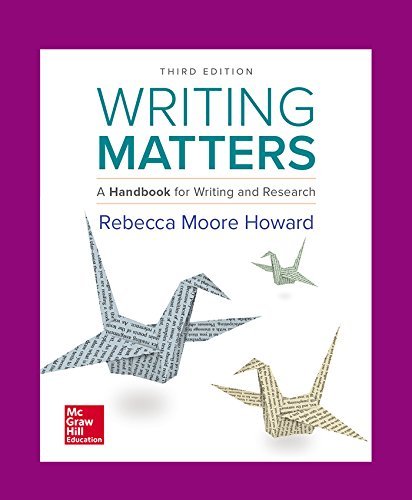
Writing Matters: A Handbook for Writing and Research 3rd Edition, ISBN-13:9781260166446
Original price was: $50.00.$14.99Current price is: $14.99.
Safe & secure checkout
Description
Description
[PDF eBook eTextbook]
585 pages
Publisher: McGraw-Hill Higher Education; 3 edition (January 9, 2018)
Publication Date: January 9, 2018
Language: English
ISBN-10: 1260166449
ISBN-13: 978-1260166446
This tabbed version of Writing Matters unites research reasoning documentation grammar and style into a cohesive whole helping students see the conventions of writing as a network of responsibilities that writers have…… to other writers. Writing Matters emphasizes the responsibility writers share whether collaborating online in peer review or conducting research with digital and print sources to treat information fairly and accurately and to craft writing that is unique and original – their own!… to the audience. Writing Matters emphasizes the need to use conventions that are appropriate for readers to write clearly and to provide readers with the information and interpretation they need to make sense of a topic. … to the topic. Writing Matters encourages writers to explore a topic thoroughly and creatively to assess sources carefully and to provide reliable information at a depth that does the topic justice…. to themselves. Writing Matters encourages writers to take their writing seriously and to approach writing tasks as an opportunity to learn about a topic and to expand their scope as writers. Students are more likely to write well when they think of themselves as writers rather than as error-makers. Connect Composition supports instruction across multiple semesters and courses with interactive exercises online learning videos enriched eBook materials annotation and writing tools and much more!* Learnsmart Achieve – a continuously adaptive learning system that pinpoints students’ individual strengths and weaknesses and provides personalized support to help them master key topics and material. Learnsmart Achieve provides foundational support on key course areas such as the writing process critical reading the research process reasoning and argument grammar and common sentence problems punctuation and mechanics style and word choice and support for multilingual writers. * Power of Process – a critical reading and writing tool that guides students through instructor chosen strategies and helps them engage directly with a text through highlighting annotation and short answer questions. * Analytics – Progress dashboards that quickly show students how they are performing on their assignments and provide tips for improvement.
Table of contents:
Cover
Contents
Title Page
Copyright Page
Tab 1: Writing Responsibly
a. The Expanding Definition of Literacy
b. Multiliteracies and Print Literacy
a. To Your Audience
c. To Other Writers
d. To Yourself
Tab 2: Writing Matters
b. Reflecting on the Text
c. Research Questions, Thesis
a. Analyzing Your Writing Situation
b. Analyzing the Assignment and Setting a Schedule
c. Generating Topics and Ideas
d. Narrowing Your Topic and Drafting an Effective Thesis
Informal (or Scratch) Outline
First Draft
a. Relevance
c. Coherence
d. Development Using Patterns
e. Introductions
f. Conclusions
g. Connecting Paragraphs
a. Analyzing Your Own Work
b. Reconsidering Your Title
c. Peer Review
d. Editing Your Words, Sentences
e. Proofreading
Final Draft
Brainstorm
Journalists’ Questions
Professional Models Newspaper Article
Speech
Tab 3: Design Matters
a. Planning Your Design Project
b. Layout and Format
c. Adding Visuals
b. Business Texts
Résumé and Cover Letter
d. Social Media
a. Identifying Your Writing Situation
c. Organizing the Presentation
d. Rehearsing the Presentation
e. Connecting with the Audience
Student Models MLA-Style Writing Project and Works Cited
Business Letter
Tab 4: Genre Matters
a. Academic Approach
c. Language of the Discipline
e. Using Visuals in the Disciplines
f. Preparing for and Taking Exams
a. Persuading and Exploring
b. Making Claims
c. Choosing Evidence Rhetorically
d. Considering Alternative Viewpoints
f. Organizing Arguments: Classical, Rogerian, and Toulmin Models
g. Avoiding Logical Fallacies
a. Analyzing Literature
b. Devising a Literary Thesis
d. Using the Appropriate Tense, Point of View, and Voice
Explication
Student Models Essay Exam Response
Exploratory Essay
Textual Analysis
Tab 5: Research Matters
a. Analyzing the Research Assignment and Setting a Schedule
b. Choosing and Narrowing a Topic
e. Working Bibliography
a. Reference Works
b. Information on the Web
c. Reliable Interactive Media
d. Articles in Journals, Periodicals
e. Using Your Library’s Catalog
g. Multimedia Sources
h. Field Research
a. Relevance
b. Reliability
c. Online Texts
d. Detecting Fake News
16 Using Information Responsibly: Taking Notes and Avoiding Plagiarism
a. Learning What You Do and Do Not Have to Acknowledge
c. Paraphrasing and Summarizing without Patchwriting
d. Capturing Quotations in Notes
e. Including Analysis, Interpretation, Synthesis, and Critique in Notes
a. Drafting a Thesis Statement
b. Organizing Notes and Outlining
d. Supporting Claims with Summaries, Paraphrases, and Quotations
e. Revising, Editing, Proofreading, and Formatting
18 Citing Expertly
a. Integrating Source Material Responsibly
b. Showing Source Boundaries
c. Emphasizing Your Voice
d. Providing Context
e. Integrating Altered Quotations
f. Writing Responsibly Explaining Your Choice of Sources
g. Writing Responsibly Understanding and Representing the Entire Source
h. Writing Responsibly Choosing and Unpacking Complex Sources
i. Writing Responsibly Blending Voices in Your Text
j. Writing Responsibly Acknowledging Indirect Sources
Topic Outline
Reading Note
Tab 6: Documentation Matters: MLA Style
Tutorial Documentation Matters: MLA Style
19 MLA-Style In-Text Citations
20 MLA-Style List of Works Cited
21 MLA Style for Informational Notes
22 Formatting in MLA Style
Student Model Research Project: MLA Style
Tab 7: Documentation Matters: APA Style
Tutorial Documentation Matters: APA Style
23 APA-Style In-Text Citations
24 APA-Style Reference List
25 APA Style for Informational Notes
26 Formatting in APA Style
Student Model Research Project: APA Style
Tab 8: Documentation Matters: Chicago Style and CSE Style
27 Documenting Sources: Chicago Style
28 Documenting Sources: CSE Style
Student Models Research Project: Chicago Style
Research Project: CSE-Style Reference List
Tab 9: Style Matters
29 Writing Concisely
30 Parallelism
31 Variety and Emphasis
32 Appropriate Language
33 Effective Words
34 Dictionary and Thesaurus
35 Glossary of Usage
Tab 10: Grammar Matters
Tutorial Grammar Matters: Common Sentence Problems
36 Understanding Grammar
37 Sentence Fragments
38 Comma Splices and Fused Sentences
39 Agreement
40 Verbs
41 Pronoun Case and Reference
42 Adjectives and Adverbs
43 Misplaced and Dangling Modifiers
44 Confusing Shifts
45 Mixed and Incomplete Constructions
Tab 11: Language Matters
46 English Word Order and Sentence Structure
47 Nouns and Noun Determiners
48 English Verbs
49 Adjectives and Adverbs
50 Prepositions
Tab 12: Detail Matters
51 Commas
52 Semicolons
53 Apostrophes
54 Quotation Marks
55 End Punctuation: Periods, Question Marks, and Exclamation Points
56 Other Punctuation: Dashes, Parentheses, Brackets, Colons, Ellipses, and Slashes
57 Capitalizing
58 Italics and Underlining
59 Abbreviations
60 Numbers
61 Spelling and Hyphenation
Glossary of Key Terms
Index
EFL Index
What makes us different?
• Instant Download
• Always Competitive Pricing
• 100% Privacy
• FREE Sample Available
• 24-7 LIVE Customer Support
Reviews
There are no reviews yet.