

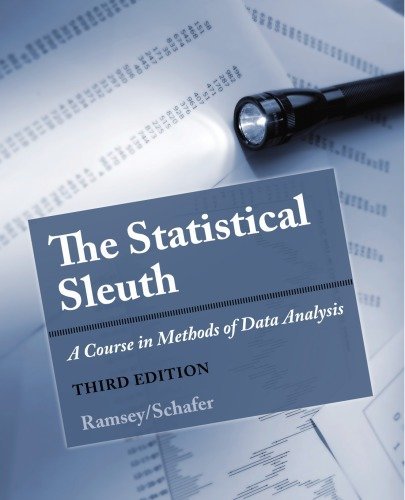
The Statistical Sleuth: A Course in Methods of Data Analysis 3rd Edition by Fred Ramsey, ISBN-13: 978-1133490678
Original price was: $50.00.$14.99Current price is: $14.99.
Safe & secure checkout
Description
Description
The Statistical Sleuth: A Course in Methods of Data Analysis 3rd Edition by Fred Ramsey, ISBN-13: 978-1133490678
[PDF eBook eTextbook]
- Publisher: Cengage Learning; 3rd edition (May 2, 2012)
- Language: English
- 784 pages
- ISBN-10: 1133490670
- ISBN-13: 978-1133490678
THE STATISTICAL SLEUTH: A COURSE IN METHODS OF DATA ANALYSIS, Third Edition offers an appealing treatment of general statistical methods that takes full advantage of the computer, both as a computational and an analytical tool. The material is independent of any specific software package, and prominently treats modeling and interpretation in a way that goes beyond routine patterns. The book focuses on a serious analysis of real case studies, strategies and tools of modern statistical data analysis, the interplay of statistics and scientific learning, and the communication of results. With interesting examples, real data, and a variety of exercise types (conceptual, computational, and data problems), the authors get readers excited about statistics.
Table of Contents:
Title
Statement
Copyright
Dedications
Contents
Preface
Ch 1: Drawing Statistical Conclusions
Introduction
1.1 Case Studies
1.2 Statistical Inference and Study Design
1.3 Measuring Uncertainty in Randomized Experiments
1.4 Measuring Uncertainty in Observational Studies
1.5 Related Issues
1.6 Summary
1.7 Exercises
Ch 2: Inference Using t-Distributions
Introduction
2.1 Case Studies
2.2 One-Sample t-Tools and the Paired t-Test
2.3 A t-Ratio for Two-Sample Inference
2.4 Inferences in a Two-Treatment Randomized Experiment
2.5 Related Issues
2.6 Summary
2.7 Exercises
Ch 3: A Closer Look at Assumptions
Introduction
3.1 Case Studies
3.2 Robustness of the Two-Sample t-Tools
3.3 Resistance of the Two-Sample t-Tools
3.4 Practical Strategies for the Two-Sample Problem
3.5 Transformations of the Data
3.6 Related Issues
3.7 Summary
3.8 Exercises
Ch 4: Alternatives to the t-Tools
Introduction
4.1 Case Studies
4.2 The Rank-Sum Test
4.3 Other Alternatives for Two Independent Samples
4.4 Alternatives for Paired Data
4.5 Related Issues
4.6 Summary
4.7 Exercises
Ch 5: Comparisons Among Several Samples
Introduction
5.1 Case Studies
5.2 Comparing Any Two of the Several Means
5.3 The One-Way Analysis of Variance F-Test
5.4 More Applications of the Extra-Sum-of-Squares F-Test
5.5 Robustness and Model Checking
5.6 Related Issues
5.7 Summary
5.8 Exercises
Ch 6: Linear Combinations and Multiple Comparisons of Means
Introduction
6.1 Case Studies
6.2 Inferences About Linear Combinations of Group Means
6.3 Simultaneous Inferences
6.4 Some Multiple Comparison Procedures
6.5 Related Issues
6.6 Summary
6.7 Exercises
Ch 7: Simple Linear Regression A Model for the Mean
Introduction
7.1 Case Studies
7.2 The Simple Linear Regression Model
7.3 Least Squares Regression Estimation
7.4 Inferential Tools
7.5 Related Issues
7.6 Summary
7.7 Exercises
Ch 8: A Closer Look at Assumptions for Simple Linear Regression
Introduction
8.1 Case Studies
8.2 Robustness of Least Squares Inferences
8.3 Graphical Tools for Model Assessment
8.4 Interpretation After Log Transformations
8.5 Assessment of Fit Using the Analysis of Variance
8.6 Related Issues
8.7 Summary
8.8 Exercises
Ch 9: Multiple Regression
Introduction
9.1 Case Studies
9.2 Regression Coefficients
9.3 Specially Constructed Explanatory Variables
9.4 A Strategy for Data Analysis
9.5 Graphical Methods for Data Exploration and Presentation
9.6 Related Issues
9.7 Summary
9.8 Exercises
Ch 10: Inferential Tools for Multiple Regression
Introduction
10.1 Case Studies
10.2 Inferences About Regression Coefficients
10.3 Extra-Sums-of-Squares F-Tests
10.4 Related Issues
10.5 Summary
10.6 Exercises
Ch 11: Model Checking and Refinement
Introduction
11.1 Case Studies
11.2 Residual Plots
11.3 A Strategy for Dealing with Influential Observations
11.4 Case-Influence Statistics
11.5 Refining the Model
11.6 Related Issues
11.7 Summary
11.8 Exercises
Ch 12: Strategies for Variable Selection
Introduction
12.1 Case Studies
12.2 Specific Issues Relating to Many Explanatory Variables
12.3 Sequential Variable-Selection Techniques
12.4 Model Selection Among All Subsets
12.5 Posterior Beliefs About Different Models
12.6 Analysis of the Sex Discrimination Data
12.7 Related Issues
12.8 Summary
12.9 Exercises
Ch 13: The Analysis of Variance for Two-Way Classifications
Introduction
13.1 Case Studies
13.2 Additive and Nonadditive Models for Two-Way Tables
13.3 Analysis of the Seaweed Grazer Data
13.4 Analysis of the Pygmalion Data
13.5 Related Issues
13.6 Summary
13.7 Exercises
Ch 14: Multifactor Studies Without Replication
Introduction
14.1 Case Studies
14.2 Strategies for Analyzing Tables with One Observation per Cell
14.3 Analysis of the Chimpanzee Learning Times Study
14.4 Analysis of the Soybean Data
14.5 Related Issues
14.6 Summary
14.7 Exercises
Ch 15: Adjustment for Serial Correlation
Introduction
15.1 Case Studies
15.2 Comparing the Means of Two Time Series
15.3 Regression After Transformation in the AR(1) Model
15.4 Determining if Serial Correlation is Present
15.5 Diagnostic Procedures for Judging the Adequacy of the AR(1) Model
15.6 Related Issues
15.7 Summary
15.8 Exercises
Ch 16: Repeated Measures and Other Multivariate Responses
Introduction
16.1 Case Studies
16.2 Tools and Strategies for Analyzing Repeated Measures
16.3 Comparing the Means of Bivariate Responses in Two Groups
16.4 One-Sample Analysis with Bivariate Responses
16.5 Related Issues
16.6 Summary
16.7 Exercises
Ch 17: Exploratory Tools for Summarizing Multivariate Responses
Introduction
17.1 Case Studies
17.2 Linear Combinations of Variables
17.3 Principal Components Analysis
17.4 Canonical Correlations Analysis
17.5 Introduction to Other Multivariate Tools
17.6 Summary
17.7 Exercises
Ch 18: Comparisons of Proportions or Odds
Introduction
18.1 Case Studies
18.2 Inferences for the Difference of Two Proportions
18.3 Inference About the Ratio of Two Odds
18.4 Inference from Retrospective Studies
18.5 Summary
18.6 Exercises
Ch 19: More Tools for Tables of Counts
Introduction
19.1 Case Studies
19.2 Population Models for 2 x 2 Tables of Counts
19.3 The Chi-Squared Test
19.4 Fisher’s Exact Test The Randomization (Permutation) Test for 2 x 2 Tables
19.5 Combining Results from Several Tables with Equal Odds Ratios
19.6 Related Issues
19.7 Summary
19.8 Exercises
Ch 20: Logistic Regression for Binary Response Variables
Introduction
20.1 Case Studies
20.2 The Logistic Regression Model
20.3 Estimation of Logistic Regression Coefficients
20.4 The Drop-in-Deviance Test
20.5 Strategies for Data Analysis Using Logistic Regression
20.6 Analyses of Case Studies
20.7 Related Issues
20.8 Summary
20.9 Exercises
Ch 21: Logistic Regression for Binomial Counts
Introduction
21.1 Case Studies
21.2 Logistic Regression for Binomial Responses
21.3 Model Assessment
21.4 Inferences About Logistic Regression Coefficients
21.5 Extra-Binomial Variation
21.6 Analysis of Moth Predation Data
21.7 Related Issues
21.8 Summary
21.9 Exercises
Ch 22: Log-Linear Regression for Poisson Counts
Introduction
22.1 Case Studies
22.2 Log-Linear Regression for Poisson Responses
22.3 Model Assessment
22.4 Inferences About Log-Linear Regression Coefficients
22.5 Extra-Poisson Variation and the Log-Linear Model
22.6 Related Issues
22.7 Summary
22.8 Exercises
Ch 23: Elements of Research Design
Introduction
23.1 Case Study
23.2 Considerations in Forming Research Objectives
23.3 Research Design Tool Kit
23.4 Design Choices That Affect Accuracy and Precision
23.5 Choosing a Sample Size
23.6 Steps in Designing a Study
23.7 Related Issue—A Factor of 4
23.8 Summary
23.9 Exercises
Ch 24: Factorial Treatment Arrangements and Blocking Designs
Introduction
24.1 Case Study
24.2 Treatments
24.3 Factorial Arrangement of Treatment Levels
24.4 Blocking
24.5 Summary
24.6 Exercises
Appendix Bibliography
Index
Fred Ramsey received his undergraduate degree from the University of Oregon (1961) and graduate degrees from Iowa State University (1963, 1964). He completed post-doctorate work at Johns Hopkins University. He has been on the faculty of the Department of Statistics at Oregon State University since 1966, with leaves for teaching and research positions at the University of Copenhagen, Denmark (1972-1973); Murdoch University, Perth, Western Australia (1997-1978); the University of Wollongong, NSW, Australia (1985-1986); and Oregon Health Sciences University in Portland, Oregon (1990-1991). His principal research interest is applications of statistics to wildlife problems.
Daniel Schafer holds an undergraduate degree in Mathematics from Pomona College (1978) and graduate degrees in Statistics from the University of Chicago (1981, 1982). He is currently a professor of statistics at Oregon State University. His hobby is wildlife photography.
What makes us different?
• Instant Download
• Always Competitive Pricing
• 100% Privacy
• FREE Sample Available
• 24-7 LIVE Customer Support


Reviews
There are no reviews yet.