

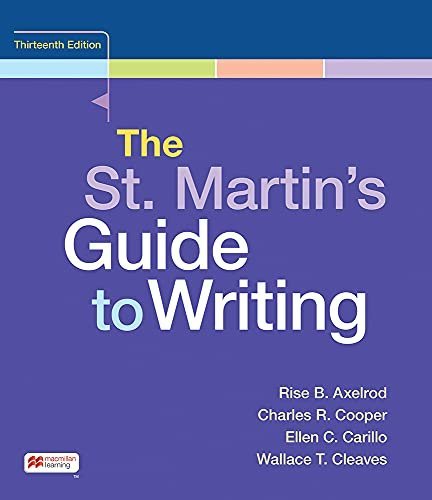
The St. Martin’s Guide to Writing 13th Edition by Rise B. Axelrod, ISBN-13: 978-1319249229
$49.99
Safe & secure checkout
Description
Description
The St. Martin’s Guide to Writing 13th Edition by Rise B. Axelrod, ISBN-13: 978-1319249229
[PDF eBook eTextbook]
- Publisher: Bedford/St. Martin’s; Thirteenth edition (September 24, 2021)
- Language: English
- 832 pages
- ISBN-10: 1319249221
- ISBN-13: 978-1319249229
The comprehensive resource for helping students succeed in the full variety of assignments they’ll face in first-year writing courses.
Whether you have years of teaching experience or are new to the classroom, you and your students can count on The St. Martin’s Guide to Writing to provide the thoroughly class-tested support you need for first-year composition. Thousands of instructors and their students rely on the Guide’s proven approach because it works: Acclaimed step-by-step reading and writing guides to 9 different genres offer sure-fire invention strategies that get students started and revision strategies that help them develop their writing. The new edition with Achieve provides even more scaffolded support for the drafting and revising processes and models for students of the recursive nature of writing. Envisioned as a complete composition course— with a rhetoric, an array of engaging readings, a research manual, and a handbook in a single text— the thirteenth edition prepares students to read analytically and write recursively, revise deeply, and transfer these skills from first-year composition to courses across campus.
Table of Contents:
1 Foundations for Becoming a Successful College Writer
Understanding the Rhetorical Situation
Understanding Multimodality
Composing Multimodal Texts
Academic Habits of Mind
Reflect on your habits of mind.
The Writing Process
A WRITER AT WORK
Selena Jiménez’s Writing Process
Generating Ideas ■ Planning a Draft ■ Writing a Draft ■ Getting Feedback from Others ■ Preparing to Revise ■ Revising Deeply
Part 1 Writing Activities
2 Autobiography and Literacy Narratives
PRACTICING THE GENRE: Telling a Story
GUIDE TO READING
Analyzing Autobiographies and Literacy Narratives
Determine the writer’s purpose and audience. ■ Assess the genre’s basic features.
Readings
Rhea Jameson, Mrs. Maxon
Molly Montgomery, Literacy Narrative: In Search of Dumplings and Dead Poets
Ta-Nehisi Coates, Losing My Innocence
Elissa Washuta, Wednesday Addams Is Just Another Settler
GUIDE TO WRITING
The Writing Assignment
STARTING POINTS: Remembering an Experience
Writing a Draft: Invention, Research, Planning, and Composing
Choose an experience to write about.
TEST YOUR CHOICE: Considering Your Purpose and Audience
Give your story a dramatic arc.
TEST YOUR CHOICE: Facing an Audience
Use tenses to clarify the sequence of actions. ■ Describe key people and places vividly, and show their significance. ■ Use dialogue to portray people and dramatize relationships. ■ Clarify your story’s significance. ■ Write the opening sentences. ■ Draft your story.
Evaluating the Draft: Using Peer Review
A PEER REVIEW GUIDE
Improving the Draft: Revising, Editing, and Proofreading
Revise your draft.
A TROUBLESHOOTING GUIDE
Edit and proofread your final draft.
A WRITER AT WORK
Dramatizing Conflict and Developing Significance in Rhea Jameson’s Literacy Narrative
REFLECTION
Reflecting on Reading and Writing Autobiographical and Literacy Narratives
3 Writing Profiles
PRACTICING THE GENRE: Conducting an Interview
GUIDE TO READING
Analyzing Profiles
Determine the writer’s purpose and audience. ■ Assess the genre’s basic features.
Readings
Brian Cable, The Last Stop
Victoria C. Moré, Dumpster Dinners: An Ethnography of Freeganism
Amanda Coyne, The Long Good-Bye: Mother’s Day in Federal Prison
Gabriel Thompson, A Gringo in the Lettuce Fields
GUIDE TO WRITING
The Writing Assignment
STARTING POINTS: Writing a Profile
Writing a Draft: Invention, Research, Planning, and Composing
Choose a subject to profile.
TEST YOUR CHOICE: Considering Your Purpose and Audience
Conduct your field research or investigation. ■ Use quotations that provide information and reveal character. ■ Consider adding visual or audio elements. ■ Create an outline that will organize your profile effectively for your readers. ■ Determine your role in the profile. ■ Develop your perspective on the subject. ■ Clarify the dominant impression. ■ Write the opening sentences. ■ Draft your profile.
Evaluating the Draft: Using Peer Review
A PEER REVIEW GUIDE
Improving the Draft: Revising, Editing, and Proofreading
Revise your draft.
A TROUBLESHOOTING GUIDE
Edit and proofread your final draft.
A WRITER AT WORK
Brian Cable’s Interview Notes and Write-Up
The Interview Notes ■ The Interview Write-Up
REFLECTION
Reflecting on Reading and Writing a Profile
4 Explaining a Concept
PRACTICING THE GENRE: Explaining an Academic Concept
GUIDE TO READING
Analyzing Concept Explanations
Determine the writer’s purpose and audience. ■ Assess the genre’s basic features.
Readings
Rosa Alexander, The Meme-ing of Trigger Warnings
Anastasia Toufexis, Love: The Right Chemistry
Lindsay Grace, Persuasive Play: Designing Games That Change Players
Wesley Morris, Who Gets to Decide What Belongs in the “Canon”?
GUIDE TO WRITING
The Writing Assignment
STARTING POINTS: Explaining a Concept
Writing a Draft: Invention, Research, Planning, and Composing
Choose a concept to write about.
TEST YOUR CHOICE: Considering Your Purpose and Audience
Conduct initial research on the concept. ■ Focus your explanation of the concept.
TEST YOUR CHOICE: Evaluating Your Focus
Conduct further research on your focused concept. ■ Draft your working thesis. ■ Create an outline that will organize your concept explanation effectively for your readers. ■ Design your writing project. ■ Consider the explanatory strategies you should use. ■ Use summaries, paraphrases, and quotations from sources to support your points. ■ Use visuals or multimedia illustrations. ■ Use appositives to integrate sources. ■ Use descriptive verbs in signal phrases to introduce information from sources. ■ Write the opening sentences. ■ Draft your explanation.
Evaluating the Draft: Using Peer Review
A PEER REVIEW GUIDE
Improving the Draft: Revising, Editing, and Proofreading
Revise your draft.
A TROUBLESHOOTING GUIDE
Edit and proofread your final draft.
A WRITER AT WORK
Rosa Alexander Focuses Her Concept Explanation
REFLECTION
Reflecting on Reading and Writing a Concept Analysis
5 Analyzing and Synthesizing Opposing Arguments
PRACTICING THE GENRE: Analyzing Opposing Arguments
GUIDE TO READING
Analyzing Opposing Arguments
Determine the writer’s purpose and audience. ■ Assess the genre’s basic features.
Readings
Max King, Freedom of or from Speech
Tyler Stiem, Statue Wars: What Should We Do With Troublesome Monuments?
Emily Stewart, The Debate over Joe Biden Canceling Student Debt, Explained
David Wallace-Wells, People Don’t Trust Public-Health Experts Because Public-Health Experts Don’t Trust People
GUIDE TO WRITING
The Writing Assignment
STARTING POINTS: Analyzing and Synthesizing Opposing Arguments
Writing a Draft: Invention, Research, Planning, and Composing
Choose a controversial issue to write about.
TEST YOUR CHOICE: Selecting a Topic
Conduct research. ■ Create an annotated working bibliography. ■ Analyze your audience. ■ Choose opposing arguments to analyze. ■ Analyze and synthesize the opposing arguments.
TEST YOUR CHOICE: Evaluating Your Analysis
Draft a working thesis. ■ Create an outline to plan or assess your organization. ■ Develop your analysis. ■ Draft the opening sentences. ■ Draft your analysis.
Evaluating the Draft: Using Peer Review
A PEER REVIEW GUIDE
Improving the Draft: Revising, Editing, and Proofreading
Revise your draft.
A TROUBLESHOOTING GUIDE
Edit and proofread your final draft.
A WRITER AT WORK
Max King’s Analysis
REFLECTION
Reflecting on Reading and Writing an Analysis of Opposing Arguments
6 Arguing a Position
PRACTICING THE GENRE: Debating a Position
GUIDE TO READING
Analyzing Position Arguments
Determine the writer’s purpose and audience. ■ Assess the genre’s basic features.
Readings
Soham Patil, Stay in Class, Not Online
Laura Beth Nielsen, The Case for Restricting Hate Speech
Scott Nolen, The “Seatbelt” Approach to the Opioid Crisis
Daniel J. Solove, Why Privacy Matters Even If You Have “Nothing to Hide”
GUIDE TO WRITING
The Writing Assignment
STARTING POINTS: Arguing a Position
Writing a Draft: Invention, Research, Planning, and Composing
Choose a controversial issue on which to take a position.
TEST YOUR CHOICE: Choosing an Issue
Frame the issue for your readers.
TEST YOUR CHOICE: Frame Your Issue
Formulate a working thesis stating your position. ■ Develop the reasons supporting your position. ■ Research your position. ■ Use sources to reinforce your credibility. ■ Identify and respond to your readers’ likely reasons and objections. ■ Create an outline that will organize your argument effectively for your readers. ■ Consider document design. ■ Write the opening sentences. ■ Draft your position argument.
Evaluating the Draft: Using Peer Review
A PEER REVIEW GUIDE
Improving the Draft: Revising, Editing, and Proofreading
Revise your draft.
A TROUBLESHOOTING GUIDE
Edit and proofread your final draft.
A WRITER AT WORK
Soham Patil’s Response to Instructor and Peer Feedback
REFLECTION
Reflecting on Reading and Writing a Position Argument
7 Proposing a Solution
PRACTICING THE GENRE: Arguing That a Solution Is Feasible
GUIDE TO READING
Analyzing Proposals
Determine the writer’s purpose and audience. ■ Assess the genre’s basic features.
Readings
Patrick O’Malley, More Testing, More Learning
David Figlio, Starting High School Later
Maryanne Wolf, Skim Reading Is the New Normal
Alice Wong, The Last Straw
GUIDE TO WRITING
The Writing Assignment
STARTING POINTS: Proposing a Solution
Writing a Draft: Invention, Research, Planning, and Composing
Choose a problem for which you can propose a solution. ■ Frame the problem for your readers.
TEST YOUR CHOICE: Defining the Problem
Assess how the problem has been framed, and reframe it for your readers. ■ Develop a possible solution. ■ Explain your solution. ■ Research your proposal. ■ Develop a response to objections or alternative solutions. ■ Create an outline that will organize your proposal effectively for your readers. ■ Write the opening sentences. ■ Draft your proposal.
Evaluating the Draft: Using Peer Review
A PEER REVIEW GUIDE
Improving the Draft: Revising, Editing, and Proofreading
Revise your draft.
A TROUBLESHOOTING GUIDE
Edit and proofread your final draft.
A WRITER AT WORK
Patrick O’Malley’s Revision Process
REFLECTION
Reflecting on Reading and Writing Proposals
8 Justifying an Evaluation
PRACTICING THE GENRE: Choosing Appropriate Criteria
GUIDE TO READING
Analyzing Evaluations
Determine the writer’s purpose and audience. ■ Assess the genre’s basic features.
Readings
William Akana, Scott Pilgrim vs. the World: A Hell of a Ride
Tasha Robinson, Moana: The Perfect Disney Movie
Katherine Isbister, Why Pokémon Go Became an Instant Phenomenon
Malcolm Gladwell, What College Rankings Really Tell Us
GUIDE TO WRITING
The Writing Assignment
STARTING POINTS: Justifying an Evaluation
Writing a Draft: Invention, Research, Planning, and Composing
Choose a subject to evaluate.
TEST YOUR CHOICE: Choosing a Subject
Assess your subject, and consider how to present it to your readers. ■ Formulate a working thesis stating your overall judgment. ■ Develop the reasons and evidence supporting your judgment. ■ Research your evaluation. ■ Respond to a likely objection or alternative judgment. ■ Organize your evaluation to appeal to your readers. ■ Consider document design. ■ Write the opening sentences. ■ Draft your evaluation.
Evaluating the Draft: Using Peer Review
A PEER REVIEW GUIDE
Improving the Draft: Revising, Editing, and Proofreading
Revise your draft.
A TROUBLESHOOTING GUIDE
Edit and proofread your final draft.
A WRITER AT WORK
William Akana’s Thesis and Response to Objections
REFLECTION
Reflecting on Reading and Writing an Evaluation
9 Arguing for Causes or Effects
PRACTICING THE GENRE: Arguing That a Cause Is Plausible
GUIDE TO READING
Analyzing Cause-Effect Arguments
Determine the writer’s purpose and audience. ■ Assess the genre’s basic features.
Readings
Clayton Pangelinan, #socialnetworking: Why It’s Really So Popular
Stephen King, Why We Crave Horror Movies
Jean M. Twenge, Have Smartphones Destroyed a Generation?
Shankar Vedantam, The Telescope Effect
GUIDE TO WRITING
The Writing Assignment
STARTING POINTS: Arguing for Causes or Effects
Writing a Draft: Invention, Research, Planning, and Composing
Choose a subject to analyze.
TEST YOUR CHOICE: Choosing a Topic
Present the subject to your readers. ■ Analyze possible causes or effects. ■ Conduct research. ■ Cite a variety of sources to support your cause-effect analysis. ■ Formulate a working thesis stating your preferred cause(s) or effect(s). ■ Draft a response to objections readers are likely to raise. ■ Draft a response to the causes or effects your readers are likely to favor. ■ Create an outline that will organize your cause-effect argument effectively for your readers. ■ Write the opening sentences. ■ Draft your cause-effect argument.
Evaluating the Draft: Using Peer Review
A PEER REVIEW GUIDE
Improving the Draft: Revising, Editing, and Proofreading
Revise your draft.
A TROUBLESHOOTING GUIDE
Edit and proofread your final draft.
A WRITER AT WORK
Clayton Pangelinan’s Analysis of Possible Causes
REFLECTION
Reflecting on Reading and Writing a Cause-Effect Analysis
10 Analyzing Stories
PRACTICING THE GENRE: Analyzing a Story Collaboratively
GUIDE TO READING
Analyzing Essays That Analyze Stories
Determine the writer’s purpose and audience. ■ Assess the genre’s basic features.
Readings
William Carlos Williams, The Use of Force
Iris Lee, Performing a Doctor’s Duty
Isabella Wright, “For Heaven’s Sake!”
GUIDE TO WRITING
The Writing Assignment
STARTING POINTS: Analyzing Stories
Writing a Draft: Invention, Research, Planning, and Composing
Find a story to write about. ■ Analyze the story. ■ Generate ideas by moving from specific to general or the reverse.
TEST YOUR CHOICE: Choosing a Topic
Formulate a working thesis. ■ Provide support for your argument. ■ To build on your support, consider doing outside research. ■ Create an outline that will organize your argument effectively. ■ Write the opening sentences. ■ Draft your analysis.
Evaluating the Draft: Using Peer Review
A PEER REVIEW GUIDE
Improving the Draft: Revising, Editing, and Proofreading
Revise your draft.
A TROUBLESHOOTING GUIDE
Edit and proofread your final draft.
A WRITER AT WORK
Isabella Wright’s Invention Work
Annotating ■ Examining Patterns in the Story ■ Listing Ideas
REFLECTION
Reflecting on Reading and Writing a Literary Analysis
AN ANTHOLOGY OF SHORT STORIES
Kate Chopin, The Story of an Hour
Jamaica Kincaid, Girl
Ted Chiang, The Great Silence
REFLECTION
Reflecting on Analyzing Stories
Part 2 Critical Thinking Strategies
11 A Catalog of Invention and Inquiry Strategies
Mapping
Create a cluster diagram to reveal relationships among ideas. ■ Make a list to generate a plan quickly. ■ Create an outline to invent and organize.
Writing
Use cubing to explore a topic from six perspectives. ■ Construct a dialogue to explore an experience or an alternative view. ■ Use dramatizing to analyze behavior. ■ Freewrite to generate ideas freely and creatively. ■ Use looping to explore aspects of a topic. ■ Take notes in a journal. ■ Ask questions to explore a subject systematically.
12 A Catalog of Reading Strategies
Annotating
Martin Luther King Jr., An Annotated Sample from “Letter from Birmingham Jail”
Taking Inventory
Outlining
Paraphrasing
Summarizing
Synthesizing
Contextualizing
Exploring the Significance of Figurative Language
Looking for Patterns of Opposition
Reflecting on Challenges to Your Beliefs and Values
Evaluating the Logic of an Argument
Test for appropriateness. ■ Test for believability. ■ Test for consistency and completeness.
Recognizing Emotional Manipulation
Judging the Writer’s Credibility
Test for knowledge. ■ Test for common ground. ■ Test for fairness.
Part 3 Writing Strategies
13 Cueing the Reader
Orienting Statements
Use thesis statements to announce the main idea. ■ Use forecasting statements to preview topics.
Paragraphing
Paragraph indents signal related ideas. ■ Topic sentences announce the paragraph’s focus.
Cohesive Devices
Pronouns connect phrases or sentences. ■ Word repetition aids cohesion. ■ Synonyms connect ideas. ■ Repetition of sentence structure emphasizes connections.
Transitions
Transitions emphasize logical relationships. ■ Transitions can indicate a sequence in time. ■ Transitions can indicate relationships in space.
Headings and Subheadings
Headings indicate sections and levels. ■ Headings are not common in all genres. ■ At least two headings are needed at each level.
14 Narrating and Describing
Narrating
Use narrating strategies to sequence and dramatize events. ■ Use narrating strategies to explain and instruct.
Describing
Use naming to give an overall impression. ■ Use detailing to add specifics and convey thoughts, feelings, and judgments. ■ Use comparisons to make a description vivid and convey emotion. ■ Use sensory description to convey what you saw, heard, smelled, felt, and tasted. ■ Use description to create a dominant impression.
15 Defining, Classifying, and Comparing
Defining
Use sentence definitions to explain terms and concepts briefly. ■ Use extended definitions to convey the meaning of complex concepts. ■ Use historical definitions to explain how a meaning has changed over time or across cultures. ■ Use stipulative definitions to reach an agreement on the meaning of a term or concept.
Classifying
Use topics and subtopics to organize classifications. ■ Use graphics to depict a classification scheme. ■ Use cues to maintain clarity and coherence in a classification.
Comparing and Contrasting
Use chunking or sequencing to organize comparisons and contrasts. ■ Use analogies to make comparisons clear and vivid.
16 Arguing
Asserting a Thesis
Make arguable assertions. ■ Use clear and precise wording. ■ Qualify the thesis appropriately.
Giving Reasons and Support
Use representative examples for support. ■ Use up-to-date, relevant, and accurate statistics. ■ Cite reputable authorities on relevant topics. ■ Use vivid, relevant anecdotes. ■ Use relevant textual evidence.
Responding to Objections and Alternatives
Acknowledge readers’ concerns. ■ Concede readers’ concerns. ■ Refute readers’ objections.
Identifying Logical Fallacies
Part 4 Research Strategies
17 Planning and Conducting Research
Analyzing Your Rhetorical Situation and Setting a Schedule
Choosing a Topic and Getting an Overview
Focusing Your Topic and Drafting Research Questions
Establishing a Research Log
Develop a list of search terms. ■ Create a working bibliography.
Annotating Your Working Bibliography
Taking Notes on Your Sources
Finding Sources
Search library catalogs and databases. ■ Find books (and other sources). ■ Find articles in periodicals. ■ Find government documents and statistical information. ■ Find websites and interactive sources.
Conducting Field Research or Investigations
Conduct observational studies. ■ Conduct interviews. ■ Conduct surveys.
18 Selecting and Evaluating Sources
Selecting Relevant Sources
Evaluating Sources
Who wrote it? ■ How recently was it published? ■ Is the source scholarly, popular, or for a trade group? ■ Who published it? ■ How is the source written? ■ What does the source say?
19 Using Sources to Support Your Ideas
Synthesizing Sources
Acknowledging Sources and Avoiding Plagiarism
What does and does not need to be acknowledged? ■ Avoid plagiarism by acknowledging sources and quoting, paraphrasing, and summarizing carefully.
Using Information from Sources to Support Your Claims
Decide whether to quote, paraphrase, or summarize. ■ Copy quotations exactly, or use italics, ellipses, and brackets to indicate changes. ■ Use in-text or block quotations. ■ Use punctuation to integrate quotations into your writing. ■ Paraphrase sources carefully. ■ Write summaries that present the source’s main ideas in a balanced and readable way.
20 Citing and Documenting Sources in MLA Style
Citing Sources in the Text
DIRECTORY TO IN-TEXT-CITATION MODELS
Creating a List of Works Cited
To cite a source without a model, use a similar model, or devise your own using the general principles. ■ Format your list of works cited.
DIRECTORY TO WORKS-CITED-LIST MODELS
Student Research Project in MLA Style
21 Citing and Documenting Sources in APA Style
Citing Sources in the Text
DIRECTORY TO IN- TEXT-CITATION MODELS
Creating a List of References
DIRECTORY TO REFERENCE-LIST MODELS
A Sample Reference List in APA Style
Part 5 Composing Strategies for College and Beyond
22 Analyzing and Composing Multimodal Texts
Analyzing Multimodal Texts
Composing Multimodal Texts
Design a multimodal text. ■ Embed visuals and media in texts.
Creating a Multimodal Presentation
Assess your rhetorical situation. ■ Determine how much information you can present in the allotted time. ■ Use cues to orient audience members. ■ Design your presentation effectively.
23 Taking Essay Examinations
Preparing for an Exam
Taking the Exam
Read the exam carefully. ■ Review typical essay exam questions. ■ Write your answer.
24 Writing in Business
Business Letters
Résumés and Online Professional Profiles
Job-Application Letters
25 Writing for and about Your Community
Writing about Your Service Experience
Find a topic. ■ Gather sources.
Writing for Your Service Organization
26 Writing Collaboratively
Working with Others on Your Individual Writing Projects
Collaborating on Joint Writing Projects
Handbook
How to Use This Handbook
Keeping a Record of Your Errors
S
Sentence Boundaries
S1 Comma Splices S2 Fused
Sentences S3 Sentence Fragments
G
Grammatical Sentences
G1 Pronoun Reference G2 Pronoun
Agreement G3 Relative
Pronouns G4 Pronoun Case
G5 Verbs G6 Subject-Verb
Agreement G7 Adjectives and
Adverbs
E
Effective Sentences
E1 Missing Words E2 Shifts
E3 Noun Agreement E4 Modifiers
E5 Mixed Constructions
E6 Integrated Quotations, Questions, and
Thoughts E7 Parallelism
E8 Coordination and Subordination
W
Word Choice
W1 Concise Sentences
W2 Exact Words
W3 Appropriate Words
P
Punctuation
P1 Commas P2 Unnecessary
Commas P3 Semicolons
P4 Colons P5 Dashes
P6 Quotation Marks
P7 Apostrophes P8 Parentheses
P9 Brackets P1 Ellipsis Marks
P11 Slashes P12 Periods
P13 Question Marks
P14 Exclamation Points
M
Mechanics
M1 Hyphens M2 Capitalization
M3 Spacing M4 Numbers
M5 Italics M6 Abbreviations
M7 Spelling
T
Troublespots for Multilingual Writers
T1 Articles T2 Verbs
T3 Prepositions T4 Omitted or
Repeated Words T5 Adjective
Order T6 Participles
R
Review of Sentence Structure
R1 Basic Sentence Structure R2 Basic Sentence Elements
GL
Glossary of Frequently Misused Words
Rise B. Axelrod is McSweeney Professor of Rhetoric and Teaching Excellence, Emeritus, at the University of California, Riverside, where she was also director of English Composition. She has previously been professor of English at California State University, San Bernardino; director of the College Expository Program at the University of Colorado, Boulder; and assistant director of the Third College (now Thurgood Marshall College) Composition Program at the University of California, San Diego. She is the co-author, with Charles R. Cooper, of the best-selling textbooks The St. Martin’s Guide to Writing and The Concise St. Martin’s Guide to Writing, as well as Reading Critically, Writing Well.
Charles R. Cooper, was emeritus professor at the University of California, San Diego until his passing in 2017. He served as coordinator of the Third College (now Thurgood Marshall College) Composition Program at the University of California, San Diego, and co-director of the San Diego Writing Project, one of the National Writing Project Centers. He advised the National Assessment of Educational Progress writing study and coordinated the development of California’s first statewide writing assessment. He taught at the University of California, Riverside; the State University of New York at Buffalo; and the University of California, San Diego. Co-editor, with Lee Odell, of Evaluating Writing and Research on Composing: Points of Departure, and he was co-author, with Rise Axelrod, of the best-selling textbooks The St. Martin’s Guide to Writing and The Concise St. Martin’s Guide to Writing, as well as Reading Critically, Writing Well.
Ellen C. Carillo is a Professor of English at the University of Connecticut and the writing program coordinator at its Waterbury Campus where she teaches writing and literature courses. She is the author of Securing a Place for Reading in Composition: The Importance of Teaching for Transfer; A Writer’s Guide to Mindful Reading; Teaching Readers in Post-Truth America; The Hidden Inequities in Labor-Based Contract Grading; and the MLA Guide to Digital Literacy, as well as the editor or co-editor of several collections.
Wallace T. Cleaves is an Associate Professor of Teaching at the University of California, Riverside, where he is the Associate Director of the University Writing Program and the Director of the California Center for Native Nations. He has also taught courses in Medieval, Renaissance and Native American literature at Pomona College in Claremont and at California State University, Fullerton. Recent publications include a piece for World Literature Today, “Mission Project: Activism on a Smaller Scale,” a co-authored work of Indigenous speculative fiction, “A Parable of Things that Crawl and Fly,” in Pulp Literature, and the essay “From Monmouth to Madoc to Māori: The Myth of Medieval Colonization and an Indigenous Alternative,” in the Indigenous Futures and Medieval Pasts issue of English Language Notes.
What makes us different?
• Instant Download
• Always Competitive Pricing
• 100% Privacy
• FREE Sample Available
• 24-7 LIVE Customer Support
Reviews
There are no reviews yet.