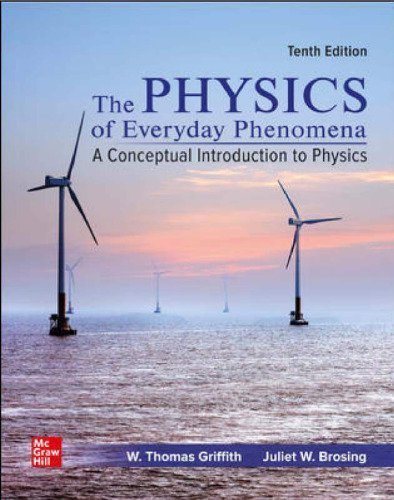
The Physics of Everyday Phenomena 10th Edition by W. Thomas Griffith, ISBN-13: 978-1260718935
Original price was: $50.00.$19.99Current price is: $19.99.
Safe & secure checkout
Description
Description
The Physics of Everyday Phenomena 10th Edition by W. Thomas Griffith, ISBN-13: 978-1260718935
[PDF eBook eTextbook] – Available Instantly
- Publisher: McGraw Hill; 10th edition (January 8, 2021)
- Language: English
- 544 pages
- ISBN-10: 126071893X
- ISBN-13: 978-1260718935
The Physics of Everyday Phenomena introduces students to the basic concepts of physics, using examples of common occurrences in everyday life. Intended for use in a one-semester or two-semester course in conceptual physics, this book is written in a narrative style, frequently using questions designed to draw the reader into a dialogue about the ideas of physics. This inclusive style allows the book to be used by anyone interested in exploring the nature of physics and explanations of everyday physical phenomena.
Table of Contents:
Cover page
Title page
Copyright page
Brief Contents
About the Authors
Detailed Contents
Preface
Secrets to Success in Studying Physics
1 Physics, the Fundamental Science 1
1.1 What about Energy? 2
1.2 The Scientific Enterprise 5
Everyday Phenomenon Box 1.1
The Case of the Malfunctioning Coffeemaker 7
1.3 The Scope of Physics 8
1.4 The Role of Measurement and Mathematics in Physics 10
1.5 Physics and Everyday Phenomena 12
Everyday Phenomenon Box 1.2
Scaling a Recipe 11
Summary 13
Key Terms 14
Conceptual Questions 14
Exercises 15
Synthesis Problems 16
Home Experiments and Observations 16
Unit One The Newtonian Revolution 17
2 Describing Motion 18
2.1 Average and Instantaneous Speed 19
Everyday Phenomenon Box 2.1
Transitions in Traffic Flow 22
2.2 Velocity 23
2.3 Acceleration 24
2.4 Graphing Motion 27
Everyday Phenomenon Box 2.2
The 100-m Dash 30
2.5 Uniform Acceleration 31
Summary 33
Key Terms 33
Conceptual Questions 34
Exercises 36
Synthesis Problems 36
Home Experiments and Observations 37
3 Falling Objects and Projectile Motion 38
3.1 Acceleration Due to Gravity 39
3.2 Tracking a Falling Object 42
Everyday Phenomenon Box 3.1
Reaction Time 44
3.3 Beyond Free Fall: Throwing a Ball Upward 46
3.4 Projectile Motion 48
3.5 Hitting a Target 50
Everyday Phenomenon Box 3.2
Shooting a Basketball 52
Summary 54
Key Terms 55
Conceptual Questions 55
Exercises 57
Synthesis Problems 57
Home Experiments and Observations 58
4 Newton’s Laws: Explaining Motion 59
4.1 A Brief History 60
4.2 Newton’s First and Second Laws 62
Everyday Phenomenon Box 4.1
The Tablecloth Trick 65
4.3 Mass and Weight 66
4.4 Newton’s Third Law 68
Everyday Phenomenon Box 4.2
Riding an Elevator 70
4.5 Applications of Newton’s Laws 71
Summary 74
Key Terms 75
Conceptual Questions 75
Exercises 77
Synthesis Problems 78
Home Experiments and Observations 79
5 Circular Motion, the Planets, and Gravity 80
5.1 Centripetal Acceleration 81
5.2 Centripetal Forces 84
Everyday Phenomenon Box 5.1
Seat Belts, Air Bags, and Accident Dynamics 86
5.3 Planetary Motion 87
5.4 Newton’s Law of Universal Gravitation 91
5.5 The Moon and Other Satellites 94
Everyday Phenomenon Box 5.2
Explaining the Tides 96
Summary 97
Key Terms 98
Conceptual Questions 98
Exercises 99
Synthesis Problems 100
Home Experiments and Observations 101
6 Energy and Oscillations 102
6.1 Simple Machines, Work, and Power 103
6.2 Kinetic Energy 106
6.3 Potential Energy 108
6.4 Conservation of Energy 110
Everyday Phenomenon Box 6.1
Conservation of Energy 112
Everyday Phenomenon Box 6.2
Energy and the Pole Vault 114
6.5 Springs and Simple Harmonic Motion 115
Summary 118
Key Terms 119
Conceptual Questions 119
Exercises 121
Synthesis Problems 122
Home Experiments and Observations 123
7 Momentum 124
7.1 Momentum and Impulse 125
7.2 Conservation of Momentum 128
Everyday Phenomenon Box 7.1
The Egg Toss 129
7.3 Recoil 131
7.4 Elastic and Inelastic Collisions 133
7.5 Collisions at an Angle 135
Everyday Phenomenon Box 7.2
An Automobile Collision 137
Summary 139
Key Terms 140
Conceptual Questions 140
Exercises 142
Synthesis Problems 143
Home Experiments and Observations 144
8 Rotational Motion of Solid Objects 145
8.1 What Is Rotational Motion? 146
8.2 Torque and Balance 149
8.3 Rotational Inertia and Newton’s Second Law 152
8.4 Conservation of Angular Momentum 155
8.5 Riding a Bicycle and Other Amazing Feats 158
Everyday Phenomenon Box 8.1
Achieving the State of Yo 159
Everyday Phenomenon Box 8.2
Bicycle Gears 162
Summary 163
Key Terms 163
Conceptual Questions 164
Exercises 165
Synthesis Problems 166
Home Experiments and Observations 167
Unit Two Fluids and Heat 169
9 The Behavior of Fluids 170
9.1 Pressure and Pascal’s Principle 171
9.2 Atmospheric Pressure and the Behavior of Gases 173
Everyday Phenomenon Box 9.1
Measuring Blood Pressure 175
9.3 Archimedes’ Principle 178
9.4 Fluids in Motion 181
9.5 Bernoulli’s Principle 184
Everyday Phenomenon Box 9.2
Throwing a Curveball 187
Summary 188
Key Terms 189
Conceptual Questions 189
Exercises 190
Synthesis Problems 191
Home Experiments and Observations 191
10 Temperature and Heat 192
10.1 Temperature and Its Measurement 193
10.2 Heat and Specific Heat Capacity 196
Everyday Phenomenon Box 10.1
Heat Packs 200
10.3 Joule’s Experiment and the First Law of Thermodynamics 201
10.4 Gas Behavior and the First Law 203
10.5 The Flow of Heat 206
Everyday Phenomenon Box 10.2
Solar Collectors, Greenhouses, and Global Warming 209
Summary 210
Key Terms 210
Conceptual Questions 211
Exercises 212
Synthesis Problems 213
Home Experiments and Observations 214
11 Heat Engines and the Second Law of Thermodynamics 215
11.1 Heat Engines 216
Everyday Phenomenon Box 11.1
Hybrid Automobile Engines 218
11.2 The Second Law of Thermodynamics 220
11.3 Refrigerators, Heat Pumps, and Entropy 222
11.4 Thermal Power Plants and Energy Resources 225
11.5 Perpetual Motion and Energy Frauds 228
Everyday Phenomenon Box 11.2
A Productive Pond 230
Summary 231
Key Terms 232
Conceptual Questions 232
Exercises 234
Synthesis Problems 234
Home Experiments and Observations 235
Unit Three Electricity and Magnetism 237
12 Electrostatic Phenomena 238
12.1 Effects of Electric Charge 239
12.2 Conductors and Insulators 242
12.3 The Electrostatic Force: Coulomb’s Law 244
Everyday Phenomenon Box 12.1
Cleaning Up the Smoke 245
12.4 The Electric Field 248
12.5 Electric Potential 251
Everyday Phenomenon Box 12.2
Lightning 254
Summary 255
Key Terms 256
Conceptual Questions 256
Exercises 258
Synthesis Problems 258
Home Experiments and Observations 259
13 Electric Circuits 260
13.1 Electric Circuits and Electric Current 261
Everyday Phenomenon Box 13.1
Electrical Impulses in Nerve Cells 264
13.2 Ohm’s Law and Resistance 266
13.3 Series and Parallel Circuits 268
13.4 Electric Energy and Power 272
13.5 Alternating Current and Household Circuits 274
Everyday Phenomenon Box 13.2
The Hidden Switch in Your Toaster 275
Summary 278
Key Terms
Conceptual Questions 279
Exercises 281
Synthesis Problems 282
Home Experiments and Observations 283
14 Magnets and Electromagnetism 284
14.1 Magnets and the Magnetic Force 285
14.2 Magnetic Effects of Electric Currents 288
14.3 Magnetic Effects of Current Loops 291
Everyday Phenomenon Box 14.1
Direct-Current Motors 294
14.4 Faraday’s Law: Electromagnetic Induction 295
Everyday Phenomenon Box 14.2
Vehicle Sensors at Traffic Lights 298
14.5 Generators and Transformers 299
Summary 302
Key Terms
Conceptual Questions 303
Exercises 304
Synthesis Problems 305
Home Experiments and Observations 306
Unit Four Wave Motion and Optics 307
15 Making Waves 308
15.1 Wave Pulses and Periodic Waves 309
Everyday Phenomenon Box 15.1
Electric Power from Waves 310
15.2 Waves on a Rope 313
15.3 Interference and Standing Waves 315
15.4 Sound Waves 319
Everyday Phenomenon Box 15.2
A Moving Car Horn and the Doppler Effect 321
15.5 The Physics of Music 322
Summary 326
Key Terms
Conceptual Questions 327
Exercises 329
Synthesis Problems 329
Home Experiments and Observations 330
16 Light Waves and Color 331
16.1 Electromagnetic Waves 332
16.2 Wavelength and Color 336
16.3 Interference of Light Waves 338
Everyday Phenomenon Box 16.1
Why Is the Sky Blue? 339
Everyday Phenomenon Box 16.2
Antireflection Coatings on Eyeglasses 343
16.4 Diffraction and Gratings 343
16.5 Polarized Light 346
Summary 349
Key Terms 350
Conceptual Questions 350
Exercises 351
Synthesis Problems 352
Home Experiments and Observations 353
17 Light and Image Formation 354
17.1 Reflection and Image Formation 355
17.2 Refraction of Light 358
Everyday Phenomenon Box 17.1
Rainbows 362
17.3 Lenses and Image Formation 362
17.4 Focusing Light with Curved Mirrors 366
17.5 Eyeglasses, Microscopes, and Telescopes 369
Everyday Phenomenon Box 17.2
Laser Refractive Surgery 372
Summary 375
Key Terms 376
Conceptual Questions 376
Exercises 377
Synthesis Problems 378
Home Experiments and Observations 379
Unit Five The Atom and Its Nucleus 381
18 The Structure of the Atom 382
18.1 The Existence of Atoms: Evidence from Chemistry 383
Everyday Phenomenon Box 18.1
Fuel Cells and the Hydrogen Economy 386
18.2 Cathode Rays, Electrons, and X-rays 389
Everyday Phenomenon Box 18.2
Television Development 390
18.3 Radioactivity and the Discovery of the Nucleus 393
18.4 Atomic Spectra and the Bohr Model of the Atom 396
18.5 Particle Waves and Quantum Mechanics 400
Summary 404
Key Terms 404
Conceptual Questions 405
Exercises 406
Synthesis Problems 406
Home Experiments and Observations 407
19 The Nucleus and Nuclear Energy 408
19.1 The Structure of the Nucleus 409
19.2 Radioactive Decay 412
Everyday Phenomenon Box 19.1
Smoke Detectors 414
19.3 Nuclear Reactions and Nuclear Fission 417
19.4 Nuclear Reactors 420
Everyday Phenomenon Box 19.2
What Happened at Fukushima? 424
19.5 Nuclear Weapons and Nuclear Fusion 425
Summary 428
Key Terms 429
Conceptual Questions 429
Exercises 430
Synthesis Problems 431
Home Experiments and Observations 431
Unit Six Relativity and Beyond 433
20 Relativity 434
20.1 Relative Motion in Classical Physics 435
20.2 The Speed of Light and Einstein’s Postulates 438
20.3 Time Dilation and Length Contraction 442
20.4 Newton’s Laws and Mass-Energy Equivalence 445
Everyday Phenomenon Box 20.1
The Twin Paradox 446
20.5 General Relativity 449
Summary 453
Key Terms 454
Conceptual Questions 454
Exercises 455
Synthesis Problems 455
Home Experiments and Observations 456
21 Looking Deeper into Everyday Phenomena 457
21.1 Quarks and Other Elementary Particles 458
21.2 Cosmology: Looking Out into the Universe 461
21.3 Semiconductors and Microelectronics 464
21.4 Superconductors and Other New Materials 468
Everyday Phenomenon Box 21.1
Holograms 471
Summary 473
Key Terms 473
Conceptual Questions 474
Exercises 474
Synthesis Problems 474
Home Experiments and Observations 475
Appendix A
Using Simple Algebra A- 1
Appendix B
Decimal Fractions, Percentages, and Scientific Notation A- 3
Appendix C
Vectors and Vector Addition A- 7
Appendix D
Answers to Selected Questions, Exercises, and Synthesis Problems A- 11
Appendix E
Conversion Factors and Periodic Table of the Elements A- 19
Glossary G- 1
Index I- 1
What makes us different?
• Instant Download
• Always Competitive Pricing
• 100% Privacy
• FREE Sample Available
• 24-7 LIVE Customer Support