

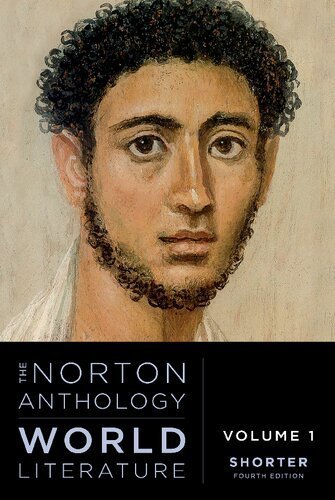
The Norton Anthology of World Literature Volume 1 Shorter 4th Edition by Martin Puchner, ISBN-13: 978-0393602876
Original price was: $50.00.$19.99Current price is: $19.99.
Safe & secure checkout
Description
Description
The Norton Anthology of World Literature Volume 1 Shorter 4th Edition by Martin Puchner, ISBN-13: 978-0393602876
[PDF eBook eTextbook]
- Publisher: W. W. Norton & Company; Shorter Fourth edition (October 19, 2018)
- Language: English
- 1856 pages
- ISBN-10: 0393602877
- ISBN-13: 978-0393602876
An incomparable resource, an unmatched value.
The Fourth Edition of the most trusted and widely used brief anthology of world literature retains and expands the most popular works from the last edition while offering exciting new selections and new translations of major works. As always, the Norton Anthology also provides helpful apparatus, beautiful illustrations, and a robust suite of digital resources―all at an affordable price.
Table of Contents:
Cover
Publisher’s Notice
Title Page
Editorial Consultants
Copyright Page
Contents
Preface
About the Shorter Fourth Edition
Acknowledgments
I. ANCIENT MEDITERRANEAN AND NEAR EASTERN LITERATURE
THE EPIC OF GILGAMESH (ca. 1900–250 B.C.E.)
Tablet I
Tablet II
Tablet III
Tablet IV
Tablet V
Tablet VI
Tablet VII
Tablet VIII
Tablet IX
Tablet X
Tablet XI
THE HEBREW BIBLE(ca. 1000–300 B.C.E.)
Genesis
1–4 [From Creation to the Murder of Abel]
6–9 [Noah and the Flood]
11 [The Tower of Babel]
12, 17, 18 [God’s Promise to Abraham]
21, 22 [Abraham and Isaac]
Exodus 19–20 [Moses Receives the Law]
Job
Psalm 8
Psalm 19
Psalm 23
Psalm 104
Psalm 137
HOMER (eighth century B.C.E.)
The Iliad
Book I [The Wrath of Achilles]
Book XVIII [The Shield of Achilles]
Book XXII [The Death of Hector]
Book XXIV [Achilles and Priam]
The Odyssey
Book 1 [The Boy and the Goddess]
Book 5 [From the Goddess to the Storm]
Book 6 [A Princess and Her Laundry]
Book 7 [A Magical Kingdom]
Book 8 [The Songs of a Poet]
Book 9 [A Pirate in a Shepherd’s Cave]
Book 10 [The Winds and the Witch]
Book 11 [The Dead]
Book 12 [Difficult Choices]
Book 16 [Father and Son]
Book 17 [Insults and Abuse]
Book 19 [The Queen and the Beggar]
Book 21 [An Archery Contest]
Book 22 [Bloodshed]
Book 23 [The Olive Tree Bed]
Book 24 [Restless Spirits]
SAPPHO (born ca. 630 B.C.E.)
1. [Deathless Aphrodite of the spangled mind]
2. [Come to me here from Crete]
16. [Some say an army of horsemen]
17. [Come close to me, I pray]
31. [He seems to me equal to gods]
44. [Cyprus . . . ]
47. [Love shook my heart]
48. [You came and I was longing for you]
51. [I don’t know what I should do]
55. [But when you die]
58. [ . . . I pray]
94. [ . . . “I honestly wish I were dead”]
102. [Truly, sweet mother]
104A. [Evening, you gather together]
104B. [ . . . most beautiful of all the stars]
105A. [ . . . like the sweet apple]
105B. [ . . . like the hyacinth]
111. [Raise high the roof—]
112. [Blessed bridegroom]
114. [“Virginity, virginity . . .”]
130. [Once again limb-loosening Love makes me tremble]
132. [I have a beautiful child who is like golden flowers]
168B. [The moon has set]
[The Brothers Poem]
[The Cypris Poem]
ANCIENT ATHENIAN DRAMA
SOPHOCLES (ca. 496–406 B.C.E.)
Oedipus the King
EURIPIDES (ca. 480–406 B.C.E.)
Medea
VIRGIL (70–19 B.C.E.)
The Aeneid
Book I [Safe Haven after Storm]
Book II [The Final Hours of Troy]
Summary of Book III
Book IV [The Tragic Queen of Carthage]
Summary of Book V
Book VI [The Kingdom of the Dead]
Summary of Books VII–VIII
Book VIII [The Shield of Aeneas]
Summary of Books IX–XI
Book XII [The Sword Decides All]
OVID (43 B.C.E.–17 C.E.)
Metamorphoses
Book I
Book II
Book V
Book IX
Book X
II. ANCIENT INDIA
THE RAMAYANA OF VALMIKI (ca. 550 B.C.E.)
Book 2. Ayodhya (sections 15–31)
Book 3. Ayodhya (sections 14–18, 32–37, 42–68)
Book 6. Yuddha (sections 109–13, 115–23, 130–31)
THE BHAGAVAD-GITA (ca. fourth century B.C.E.–fourth century C.E.)
Chapter One
Chapter Two
Chapter Three
Chapter Six
Chapter Eleven
III. EARLY CHINESE LITERATURE AND THOUGHT
CLASSIC OF POETRY (ca. 1000–600 B.C.E.)
I. Fishhawk
VI. Peach Tree Soft and Tender
XX. Plums Are Falling
XXIII. Dead Roe Deer
XXVI. Boat of Cypress
XLII. Gentle Girl
LXIV. Quince
LXXVI. Zhongzi, Please
XCV. Zhen and Wei
CXIII. Huge Rat
CCXLV. She Bore the Folk
The Great Preface
CONFUCIUS (551–479 B.C.E.)
Analects
LAOZI (sixth–third centuries B.C.E.)
Daodejing
I. [The way that can be spoken of]
II. [The whole world recognizes the beautiful as the beautiful]
III. [Not to honor men of worth]
IV. [The way is empty]
V. [Heaven and earth are ruthless]
VI. [The spirit of the valley never dies]
VII. [Heaven and earth are enduring]
VIII. [Highest good is like water]
XI. [Thirty spokes]
XII. [The five colors make man’s eyes blind]
XVI. [I do my utmost to attain emptiness]
XVII. [The best of all rulers is but a shadowy presence]
XVIII. [When the great way falls into disuse]
XIX. [Exterminate the sage]
XX. [Exterminate learning]
XXV. [There is a thing confusedly formed]
XXVIII. [Know the male]
XXXVII. [The way never acts yet nothing is left undone]
XXXVIII. [A man of the highest virtue does not keep to virtue]
XLII. [The way begets one]
XLVIII. [In the pursuit of learning one knows more every day]
LXIV. [It is easy to maintain a situation while it is still secure]
LXX. [My words are very easy to understand]
LXXVI. [A man is supple and weak when living]
LXXXI. [Truthful words are not beautiful]
IV. CIRCLING THE MEDITERRANEAN: EUROPE AND THE ISLAMIC WORLD
THE CHRISTIAN BIBLE: THE NEW TESTAMENT GOSPELS (ca. first century C.E)
Luke 2 [The Birth and Youth of Jesus]
Matthew 5–7 [The Sermon on the Mount]
Luke 15 [Parables]
Matthew 13 [Why Jesus Teaches in Parables]
Matthew 27–28 [Crucifixion and Resurrection]
John 1 [The Word]
AUGUSTINE (354–430)
Confessions
Book I [Childhood]
Book II [The Pear Tree]
Book III [Student at Carthage]
Book V [Augustine Leaves Carthage for Rome]
Book VI [Earthly Love]
Book VIII [Conversion]
Book IX [Death of His Mother]
Book XI [Time]
THE QUR’AN 610–32
1. The Opening
12. Yusuf, or Joseph
I
II
III
IV
V
VI
VII
VIII
IX
X
XI
XII
19. Mary
I
II
III
IV
V
VI
24. Light
36. Ya Sin
I
II
III
IV
V
55. The All-Merciful
91. The Sun
112. Purity [of Faith]
BEOWULF (ninth century)
[Prologue: The Rise of the Danish Nation]
[Heorot Is Attacked]
[The Hero Comes to Heorot]
[Feast at Heorot]
[The Fight with Grendel]
[Celebration at Heorot]
[Another Attack]
[Beowulf Fights Grendel’s Mother]
[Another Celebration at Heorot]
[Beowulf Returns Home]
[The Dragon Wakes]
[Beowulf Attacks the Dragon]
[Beowulf’s Funeral]
MARIE DE FRANCE (1150?–1200?)
The Lais
The Lais, Prologue
The Lais, Bisclavret
The Lais, Laustic
DANTE ALIGHIERI (1265–1321)
The Divine Comedy: Inferno
Canto I
Canto II
Canto III
Canto IV
Canto V
Canto VI
Canto VII
Canto VIII
Canto IX
Canto X
Canto XI
Canto XII
Canto XIII
Canto XIV
Canto XV
Canto XVI
Canto XVII
Canto XVIII
Canto XIX
Canto XX
Canto XXI
Canto XXII
Canto XXIII
Canto XXIV
Canto XXV
Canto XXVI
Canto XXVII
Canto XXVIII
Canto XXIX
Canto XXX
Canto XXXI
Canto XXXII
Canto XXXIII
Canto XXXIV
THE THOUSAND AND ONE NIGHTS (fourteenth century)
The Thousand and One Nights
Prologue [The Story of King Shahrayar and Shahrazad, His Vizier’s Daughter]
[The Tale of the Ox and the Donkey]
[The Tale of the Merchant and His Wife]
[The Story of the Merchant and the Demon]
[The First Old Man’s Tale]
[The Second Old Man’s Tale]
[The Third Old Man’s Tale]
GEOFFREY CHAUCER (1340?–1400)
The Canterbury Tales
The General Prologue
The Wife of Bath’s Prologue
The Wife of Bath’s Tale
CHRISTINE DE PIZAN (ca. 1364–ca. 1431)
The Book of the City of Ladies
1. Here begins The Book of the City of Ladies
2. The three ladies
3. Christine recounts how the lady who had spoken to her told her who she was
4. About the city which Christine was destined to build
14. More discussion and debate between Christine and Reason
19. About Queen Penthesilea
37. About all the great good that these ladies have brought into the world
38. More on the same topic
46. About the good sense and cleverness of Queen Dido
48. About Lavinia, daughter of King Latinus
V. MEDIEVAL CHINA
LI BO (701–762)
The Sun Rises and Sets
South of the Walls We Fought
Bring in the Wine
Question and Answer in the Mountains
Summer Day in the Mountains
Drinking Alone with the Moon
The Hardships of Traveling the Road I
Seeing Off Meng Haoran at Yellow Crane Tower, on His Way to Guangling
In the Quiet Night
Sitting Alone by Jingting Mountain
A Song on Visiting Heaven’s Crone Mountain in a Dream: On Parting
DU FU (712–770)
Painted Hawk
Moonlight Night
Spring Prospect
Qiang Village I
My Thatched Roof Is Ruined by the Autumn Wind
I Stand Alone
Spending the Night in a Tower by the River
Thoughts while Travelling at Night
Ballad of the Firewood Vendors
Autumn Meditations IV
VI. JAPAN’S CLASSICAL AGE
SEI SHONAGON (ca. 966–1017)
The Pillow Book
1 In spring, the dawn
2 Times of year
4 It breaks my heart to think
6 The Emperor’s cat
20 The sliding panels that close off the north-east corner
30 A priest who gives a sermon should be handsome
39 Refined and elegant things
40 Insects
68 Things that can’t be compared
71 Rare things
82 Once when Her Majesty was in residence
104 Things that are distressing to see
144 Endearingly lovely things
257 Things that give you pleasure
529 I have written in this book
MURASAKI SHIKIBU (ca. 978–ca. 1014)
The Tale of Genji
Chapter I. Kiritsubo: The Lady of the Paulownia-Courtyard Chambers
Chapter II. Hahakigi: Broom Cypress
Chapter V. Wakamurasaki: Little Purple Gromwell
Chapter VII. Momiji no ga: An Imperial Celebration of Autumn Foliage
Chapter IX. Aoi: Leaves of Wild Ginger
Chapter X. Sakaki: A Branch of Sacred Evergreen
Chapter XII. Suma: Exile to Suma
Chapter XIII. Akashi: The Lady at Akashi
Chapter XXV. Hotaru: Fireflies
Chapter XL. Minori: Rites of the Sacred Law
Chapter XLI. Maboroshi: Spirit Summoner
Chapter XLV. Hashihime: The Divine Princess at Uji Bridge
Chapter XLVII. Agemaki: A Bowknot Tied in Maiden’s Loops
Chapter XLIX. Yadoriki: Trees Encoiled in Vines of Ivy
Chapter LIII. Tenarai: Practicing Calligraphy
VII. ISLAM AND PRE-ISLAMIC CULTURE IN NORTH AFRICA
SUNJATA: A WEST AFRICAN EPIC OF THE MANDE PEOPLES (late thirteenth–early fourteenth century)
The Search for a Special Wife
Two Hunters Arrive in Manden
Dò Kamissa the Buffalo Woman
Dò Kamissa’s Revelations
Death of the Buffalo
Sogolon Wulen Condé of Dò Ni Kiri
The Childhood of Ma’an Sunjata
Mistaken Murder and the Question of Exile
Departure for Exile
A Visit to Soso
Sumaworo’s Tyranny over Manden
The Expedition to Find Sunjata and Return Him to Manden
Sogolon Bestows the Legacy of Maghan Konfara
The Burial of Sogolon and Departure from Nema
The Return of Sunjata
Fakoli Reveals His Power
Fakoli Explains His Dilemma and Takes His Leave from Manden
Fakoli Finds Trouble in Soso
A Visit to Kamanjan in Sibi
A Strategic Alliance: Kolonkan’s Marriage
The Battle of Negeboriya
Trading Insults and Swearing Oaths
The Battle of Dakajalan and Fakoli’s Revenge
The Campaign against Jolofin Mansa
VIII. EUROPE AND THE NEW WORLD
FRANCIS PETRARCH (1304–1374)
Rime Sparse
1 [You who hear in scattered rhymes]
3 [It was the day when the sun’s rays turned pale with grief]
34 [Apollo, if the sweet desire is still alive that inflamed you]
62 [Father in heaven, after each lost day]
126 [Clear, fresh, sweet waters]
189 [My ship laden with forgetfulness]
333 [Go, grieving rimes of mine]
NICCOLÒ MACHIAVELLI (1469–1527)
The Prince
[New Princedoms Gained with Other Men’s Forces and through Fortune] Chapter 7
[Princely Virtues] Chapter 15
Chapter 16, On Liberality and Parsimony
Chapter 17, On Cruelty and Pity
Chapter 18, In What Way Faith Should Be Kept
Chapter 19, On Avoiding Contempt and Hatred
[The Best Defense] Chapter 20
[Ferdinand of Spain, Exemplary Prince] Chapter 21
[Good Counsel vs. Flattery] Chapter 23
[Why Princes Fail] Chapter 24
[“Fortune is a woman”] Chapter 25
[The Roman Dream] Chapter 26
MARGUERITE DE NAVARRE (1492–1549)
The Heptameron
Prologue
Story 8
MICHEL DE MONTAIGNE (1533–1592)
Essays
To the Reader
Of Cannibals
MIGUEL DE CERVANTES (1547–1616)
Don Quixote
Part I
[Prologue]
[“I Know Who I Am, and Who I May Be, If I Choose”]
[Fighting the Windmills and a Choleric Biscayan]
[Of Goatherds, Roaming Shepherdesses, and Unrequited Loves]
[Fighting the Sheep]
[“To Right Wrongs and Come to the Aid of the Wretched”]
[A Story of Captivity in North Africa, Told to Don Quixote at the Inn]
[“Set Free at Once That Lovely Lady”]
Part II
[Prologue]
[Put into a Book]
[A Victorious Duel]
[“For I Well Know the Meaning of Valor”]
[Last Duel]
[Homecoming and Death]
POPOL VUH (transcribed 1554–58)
Part 1 [Prologue, Creation]
Part 2 [The Twins Defeat Seven Macaw]
Part 3 [Victory over the Underworld]
Part 4 [Origin of Humanity, First Dawn]
Part 5 [Prayer for Future Generations]
WILLIAM SHAKESPEARE (1564–1616)
Hamlet, Prince of Denmark
Act 1, Scene 1
Act 1, Scene 2
Act 1, Scene 3
Act 1, Scene 4
Act 1, Scene 5
Act 2, Scene 1
Act 2, Scene 2
Act 3, Scene 1
Act 3, Scene 2
Act 3, Scene 3
Act 3, Scene 4
Act 4, Scene 1
Act 4, Scene 2
Act 4, Scene 3
Act 4, Scene 4
Act 4, Scene 5
Act 4, Scene 6
Act 4, Scene 7
Act 5, Scene 1
Act 5, Scene 2
Selected Bibliographies
Image Galleries
Permissions Acknowledgments
Index
What makes us different?
• Instant Download
• Always Competitive Pricing
• 100% Privacy
• FREE Sample Available
• 24-7 LIVE Customer Support


Reviews
There are no reviews yet.