

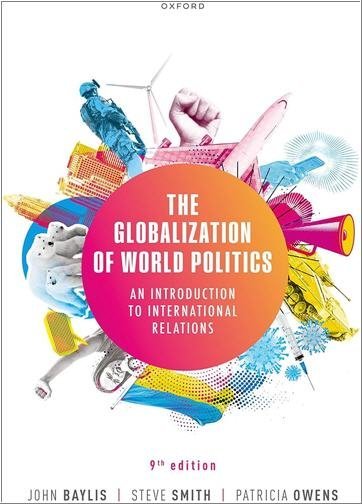
The Globalization of World Politics: An Introduction to International Relations 9th Edition, ISBN-13: 978-0192898142
Original price was: $50.00.$14.99Current price is: $14.99.
Safe & secure checkout
Description
Description
The Globalization of World Politics: An Introduction to International Relations 9th Edition, ISBN-13: 978-0192898142
[PDF eBook eTextbook]
- Publisher: Oxford University Press; 9th edition (March 15, 2023)
- Language: English
- 648 pages
- ISBN-10: 0192898140
- ISBN-13: 978-0192898142
The Globalization of World Politics is the bestselling introduction to international relations, and offers the most complete coverage of the key theories and global issues in world politics.
The ninth edition has been thoroughly updated to explore the most pressing topics and challenges that dominate international relations today, including a brand-new chapter on global health, which explores the impact of the COVID-19 pandemic.
Tailored pedagogical features help students to consider key international relations arguments and debates, and apply theories and approaches to real world events, bridging the gap between theory and application. Interactive activities, such as multiple-choice questions and the opposing opinions feature, foster active learning, enhancing students’ understanding of key concepts and debates.
A diverse range of leading scholars in the field explore the history, theory, structures, and key issues in IR, providing students with an exceptionally comprehensive and clear introduction.
Table of Contents:
Cover
Title Page
Copyright page
Dedication page
Table of Contents
Preface
Praise for The Globalization of World Politics
Acknowledgements
New to this edition
Guide to using this book
Consolidate your understanding
Develop critical thinking skills
Connect IR theory and practice
Read more widely
Resources for lecturers
List of case studies
About the contributors
World map
Part One International relations in a global era
Chapter 1 Introduction: from international politics to world politics
1.1 From international politics to world politics
1.2 The study of International Relations
1.3 Theories of world politics
1.3.1 Liberal internationalism
1.3.2 Realism
1.3.3 Social constructivism
1.3.4 Marxist theories
1.3.5 Poststructuralism
1.3.6 Postcolonial and decolonial approaches
1.3.7 Feminism
1.3.8 Some meta-theoretical questions
1.4 Theories and globalization
1.5 Globalization: myth or reality?
Further Reading
List of Key Terms
Chapter 2 Globalization and global politics
2.1 Introduction
2.2 Making sense of globalization
2.2.1 Mapping globalization
2.2.2 Analysing globalization
2.2.3 Debating globalization
2.3 The crisis of globalization and the liberal world order
2.4 Globalization and the transformation of world politics
2.4.1 From international politics to planetary politics
2.4.2 From the liberal world order to a post-Western global order
2.4.3 From intergovernmentalism to global governance
2.4.4 From national security to a world risk society
2.4.5 From hegemonic power to diffused power
2.4.6 From liberal peace to structural conflict
2.5 Conclusion
Questions
Further Reading
List of Key Terms
Part Two The historical context
Chapter 3 The rise of modern international order
3.1 Introduction
3.2 Historical international orders
3.3 How did modern international order emerge?
3.3.1 Industrialization
3.3.2 Rational states
3.3.3 Imperialism
3.4 The consequences of the global transformation
3.4.1 Shrinking the planet
3.4.2 Intergovernmental organizations and international non-governmental organizations
3.4.3 Inequality
3.4.3.1 Racism
3.4.3.2 Economic exploitation
3.5 Conclusion
Questions
Further Reading
List of Key Terms
Chapter 4 International history of the twentieth century
4.1 Introduction
4.2 Modern total war
4.2.1 The rise and fall of Japan
4.3 End of empire
4.3.1 Britain
4.3.2 France
4.3.3 Legacies and consequences: nationalism or communism?
4.4 Cold war
4.4.1 1945–53: onset of the cold war
4.4.2 1953–69: conflict, confrontation, and compromise
4.4.3 1969–79: the rise and fall of détente
4.4.4 1979–86: ‘the second cold war’
4.5 Conclusion
Questions
Further Reading
List of Key Terms
Chapter 5 From the end of the cold war to a new world dis-order?
5.1 Introduction: the cold war and after
5.2 The United States: exploiting the unipolar ‘moment’
5.3 After the USSR: Yeltsin to Putin
5.4 Europe: rise and decline?
5.5 China in a new Asian century?
5.6 A new Global South
5.7 The Middle East in turmoil: 9/11, the Arab Spring, and after
5.8 From Obama to Trump to Biden
5.9 Conclusion: beyond the liberal world order?
Questions
Further Reading
List of Key Terms
Chapter 6 Rising powers and the emerging global order
6.1 Introduction
6.2 The post-cold war order
6.3 The US order under challenge
6.4 Three questions about the power of rising powers
6.5 Debating the impact of rising powers on international relations
6.6 Beyond the BRICS: emerging powers in the twenty-first century
6.7 Conclusion
Questions
Further Reading
List of Key Terms
Part Three Theories of world politics
Chapter 7 Liberal internationalism
7.1 Introduction and context
7.2 Founding ideas of nineteenth-century liberal internationalism
7.3 Internationalism and institutionalism: peace through law
7.4 The challenges confronting liberal internationalism
7.5 Conclusion: incomplete, but indispensable, internationalism
Questions
Further Reading
List of Key Terms
Chapter 8 Marxist theories of international relations
8.1 Introduction
8.2 The essential elements of Marxist theories of world politics
8.3 Marx internationalized: from imperialism to world-systems theory
8.4 Gramscianism
8.4.1 Antonio Gramsci—the importance of hegemony
8.4.2 Robert W. Cox—the analysis of ‘world order’
8.5 Critical theory
8.6 New Marxism
8.6.1 ‘New Marxists’
8.6.2 Uneven and combined development
8.7 Conclusion
Questions
Further Reading
List of Key Terms
Chapter 9 Realism
9.1 Introduction
9.2 Fundamental ideas
9.2.1 Human nature
9.2.2 Statism
9.2.3 Power
9.2.4 Anarchy
9.2.5 Survival
9.2.6 Self-help
9.3 Realism in historical perspective
9.3.1 Realism ‘before realism’
9.3.2 Realism in the twentieth century
9.4 Geopolitics
9.5 Multiple realisms?
9.5.1 Neorealism/structural realism
9.5.2 Neoclassical realism
9.5.3 Realism and rising powers
9.6 Conclusion
Questions
Further Reading
List of Key Terms
Chapter 10 Feminism
10.1 Introduction
10.2 What is feminism?
10.3 What is feminist International Relations theory?
10.4 Gender and power
10.5 Four feminist International Relations theories
10.5.1 Liberal feminist international relations
10.5.2 Critical feminist international relations
10.5.3 Postcolonial feminist international relations
10.5.4 Poststructural feminist international relations
10.6 Conclusion
Questions
Further Reading
List of Key Terms
Chapter 11 Postcolonial and decolonial approaches
11.1 Introduction
11.2 What are postcolonial and decolonial approaches?
11.3 Where did postcolonial and decolonial ideas come from?
11.4 What are the main ideas underpinning postcolonial and decolonial thought?
11.4.1 Colonialism as a system of (total) violence
11.4.2 Neo-colonialism as an economic and political structure
11.4.3 Orientalism and Otherness as modes of representation
11.4.4 Eurocentrism as an intellectual habit/practice
11.4.5 Subaltern as the social position of the colonized
11.4.6 Modernity/coloniality as overarching historical/philosophical structure
11.4.7 ‘Border thinking’ as a way to think decolonially
11.4.8 Decolonization as practices to overturn colonialism and coloniality
11.5 Postcolonial and decolonial approaches to studying world politics
11.5.1 International relations theory
11.5.2 Alternative takes on mainstream issues
11.5.3 Retrieving the (formerly) colonized as subjects of IR
11.6 Decolonization: the struggle continues?
11.7 Conclusion
Questions
Further Reading
List of Key Terms
Chapter 12 Poststructuralism
12.1 Introduction
12.2 Studying the social world
12.3 Poststructuralism as a political philosophy
12.3.1 Discourse
12.3.2 Deconstruction
12.3.3 Genealogy
12.3.3.1 The concept of power
12.3.4 Intertextuality
12.3.4.1 Popular culture
12.4 Deconstructing state sovereignty
12.4.1 The inside–outside distinction
12.4.2 The strength of state sovereignty
12.4.3 Universal alternatives
12.5 Identity and foreign policy
12.5.1 Identity as performative
12.5.2 Subject positions
12.6 Conclusion
Questions
Further Reading
List of Key Terms
Chapter 13 Social constructivism
13.1 Introduction
13.2 The rise of constructivism
13.3 Constructivism
13.4 Constructivism and global change
13.5 Conclusion
Questions
Further Reading
List of Key Terms
Part Four Structures and processes
Chapter 14 War and world politics
14.1 Introduction
14.2 Defining war
14.3 War: international and global
14.4 Clausewitz’s philosophy of war
14.4.1 Clausewitz’s trinities
14.4.2 Limited and total war
14.4.3 War and politics
14.5 War, state, and society in the West
14.5.1 From feudalism to the nation-state
14.5.2 From the world wars to the cold war
14.6 War, state, and society in the Global South
14.6.1 Wars of empire
14.6.2 The imperial legacy in the Global South
14.6.3 War and society today in the Global South and North
14.7 Conclusion
Questions
Further Reading
List of Key Terms
Chapter 15 International and global security
15.1 Introduction
15.2 What is security?
15.3 The traditional approach to national security
15.3.1 Realism
15.3.2 Liberal institutionalism
15.4 Alternative approaches
15.4.1 Social constructivism
15.4.2 Critical, feminist, postcolonial, and discursive security studies
15.5 Globalization and the ‘return of geopolitics’
15.6 Globalization and the future of world order
15.7 Conclusion
Questions
Further Reading
List of Key Terms
Chapter 16 Global political economy
16.1 Introduction
16.2 Approaches to IPE
16.3 What drives globalization?
16.4 Who wins and who loses from globalization?
16.4.1 Globalization and inequality
16.4.2 Globalization and labour exploitation
16.4.3 Globalization and migration
16.5 The future of globalization
16.6 Conclusion
Questions
Further Reading
List of Key Terms
Chapter 17 Gender
17.1 Introduction
17.2 Sex and gender in international perspective
17.3 Global gender relations
17.4 Gendering global politics
17.5 Gendering global security
17.6 Gendering the global economy
17.7 Conclusion
Questions
Further Reading
List of Key Terms
Chapter 18 Race in world politics
18.1 Introduction
18.2 Histories of race in world politics
18.2.1 The making of the Atlantic World
18.2.2 European imperialism
18.2.3 Race and anti-racism in twentieth-century world politics
18.3 Thinking through race
18.3.1 The genetic/social construction of race
18.3.2 Race and culture
18.3.3 Whiteness
18.4 Contemporary manifestations of race in world politics
18.4.1 Security, development, and the global war on terror
18.4.2 The UN World Conference against Racism
18.5 Conclusion
Questions
Further Reading
List of Key Terms
Chapter 19 International law
19.1 Introduction
19.2 Order and institutions
19.3 The modern institution of international law
19.3.1 Historical roots
19.3.2 Multilateral legislation
19.3.3 Consent and legal obligation
19.3.4 Language and practice of justification
19.3.5 The discourse of institutional autonomy
19.4 From international to supranational law?
19.5 The laws of war
19.6 Theoretical approaches to international law
19.6.1 Realism
19.6.2 Neoliberal institutionalism
19.6.3 Constructivism
19.6.4 Critical legal studies
19.6.5 The practice turn
19.7 Conclusion
Questions
Further Reading
List of Key Terms
Chapter 20 International organizations in world politics
20.1 Introduction
20.2 What are international organizations?
20.3 Why are international organizations important?
20.4 Why do states create IOs?
20.4.1 Liberalism
20.4.2 Realism
20.4.3 Social constructivism
20.4.4 Marxist and Gramscian approaches
20.5 How can we analyse IO behaviour?
20.6 Conclusion
Questions
Further Reading
List of Key Terms
Chapter 21 The United Nations
21.1 Introduction
21.2 A brief history of the United Nations and its principal organs
21.3 The United Nations and the maintenance of international peace and security
21.3.1 Increased attention to conditions within states
21.3.2 From peacekeeping to peacebuilding
21.4 The United Nations and economic and social questions
21.5 Conclusion
Questions
Further Reading
List of Key Terms
Chapter 22 NGOs in world politics
22.1 Introduction
22.2 What are NGOs?
22.2.1 Transnational NGOs vs other international actors
22.2.1.1 TNGOs and states
22.2.1.2 TNGOs and TNCs
22.2.1.3 TNGOs, transnational social movements, and transnational advocacy networks
22.3 The growing importance of TNGOs
22.3.1 From the margins to the centre
22.3.2 Explanations for TNGO empowerment
22.3.3 The role and power of TNGOs in IGOs
22.4 Conclusion
Questions
Further Reading
List of Key Terms
Chapter 23 Regionalism in international affairs
23.1 Introduction
23.2 Regional cooperation and regional integration
23.3 Regional cooperation in a global context
23.3.1 Regionalism in the Americas
23.3.2 Regionalism in Africa
23.3.3 Regionalism in Asia
23.3.4 Eurasia and the post-Soviet states
23.4 The process of European integration
23.5 Conclusion
Questions
Further Reading
List of Key Terms
Part Five International issues
Chapter 24 Environmental issues
24.1 Introduction
24.2 Environmental issues on the international agenda: a brief history
24.3 The functions of international environmental cooperation
24.3.1 Transboundary trade and pollution control
24.3.1.1 Norm creation
24.3.1.2 Aid and capacity building
24.3.1.3 Scientific understanding
24.3.1.4 Governing the commons
24.4 Climate change
24.5 The environment and International Relations theory
24.6 Conclusion
Questions
Further Reading
List of Key Terms
Chapter 25 Global health
25.1 Introduction: why did health become a global issue?
25.2 Global health governance
25.2.1 The World Health Organization and the United Nations
25.2.2 The World Bank and international financial institutions
25.2.3 Philanthropy and public–private partnerships
25.2.4 Civil society organizations
25.3 Health financing and vertical and horizontal approaches to global health
25.4 Global health security
25.4.1 What or who is the threat?
25.4.2 The securitization of health
25.4.3 Do we need to de-securitize health?
25.5 Medicalization of security
25.6 Conclusion
Questions
Further Reading
List of Key Terms
Chapter 26 Refugees and forced migration
26.1 Introduction
26.2 Concept production and the politics of international protection
26.3 Types of forced migration
26.3.1 Classification according to geographical boundaries
26.3.1.1 Asylum seekers
26.3.1.2 Refugees
26.3.1.3 People in refugee-like situations
26.3.1.4 Internally displaced persons (IDPs)
26.3.1.5 Groups or people of concern
26.3.2 Classification according to the causes
26.3.2.1 Conflict-induced
26.3.2.2 Environmental or natural disaster-induced
26.3.2.3 Development-induced
26.3.2.4 Human trafficking
26.3.2.5 Mixed migration
26.4 The international refugee regime and institutionalized racism
26.5 Conclusion
Questions
Further Reading
List of Key Terms
Chapter 27 Poverty, hunger, and development
27.1 Introduction
27.2 Poverty
27.3 Hunger
27.3.1 The orthodox, nature-focused explanation of hunger
27.3.2 The entitlement, society-focused explanation of hunger
27.3.3 Globalization and hunger
27.4 Development
27.4.1 Development: the orthodox, mainstream approach
27.4.2 Development: alternative approaches
27.4.3 Resistance, empowerment, and development
27.4.4 The orthodox response to criticisms
27.4.5 An appraisal of the orthodox approach’s responses to its critics
27.5 Conclusion
Questions
Further Reading
List of Key Terms
Chapter 28 Global trade and global finance
28.1 Introduction
28.2 The globalization of trade and finance
28.3 The regulation of global trade
28.4 The regulation of global finance
28.5 Conclusion
Questions
Further Reading
List of Key Terms
Chapter 29 Terrorism and globalization
29.1 Introduction
29.2 Definitions
29.3 Terrorism: from transnational to global phenomenon (1968–2001)
29.4 Terrorism: the impact of globalization
29.4.1 Cultural explanations
29.4.2 Economic explanations
29.4.3 Religion and ‘new’ terrorism
29.5 Globalization, technology, and terrorism
29.5.1 Proselytizing
29.5.2 Coordination
29.5.3 Security
29.5.4 Mobility
29.5.5 Lethality
29.6 Combating terrorism
29.7 Conclusion
Questions
Further Reading
List of Key Terms
Chapter 30 Proliferation of weapons of mass destruction
30.1 Introduction
30.2 WMD technology and its spread
30.2.1 Technical basics: what is a nuclear programme?
30.2.2 Evolving views on nuclear weapons since 1945
30.2.3 Chemical and biological weapons
30.3 Theoretical debates about nuclear proliferation
30.3.1 Definitions
30.3.2 Motivations and behaviour
30.3.3 Effects of nuclear weapons
30.4 Evolution of non-proliferation efforts
30.4.1 Non-proliferation, disarmament, and arms control during the cold war
30.4.2 After the cold war
30.4.3 The search for new approaches
30.5 Conclusion
Questions
Further Reading
List of Key Terms
Chapter 31 Nationalism, national self-determination, and international relations
31.1 Introduction
31.2 Nationalism, nation-states, and global politics
31.2.1 Definitions
31.2.2 A brief history of nationalism in global politics
31.3 The changing meanings of NSD since 1918
31.3.1 General outline
31.3.2 Nationalism, nation-states, and global politics today
31.4 Conclusion
Questions
Further Reading
List of Key Terms
Chapter 32 Human rights
32.1 Introduction
32.2 The global human rights structure
32.2.1 Accountability
32.2.2 What are human rights?
32.3 The core assumptions on which human rights are based
32.3.1 Human rights and progress
32.3.2 Universality
32.3.3 The subject of human rights
32.3.3.1 Assimilation
32.3.3.2 Essentializing the difference
32.3.3.3 Incarcerating difference
32.4 Doing human rights advocacy
32.5 Conclusion
Questions
Further Reading
List of Key Terms
Chapter 33 Humanitarian intervention in world politics
33.1 Introduction
33.2 The case for humanitarian intervention
33.2.1 Human security
33.2.2 The legal argument
33.2.3 The moral case
33.3 The case against humanitarian intervention
33.3.1 No basis for humanitarian intervention in international law
33.3.2 States do not intervene for primarily humanitarian reasons
33.3.3 States should not risk the lives of their soldiers to save strangers
33.3.4 The problem of abuse
33.3.5 Selectivity of response
33.3.6 Disagreement about moral principles
33.3.7 Intervention does not work
33.4 The 1990s: a golden era of humanitarian activism?
33.4.1 The role of humanitarian sentiments in decisions to intervene
33.4.2 How legal and legitimate were the interventions?
33.4.3 Were the interventions successful?
33.5 The responsibility to protect (R2P)
33.5.1 R2P in action
33.6 Conclusion
Questions
Further Reading
List of Key Terms
Glossary
References
Index
List of Illustrations
List of Tables
Images
Chapter 2 Globalization and global politics
Chapter 3 The rise of modern international order
Chapter 4 International history of the twentieth century
Chapter 5 From the end of the cold war to a new world dis-order?
Chapter 6 Rising powers and the emerging global order
Chapter 7 Liberal internationalism
Chapter 8 Marxist theories of international relations
Chapter 9 Realism
Chapter 10 Feminism
Chapter 11 Postcolonial and decolonial approaches
Chapter 12 Poststructuralism
Chapter 13 Social constructivism
Chapter 14 War and world politics
Chapter 15 International and global security
Chapter 16 Global political economy
Chapter 17 Gender
Chapter 18 Race in world politics
Chapter 19 International law
Chapter 20 International organizations in world politics
Chapter 21 The United Nations
Chapter 22 NGOs in world politics
Chapter 23 Regionalism in international affairs
Chapter 24 Environmental issues
Chapter 25 Global health
Chapter 26 Refugees and forced migration
Chapter 27 Poverty, hunger, and development
Chapter 28 Global trade and global finance
Chapter 29 Terrorism and globalization
Chapter 30 Proliferation of weapons of mass destruction
Chapter 31 Nationalism, national self-determination, and international relations
Chapter 32 Human rights
Chapter 33 Humanitarian intervention in world politics
What makes us different?
• Instant Download
• Always Competitive Pricing
• 100% Privacy
• FREE Sample Available
• 24-7 LIVE Customer Support
Reviews
There are no reviews yet.