

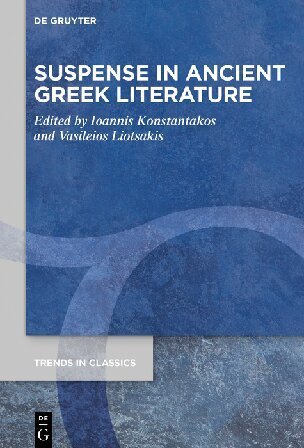
Suspense in Ancient Greek Literature by Ioannis Konstantakos, ISBN-13: 978-3110715392
Original price was: $50.00.$14.99Current price is: $14.99.
Safe & secure checkout
Description
Description
Suspense in Ancient Greek Literature by Ioannis Konstantakos, ISBN-13: 978-3110715392
[PDF eBook eTextbook]
- Publisher: Walter de Gruyter (February 22, 2021)
- Language: English
- 430 pages
- ISBN-10: 3110715392
- ISBN-13: 978-3110715392
The use of suspense in ancient literature attracts increasing attention in modern scholarship, but hitherto there has been no comprehensive work analysing the techniques of suspense through the various genres of the Classical literary canon. This volume aspires to fill such a gap, exploring the phenomenon of suspense in the earliest narrative writings of the western world, the literature of the ancient Greeks. The individual chapters focus on a wide range of poetic and prose genres (epic, drama, historiography, oratory, novel, and works of literary criticism) and examine the means by which ancient authors elicited emotions of tense expectation and fearful anticipation for the outcome of the story, the development of the plot, or the characters’ fate. A variety of theoretical tools, from narratology and performance studies to psychological and cognitive approaches, are exploited to study the operation of suspense in the works under discussion. Suspenseful effects are analysed in a double perspective, both in terms of the artifices employed by authors and with regard to the responses and experiences of the audience. The volume will be useful to classical scholars, narratologists, and literary historians and theorists.
Table of Contents:
Preface
Vasileios Liotsakis Introduction
1 The narrative perspective: Structuring suspenseful discourse
2 The sociological perspective: Narratees, character portraiture, and suspense
3 Violating the ancient narratees’ foreknowledge: ‘Suspense of distraction’
4 Suspense theories and controversial issues of Classical Philology
5 Outline of the present volume
Part I: Literary Criticism
Anna A. Novokhatko ἵν’ ὁ θεατὴς προσδοκῶν καθῇτο: What Did Ancient Critics Know of ‘Suspense’?
Part II: Archaic Poetry
Ruth Scodel Homeric Suspense
1 Homer and the paradox of suspense
2 The suspenseful episode
3 Prior knowledge and uncertainty
4 Retardation
5 Low uncertainty, emotional intensity
Polyxeni Strolonga Suspense, Orality, and Hymnic Narrative: The Case of the Homeric Hymns
1 The Homeric Hymn to Demeter
2 The Homeric Hymn to Apollo
3 The Homeric Hymn to Hermes
4 The Homeric Hymn to Aphrodite
5 Conclusions
Part III: Tragedy
Nikos Manousakis Waiting for Xerxes: Information Economics and the Composition of a Suspense Plot out of Familiar Events in Aeschylus’ Persae
1 Introduction: Qualities of suspense
2 Aeschylus’ Persae: A suspenseful plot
3 Conclusions
Andreas Markantonatos Narrative Suspense in Sophocles: The Moral Perplexity of Duelling Narratives in Philoctetes
1 Introduction
2 Disinterring the buried past: Moral suspense in Sophocles’ Philoctetes
3 Closing remarks
Francis Dunn Affective Suspense in Euripides’ Ion
Part IV: Comedy
Ioannis M. Konstantakos Staged Suspense: Scenic Spectacle, Anxious Expectation, and Dramatic Enthralment in Aristophanic Theatre
1 Introduction: Hitchcock, the Greeks, and visual suspense
2 Morphology of Aristophanic suspense
3 Suspense visualized: The scenic imagery of anxiety in the Acharnians and the Thesmophoriazusae
Part V: Historiography
Vasiliki Zali Suspense in Herodotus’ Narrative of the Battle of Thermopylae
Vasileios Liotsakis The Thucydidean Question, Structuralism, and ‘Neo-Unitarianism’: Near Misses and Suspense in the History
1 The Thucydidean Question
2 The categories of near miss narratives in the History
3 The evolution of near miss narratives: From local suspense to global suspense
4 The Thucydidean Question revisited: Structural studies and Neo-Unitarianism
Nikos Miltsios Suspense in Conspiracy Narratives: Polybius and Appian
1 The assassination of Julius Caesar (App. BC 2.111–117)
2 The Apelles conspiracy (Plb. 4.76–5.28)
3 The Sosibius and Hermeias conspiracies (Plb. 5.34–56)
4 Conclusions
Part VI: Oratory
Michael J. Edwards Suspense in Lysias
Christos Kremmydas Narrative and Suspense in Public Forensic Orations
1 Demosthenes’ oratorical performance in Athens (D. 19.17–23)
2 Demosthenes’ performance in Pella according to Aeschines (Aeschin. 2.21–43)
3 The Athenian dēmos on tenterhooks after the fall of Elateia in 339/338 (D. 18.169–179)
4 Uncertainty and apprehension in Athens after the defeat at Chaeroneia (Lycurg. 1.39–42)
5 The siege and capture of Plataea in 429–427 (Apollodorus, Against Neaira [D.] 59.98–103)
6 Conclusion
Part VII: Novel
Silvia Montiglio Suspense in the Ancient Greek Novel
1 Introduction
2 Callirhoe
3 An Ephesian Tale
4 Leucippe and Clitophon
5 Daphnis and Chloe
6 The Aethiopica
7 Conclusions
Bibliography
List of Contributors
Index Νominum et Rerum
Index Locorum
I. M. Konstantakos, National and Kapodistrian University of Athens and Vasileios Liotsakis, University of the Peloponnese, Kalamata, Greece.
What makes us different?
• Instant Download
• Always Competitive Pricing
• 100% Privacy
• FREE Sample Available
• 24-7 LIVE Customer Support

Reviews
There are no reviews yet.