

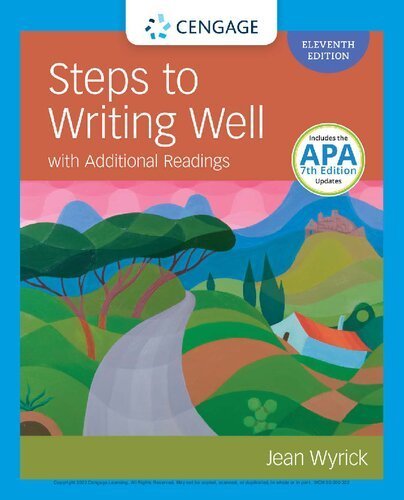
Steps to Writing Well with Additional Readings 11th Edition by Jean Wyrick, ISBN-13: 978-1337899796
Original price was: $50.00.$14.99Current price is: $14.99.
Safe & secure checkout
Description
Description
Trustpilot
Steps to Writing Well with Additional Readings 11th Edition by Jean Wyrick, ISBN-13: 978-1337899796
[PDF eBook eTextbook] – Available Instantly
- Publisher: Cengage Learning; 11th edition (January 1, 2021)
- Language: English
- 768 pages
- ISBN-10: 1337899798
- ISBN-13: 978-1337899796
Combining detailed coverage of the writing process with a wealth of professional readings, Wyrick’s STEPS TO WRITING WELL WITH ADDITIONAL READINGS has helped thousands of students learn to write effective academic essays. Extremely student-friendly, it presents rhetorical strategies for composing essays in an easy-to-follow progression of useful lessons and activities. With over 70 student and professional readings and a variety of hands-on activities, it gives you the models and practice you need to write well-constructed essays with confidence. The 11th edition features useful visual learning aids, student writing samples on timely topics, assignments that promote using sources and multiple rhetorical strategies, and updated discussions of multimodal texts and online databases. It also reflects guidelines from the APA’s 2020 Publication Manual.
Table of Contents:
Cover Page
Title Page
Copyright Page
Preface
Acknowledgments
To the Student
Part 1. The Basics of the Short Essay
Chapter 1. Prewriting
Getting Started
Selecting a Subject
Finding Your Essay’s Purpose and Focus
Pump-Primer Techniques
1. Listing
2. Freewriting
3. Looping
4. The Boomerang
5. Clustering
6. Cubing
7. Interviewing
8. The Cross-Examination
9. Sketching
10. Dramatizing the Subject
After You’ve Found Your Focus
Discovering Your Audience
How to Identify Your Readers
Keeping a Journal (Talking to Yourself Does Help)
Uses of the Journal
Chapter 1 Summary
Chapter 2. The Thesis Statement
What Is a Thesis? What Does a “Working Thesis” Do?
Can a “Working Thesis” Change?
Guidelines for Writing a Good Thesis
Avoiding Common Errors in Thesis Statements
Using the Essay Map
Chapter 2 Summary
Chapter 3. The Body Paragraphs
Planning the Body of Your Essay
Composing the Body Paragraphs
The Topic Sentence
Focusing Your Topic Sentence
Placing Your Topic Sentence
Paragraph Development
Paragraph Length
Paragraph Unity
Paragraph Coherence
A Recognizable Ordering of Information
Transitional Words and Phrases
Repetition of Key Words
Pronouns Substituted for Key Nouns
Parallelism
Using a Variety of Transitional Devices
Avoiding Whiplash
Paragraph Sequence
Transitions between Paragraphs
Chapter 3 Summary
Chapter 4. Beginnings and Endings
How to Write a Good Lead-In
Avoiding Errors in Lead-Ins
How to Write a Good Concluding Paragraph
Avoiding Errors in Conclusions
How to Write a Good Title
Chapter 4 Summary
Chapter 5. Drafting and Revising: Creative Thinking, Critical Thinking
What Is Revision?
When Does Revision Occur?
Myths about Revision
Can I Learn to Improve My Revision Skills?
Preparing to Draft
Some Basic Tips for Drafting
Some Hints When Drafting on a Computer
Some Hints When Handwriting a Draft
Writing Centers, Computer Classrooms, and Electronic Networks
Procrastination: Enemy of Critical Thinking, Thief of Time
A Revision Process for Your Drafts
I. Revising for Purpose, Thesis, and Audience
II. Revising for Ideas and Evidence
III. Revising for Organization
IV. Revising for Clarity and Style
V. Editing for Errors
VI. Proofreading
A Final Checklist for Your Essay
Sample Student Essay
Draft Essay
Revised Essay
Collaborative Activities: Group Work, Peer Revision Workshops, and Team Projects
Benefiting from Collaborative Activities
Guidelines for Peer Revision Workshops
Guidelines for Small-Group Work
Some Last Advice: How to Play with Your Mental Blocks
Chapter 5 Summary
Chapter 6. Effective Sentences
Developing a Clear Style
Give Your Sentences Content
Make Your Sentences Specific
Avoid Overpacking Your Sentences
Fix Major Sentence Errors
Pay Attention to Word Order
Avoid Mixed Constructions and Faulty Predication
Developing a Concise Style
Avoid Deadwood Constructions
Avoid Redundancy
Carefully Consider Your Passive Verbs
Avoid Pretentiousness
Developing an Engaging Style
Developing an Emphatic Style
Word Order
Coordination
Subordination
Chapter 6 Summary
Chapter 7. Word Logic
Selecting the Correct Words
Accuracy: Confused Words
Accuracy: Idiomatic Phrases
Levels of Language
Tone
Denotation and Connotation
Selecting the Best Words
Vague Verbs
Vague Nouns
Vague Modifiers
Chapter 7 Summary
Chapter 8. The Reading–Writing Connection
How Can Reading Well Help Me Become a Better Writer?
How Can I Become an Analytical Reader?
Steps to Reading Well
Sample Annotated Essay
How Can I Read Multimodal Texts Analytically?
Steps to Reading Multimodal Texts Well
Sample Annotated Advertisement
Writing a Summary
Benefiting from Class Discussions
Chapter 8 Summary
Part 2. Purposes, Modes, and Strategies
Chapter 9. Development by Example
Why and How to Use Examples in Your Writing
Developing Your Essay
Problems to Avoid
A Topic Proposal for Your Essay
Sample Student Essay 1
Sample Student Essay 2
Professional Essay
Chapter 10. Process Analysis
Types of Process Analysis Essays
Developing Your Essay
Problems to Avoid
A Topic Proposal for Your Essay
Sample Student Essay 1
Sample Student Essay 2
Professional Essays
I. The Informative Process Essay
II. The Directional Process Essay
Chapter 11. Comparison and Contrast
Developing Your Essay
Pattern One: Point-by-Point
Pattern Two: The Block
Which Pattern Should You Use?
Problems to Avoid
A Topic Proposal for Your Essay
Sample Student Essay 1
I. The Point-by-Point Pattern
Sample Student Essay 2
II. The Block Pattern
Professional Essays
I. The Point-by-Point Pattern
II. The Block Pattern
A Special Kind of Comparison: The Analogy
Chapter 12. Definition
Why Do We Define?
Developing Your Essay
Problems to Avoid
A Topic Proposal for Your Essay
Sample Student Essay 1
Sample Student Essay 2
Professional Essay
Chapter 13. Division and Classification
Division
Classification
Developing Your Essay
Problems to Avoid
A Topic Proposal for Your Essay
Sample Student Essay 1
Student Sample Essay 2
Professional Essay: Classification
Professional Essay: Division
Chapter 14. Causal Analysis
Developing Your Essay
Problems to Avoid
A Topic Proposal for Your Essay
Sample Student Essay 1
Sample Student Essay 2
Professional Essay
Chapter 15. Argumentation
Developing Your Essay
Problems to Avoid
Common Logical Fallacies
A Topic Proposal for Your Essay
Sample Student Essay 1
Student Sample Essay 2
Professional Essays
Analyzing Advertisements
Divergent Viewpoints: Gun Ownership in America
Competing Products: Sources of Energy
Popular Appeals: Spending Our Money
Chapter 16. Description
How to Write Effective Description
Problems to Avoid
A Topic Proposal for Your Essay
Sample Student Essay 1
Sample Student Essay 2
Professional Essay
Chapter 17. Narration
Writing the Effective Narrative Essay
Problems to Avoid
A Topic Proposal for Your Essay
Sample Student Essay 1
Sample Student Essay 2
Professional Essay
Chapter 18. Writing Essays Using Multiple Strategies
Choosing the Best Strategies
Problems to Avoid
Sample Student Essay
Professional Essay
Part 3. Special Assignments
Chapter 19. Conducting Research and Using Sources
Focusing Your Topic
Beginning Your Library Research
General Reference Works
Library Catalogs
Databases
Special Collections
Beginning Your Online Research
Conducting Primary Research
The Personal Interview
The Questionnaire
Preparing a Working Bibliography
Choosing and Evaluating Your Sources
Preparing an Annotated Bibliography
Taking Notes
Distinguishing Paraphrase from Summary
Incorporating Your Source Material
Avoiding Plagiarism
Chapter 20. Documenting Sources
MLA Style
MLA Citations in Your Essay
Compiling a Works Cited List: MLA Style
Guidelines to MLA Style
The Core Elements
Supplemental Elements
Containers within Containers
Citations Beyond the Research Paper
Practice Template for MLA Entries
Sample Works Cited Entries: MLA Style
Periodicals (Magazines, Journals, Newspapers)
APA Style
APA Citations in Your Essay
Compiling a Reference List: APA Style
Sample Reference List Entries: APA Style
Electronic Sources: APA Style
Footnote and Bibliography Form
Using Supplementary Notes
Sample Notes Page Using MLA Style
Sample Student Essay Using MLA Style
Sample Student Essay Using APA Style
Chapter 21. Classroom Writing: Exams, Timed Essays, and Presentations
Steps to Writing Well Under Pressure
Problems to Avoid
Writing the Summary-and-Response Essay
Reading the Assignment and the Article
Sample Student Essay
Writing for Classroom Presentations
Steps to Successful Presentations
Guidelines for Effective Delivery
Chapter 22. Writing about Literature
Using Literature in the Composition Classroom
Suggestions for Close Reading of Literature
Steps to Reading a Story
Annotated Story
Sample Student Essay
Steps to Reading a Poem
Annotated Poem
Sample Student Essay
General Guidelines for Writing about Literature
Problems to Avoid
Suggestions for Writing
Chapter 23. Writing in the World of Work
Composing Business Letters
Traditional Business Letter Format
Sample Business Letter
Creating Memos
Sending Professional E-Mail
Problems to Avoid
Writing Cover Letters and Designing Résumés
Effective Cover Letters
Effective Résumés
Problems to Avoid
Sample Résumés
Sample Résumé #1
Sample Résumé #2
Preparing Interview Notes and Post-Interview Letters
MindTap Online Chapter: Writing about Film
Using Film in the Composition Classroom
Guidelines for Writing about Film
Problems to Avoid
Sample Student Essay
Professional Essay. The Theory of Everything
Suggestions for Writing
Glossary of Film Terms
Part 4. A Concise Handbook
Chapter 24. Major Errors in Grammar
Assessing Your Skills: Grammar
Errors with Verbs
24a. Faulty Agreement S–V Agr
24b. Subjunctive V Sub
24c. Tense Shift T
24d. Split Infinitive Sp I
24e. Double Negatives D Neg
24f. Passive Voice Pass
24g. Irregular Verbs Irreg V
Errors with Nouns N
24h. Possessive with “-ing” Nouns
24i. Misuse of Nouns as Adjectives
24j. Plurals of Proper Nouns
Errors with Pronouns
24k. Faulty Agreement Pro Agr
24l. Vague Reference Ref
24m. Shift in Pronouns P Sh
24n. Incorrect Case Ca
24o. Incorrect Compound Forms
Errors with Adverbs and Adjectives
24p. Incorrect Usage Adv Adj
24q. Faulty Comparison Comp
Errors in Modifying Phrases
24r. Dangling Modifiers DM
24s. Misplaced Modifiers MM
Errors in Sentences
24t. Fragments Frag
24u. Run-on (or Fused) Sentence R-O
24v. Comma Splice CS
24w. Faulty Parallelism //
24x. False Predication Pred
24y. Mixed Structure Mix S
Chapter 25. A Concise Guide to Punctuation
Assessing Your Skills: Punctuation
Punctuation Guidelines
25a. The Period (.) P
25b. The Question Mark (?) P
25c. The Exclamation Point (!) P
25d. The Comma (,) P
25e. The Semicolon (;) P
25f. The Colon (:) P
25g. The Apostrophe (‘) AP
25h. Quotation Marks (“ ” and ‘ ’) P
25i. Parentheses ( ) P
25j. Brackets [ ] P
25k. The Dash (—) P
25l. The Hyphen (-) P
25m. Italics (Ital) and Underlining (Und) P
25n. Ellipsis Points (. . . or . . . .) P
25o. The Slash (/) P
Chapter 26. A Concise Guide to Mechanics
Assessing Your Skills: Mechanics
26a. Capitalization Cap
26b. Abbreviations Ab
26c. Numbers Num
26d. Spelling Sp
Answers to the Mechanics Assessment
Part 5. Additional Readings
Chapter 27. Development by Example
Chapter 28. Process Analysis
Chapter 29. Comparison and Contrast
Chapter 30. Definition
Chapter 31. Division and Classification
Chapter 32. Causal Analysis
Chapter 33. Argumentation
Chapter 34. Description
Chapter 35. Narration
Chapter 36. Essays Using Multiple Strategies and Styles
Chapter 37. Literature
JUST IN TIME PLUS V2
Quick Review: Active Reading
Prepare to Read
Before Reading: Preview, Predict, Connect
Preview the Text
Make Predictions
Create Connections
During Reading: Interact with the Text
After Reading: Reflect and Review
Quick Review: Reading for Evidence
Identify the Main Idea or Thesis of a Text
Identifying Main Ideas in Paragraphs
Identifying Main Ideas in Longer Readings
Recognize Types of Evidence
Evaluate Evidence
Quick Review: Annotating as You Read
Highlight or Underline Effectively
Annotate as You Read
Organize New Information
Quick Review: Using Context Clues
Types of Context Clues
Recognize and Use Inference Clues
Recognize and Use Synonym Clues
Recognize and Use Contrast Clues
Recognize and Use Example Clues
Recognize and Use Definition Clues
Quick Review: Making Pronouns Agree with Antecedents
How to Ensure Pronoun-Antecedent Agreement
Singular “They”
Ensure the Gender of a Pronoun Matches Its Antecedent
Ensure Agreement When Antecedents are Joined by and
Ensure Agreement When Antecedents Are Joined by or or nor
Ensure Agreement When an Antecedent is an Indefinite Word
Correctly use singular or plural pronouns with collective antecedents
Quick Review: Making Pronoun Reference Clear
How to Ensure Clear Pronoun Reference
Ensure Each Pronoun Has One Clear Antecedent
Ensure Pronouns Are Close to Antecedents
Ensure Pronouns Refer to Stated, Not Implied, Antecedents
Quick Review: Expanding Sentences with Phrases
How to Use Phrases to Expand Sentences
Expand Sentences Using Verb Phrases
Expand Sentences Using Noun Phrases
Expand Sentences Using Prepositional Phrases
Expand Sentences Using Verbals and Verbal Phrases
Expand Sentences Using Appositive Phrases
Expand Sentences Using Absolute Phrases
Quick Review: Expanding Sentences with Clauses
How to Use Clauses to Expand Sentences
Recognize Independent Clauses
Recognize Dependent Clauses
Quick Review: Using Colons and Semicolons
Use Colons Correctly
Use Semicolons Correctly
Quick Review: Using Apostrophes
How to Use Apostrophes Correctly
Use Apostrophes to Indicate Possession
Use Apostrophes to Show Omission of Letters
Quick Review: When and Why to Paraphrase
Recognize When to Paraphrase
Write Accurate Paraphrases
How to Paraphrase Sources
Avoid Plagiarism
Quick Review: Understanding the Ideas of a Source
Ensure You Understand the Ideas of a Source
Quick Review: Changing Words and Sentence Structure
Paraphrase Ideas Using Your Words and Sentence Structure
Guidelines for Paraphrasing in Your Own Words
Paraphrasing in Action
Quick Review: When and Why to Write Summaries
Recognize When and Why to Write Summaries
Using Summary Writing for Comprehension
Using Summary Writing to Incorporate Ideas
Quick Review: Reading and Writing to Create a Summary
Read, Annotate and Outline to Understand Text
Practice Reading and Annotating
Write Accurate, Documented Summaries
Summarizing in Practice
A Note on Documentation
Quick Review: Avoiding Interpretation in Summaries
Write Accurate, Documented Summaries
Distinguish Your Commentary and Opinions from Those of Sources
Quick Review: When and Why to Quote
Recognize When and Why to Quote Sources
Guidelines for When and Why to Quote
Quick Review: Introducing Quotations with Signal Phrases
Use Effective Signal Phrases to Introduce Quotations
Use Correct Punctuation with Signal Phrases
Use Appropriate Verbs to Indicate the Attitude of Sources
When to Use Past or Present Tense
Quick Review: Embedding Quotations in Your Sentences
Use Only the Most Perinent Words of Your Source
Using Punctuation to Indicate Changes in Quotations
Use Signal Phrases to Show the Authority and Value of Source
Analyze selected quotations
Quick Review: Using Block Quotations
Understand the Shared Characteristics of Block Quotations
Use MLA Style for Block Quotations
Use APA Style for Block Quotations
Use Brackets and Ellipses to Show Alterations
Quick Review: Using MLA Format
Use in-text citationS
Variations on In-Text Citation
Prepare a Works Cited List
The Nine Core Elements of the MLA Documentation System
Sample Entries
Use MLA Format
Quick Review: Using APA Format
Use In-Text Citations
Variations on In-Text Citation
Prepare a References List
Sample Entries
Use APA Format
Quick Review: Reading for Topics, Main Ideas, and Details
Identifying the Topic and Main Idea of an Essay
Finding the Thesis Statement of an Essay
Identifying the Major and Minor Details of an Essay
Recognizing Types of Support
Just in Time Quick Reviews
Quick Review: Understanding Writing Assignments
Understanding Context, Purpose, and Audience
Reading and Analyzing the Assignment
Quick Review: Understanding the Rhetorical Situation
Define and Consider Purpose
Define and Consider Audience
Define and Consider Context
Quick Review: Writing Thesis Statements
Generating and Narrowing Ideas for a Topic
Developing a Strong Thesis Statement
Quick Review: Organizing Your Essay
Patterns of Organization
Quick Review: Writing Introductions and Conclusions
Writing an Effective Introduction
Writing an Effective Conclusion
Quick Review: Reading Critically
Read Actively
Read Critically
Quick Review: Understanding Fact and Opinion
Facts: Reading and Writing
Opinions: Reading and Writing
Quick Review: Quoting, Paraphrasing, and Summarizing
Avoiding Plagiarism
Quoting
Paraphrasing
Summarizing
Quick Review: Writing Topic Sentences
General versus Specific Statements
Generate and Narrow Ideas for a Topic
Develop a Strong Topic Sentence
Topic Sentences Work Together in Essays
Quick Review: Including Supporting Ideas
Types of Support
Generating Support
Supporting a Topic Sentence in a Paragraph
Supporting a Thesis Statement in an Essay
Quick Review: Writing Unified Paragraphs
Ensuring Paragraph Unity
Quick Review: Writing Coherent Paragraphs
Organizational Strategies
Transitional Words and Phrases
Key Words
Pronouns
Quick Review: Varying Sentence Structure
Sentence Types
Coordination: Combining Ideas of Equal Importance
Combining Sentences by Using Coordinating Conjunctions
Combining Sentences by Using Conjunctive Adverbs
Subordination: Combining Ideas of Unequal Importance
Combining Sentences by Using Participial Phrases
Avoid Creating Dangling Modifiers
Quick Review: Making Subjects and Verbs Agree
Ensuring Subject-Verb Agreement
Quick Review: Revising Sentence Fragments
Identifying Fragments
How to Correct Sentence Fragments
Quick Review: Revising Run-On Sentences and Comma Splices
Identifying and Correcting Run-On Sentences
Identifying and Correcting Comma Splices
Quick Review: Choosing Appropriate Language
Selecting and Maintaining Appropriate Tone
Avoiding Slang, Vulgar Language, Jargon, and Colloquialisms
Avoiding Sexist Language
Avoiding Clichés
Avoiding Contractions and Nonstandard Spelling
Quick Review: Using Concise Language
Eliminate Redundant Words and Phrases
Express Your Thoughts Clearly and Directly
Combine Closely Related Sentences
Quick Review: Understanding Sound Alike and Look Alike Words
Tips for Spelling Homonyms Correctly
Ten Most Commonly Confused Sets of Homonyms
Additional Commonly Confused Homonyms
Quick Review: Using Commas
Commas in Compound Sentences
Commas in a Series
Commas with Introductory Material
Commas with Interrupters
Commas with Dialogue or Quotations
Commas in Addresses, Dates, Letters, Numbers, and Titles
Quick Review: Using Capital Letters
Rules for Capitalization
Focused Support for Key Topics
Unit 1. Reading Arguments Critically
Reading and Evaluating Arguments
Identifying Claims, Reasons, and Supporting Evidence
Claims
Reasons
Supporting Evidence
Sample Outline: Claims, Reasons, and Evidence
Review: Claims, Reasons, and Evidence
Making Assumptions in Arguments
Understanding Facts and Opinions
Identifying Bias in Language and Evidence
Professional Reading 1. “Game Play to Music Play” by Andrew Mercer
Professional Reading 1. “Players are Using and Endorsing CBD, but the PGA Tour Is Wary” by Joel Beall
Professional Reading 2. “Why Do We Love Grumpy Animal Memes? Science Explains” by Lisa Suhay
Student Reading. “Read to Succeed” by Wardah Elghazali
Unit 2. Investigating the Rhetorical Situation
Understanding the Rhetorical Situation
Thinking About Audience
Considering Purpose
Persuasive Writing
Considering the Rhetorical Context
Location
Professional Reading 1. “The Case for Lo Pro” by Maddie Oatman
Professional Reading 2. “Making Wakanda Great Again: ‘BLACK PANTHER’” by Rand Richards Cooper
Student Reading. “Remedying an E-Waste Economy” by Rachel DeBruyn
Unit 3. Developing an Argument
Choosing a Topic
Strategies for Choosing and Narrowing Your Topic
Establishing Your Claim
Claims of Fact
Claims of Definition
Claims of Cause
Claims of Value
Claims of Policy
Apply It Now
Supporting Your Claim: Logos
Facts and Statistics
Examples
Expert Testimony
Apply It Now
Supporting Your Claim: Ethos
Style: Diction and Tone
Supporting Your Claim: Pathos
Summarizing and Refuting Opposing Arguments
Summarize Fairly and Accurately
Professional Reading 1. “Editorial: College Administrators and Local Authorities Could Curb Binge Drinking”
Professional Reading 2. “Big on Breakfast” by Alexander Blum
Student Reading. “ChooseMyPlate.gov Hinders Choice with Poor Web Design” by Jennika Smith
Unit 4. Synthesizing Diverse Perspectives
Using Synthesis
Strategies for Reading Diverse Perspectives
Recognizing Distinct Points of View in Your Sources
Identify Each Author’s Primary Argument and Conclusion
Use Summary to Make Sure You Understand Sources’ Main Ideas
Look for Points of Agreement, Partial Agreement, and Disagreement
Determining Relationships Between Different Points of View and Your Own
Create an Outline or Map to Show How the Different Sources Overlap
Integrating Sources into Your Own Writing
Considering Audience
Methods for Synthesizing Sources
Professional Reading 1. “What Education Can’t Do” by Diane Ravitch
Professional Reading 2. “Locking Away the Black Vote” by Eli Day
Professional Reading 2. “‘The Visiting Room’ Creates Connections: Impact of Play by Formerly Incarcerated Women Goes Beyond the Fourth Wall” by Maria Benevento
Student Reading. “Discrimination in Ireland” by Marianna Williams
Unit 5. Revising Logical Fallacies
The Illogic of Logical Fallacies
Deductive versus Inductive Reasoning
Identifying Logical Fallacies
Ad Hominem
False Dilemma
Appeal to Ignorance
Slippery Slope
Circular Argument
Hasty Generalization
Red Herring
Post Hoc, Ergo Propter Hoc
Appeal to Authority
Bandwagon
Personal Incredulity
Apply It Now
Avoiding Fallacies in Your Own Writing
Examples of Fallacies in a Source
Professional Reading 1. “United States of Narcissism” by Daniel Altman
Professional Reading 2. “The Monday Question: Is Animal Testing Acceptable for Medical Research?” from The Journal
Student Reading. “Why Is College So Important in the United States?” by Chloe Charles
Unit 6. Using Research in Argument
Using Reputable Research Sources to Support Your Ideas
Using Information from Research Sources to Support Your Ideas
Using Research from Reputable Sources
Using Research from Print and Online Sources
Using Books from the General Collection
Using Research from a Wide Variety of Viewpoints
Tips for Thoroughly and Accurately Citing Sources
Documenting Information from Research Sources Accurately
How to Cite Research Sources: An Overview
Professional Reading 1. “Millennials and Technology: Addressing the Communication Gap in Education and Practice” by Lindsey A. Gibson and William A. Sodeman
Professional Reading 1. “Praise, Rather Than Punish, to See Up to 30% Greater Focus in the Classroom”
Professional Reading 2. “NO CAKE FOR US: Whether They Intended to or Not, the Justices Sent Same-Sex Couples a Message about Who Is Welcome” by Lucas Grindley
Student Reading. “Slang Rebels” by Greg Coles
Unit 7. Investigating the Source or Sponsor of Information
Realize That All Sources Have Certain Biases
Evaluate the Likely Bias of a Source
Questions for Evaluating the Likely Bias of a Source
Evaluate the Author’s Sources by Reviewing the Bibliography
Determine the Likely Bias of the Organization that Sponsored the Study, Website, or Other Content
How to Determine Who Sponsors a Website or Study
Professional Reading 1. “Is Addiction Really a Disease? A Challenge to Twelve-Step Programs” by Nicholas Grant Boeving
Professional Reading 1. “Here Come the Prose Police: Why Academic Writing Gets a Bad Rap” by Jan Mieszkowski
Professional Reading 2. “A Doggone Way to Reduce Stress: An Animal Assisted Intervention with College Students” by Lisa A. House, et al.
Student Reading. “Entertainment Slaves” by Brittany Weishuhn
Unit 8. Evaluating Format to Decide If a Source Is “Fake News”
Identify Fake News
Examine the Headline
Evaluate Spelling and Punctuation
Determine If the URL Is the Correct One for a Real News Site
Check the Date of the Article to See If It Makes Sense Given the Context
Professional Reading 1. “The Importance of Critical Thinking for Student Use of the Internet” by M. Neil Browne, Kari E. Freeman, et al.
Professional Reading 2. “Debunking the Fictions of the Tet Offensive” by Maj Thomas Herman
Professional Reading 2. “Debunking Marijuana Myths for Teens” by Susan D. Swick and Michael S. Jellinek
Student Reading. “To Fish and Be Fished: A Tinder-fied Game of Love” by Kellie Coppola
Unit 9. Determining the Expertise of the Author
Evaluate the Author’s Credentials Provided in a Headnote or Cover Blurb
Evaluate the Author’s Credentials Based on a Source’s Website
Evaluate the Author’s Credentials Using a Google Search
Professional Reading 1. “Drug Prohibition Is the Problem: Reflections from a Former Judge” by James P. Gray
Professional Reading 1. “The New Jim Crow: How Mass Incarceration Turns People of Color into Permanent Second-Class Citizens” by Michelle Alexander
Professional Reading 2. “Facebook Age Display and Alcohol Use among College Students” by Molly Wilner, Bradley Kerr, et al.
Student Reading. “The Perils of the Second Shift: Navigating Work-Family Conflict in the 21st Century” by Nichole Peña
50 Readings
“Policing the Imagination” by Madison Smartt Bell
“When Does Appreciation Become Appropriation?” by Brian Schaeffer
“Beats Against Colonialism: A Tribe Called Red” by Sheldon Birnie
“Hip or Hype? Virtual Influencers Are Brands’ Latest Social Tool by Madison Patrick Kulp”
“Combing Through Black Beauty Culture” by Cicely-Belle Blain
“Coronavirus Infodemic” by Amy Affelt
“Bots Bite Man: Why Our Fake-News Problem Will Get Worse Before It Gets Better” by Amy Web
“How Science Will Explain and Fix Fake News” by David Cowan
“Flat Earth, Illuminati, and Fake Moon Landing: Are Conspiracy Theory Videos Hurting YouTube?” by Kate Sheridan
“Make Media Great Again: The Line Between Sponsored and Editorial Content Needs to Be Reinforced” by Mark Tungate
“Stand for Something: Let’s Talk about Media Bias” by Monika Bauerlein
“The Bad News About Good News” by Alexander Nazaryan
“We Haven’t Fully Grappled with How Much We Unwittingly Judge Journalism Through A White Lens” by Isaac Bailey
“Is the Media Fuelling Herder vs. Farmer Clashes?” by Tom Collins
“Women’s News Agency in Turkey Targeted” by Dano Sabaghi
“Ties of Blood: Our Deep and Abiding Connection with Mother Earth Is What Compels Us to Fight to Protect It” by Kandi White
“Last Chances” by Elizabeth Kolbert
“Strength in Numbers” by Eric Klinenberg
“A New Leaf” by Jackie Mogensen
“A Solution for Climate Pollution?” by Patricia Smith
“Mapping My Mother” by Anna Kushner
“The Real North Is an Idea” by Lindsay Bell and Jesse Colin Jackson
“Crossed Paths: Wang Anyi Traces Shanghai in Map and Memory as She Revisits Its Lanes, a Mental Flaneur” by Wang Anyi
“A Tale of Three Cities” by Kolundi Serumaga
“Ocala National Forest: Full of Special Places” by Robert H. Mohlenbrock
“The White Imagination Must Be Bound” by Anya Steinberg
“Check-the-Box Training Won’t Work. Communities of Color Must Drive Policing” by Ron Johnson
“The Forgotten King: Commentary on Protest, Race, and MLK” by Ken Makin
“Anti-Culture Warriors” by The American Conservative
“Summer School for Protest Writing” by Tyler Foggatt
“The Perils of Trashing the Value of College” by Margaret Spellings
“A Degree in Debt: The High Price of Higher Education” by Hollis Phelps
“Lessons from the Olin College Experiment” by Richard K. Miller
“The Prison-to-College Pipeline” by Mel Jones
“How Can Values be Taught in the University?” by Toni Morrison
“Editorial: Caitlyn and Jim Show Us What Discrimination Looks Like” by the St. Louis Post-Dispatch
“Supporting the Gender Expansive Student” by Shannon Sheldon
“Privacy and Inclusion: Creating Welcoming Public Facilities that Truly Serve” by Lindsey Peckinpaugh and Jenny Stephens
“Ungendered: More Brands and Retailers are Doing Away with Male and Female Marketing Stereotypes” by Kristina Monllos
“Generation X” by John Paul Brammer
“Listen So People Will Talk” by Dolores T. Puterbaugh
“‘Her’ Again” by the Staff from Wired
“From Subtweets to Sarcastic Put-Downs, Online Culture Is Giving Adults a Taste for Bullying” by Amelia Tait
“Protecting the Right to Write” by Chrisanne Grise
“Discrimination’s ‘Back Door’: Tackling Language Bias on Campus” by Heidi
“How to Write the Perfect Sentence” by Stanley Fish
“Love to Write? Keep It to Yourself” by Rachel Toor
“Cataclysm” by Rilla Askew
“Why the Novel Matters in the Age of Anger” by Elif Shafak
“Writing a Life, Living a Writer’s Life” by Gaiutra Bahadur
Jean Wyrick is Professor Emerita of English at Colorado State University, where she was director of composition for 11 years. She has more than 25 years of experience teaching writing, training writing teachers, and designing writing/writing-across-the-curriculum programs. Her other textbooks include THE RINEHART READER and DISCOVERING IDEAS. She has presented over 100 workshops and papers on the teaching of writing, American literature, American studies, and women’s studies.
What makes us different?
• Instant Download
• Always Competitive Pricing
• 100% Privacy
• FREE Sample Available
• 24-7 LIVE Customer Support
Reviews
There are no reviews yet.