

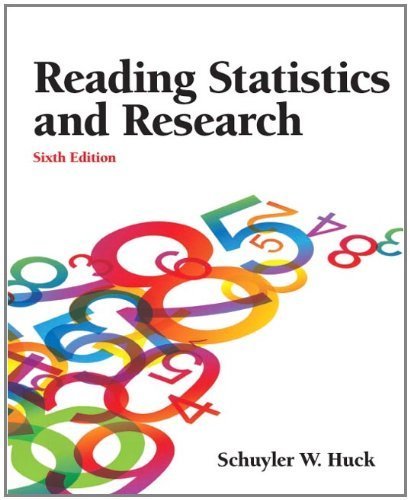
Reading Statistics and Research 6th Edition by Schuyler Huck, ISBN-13: 978-0132178631
Original price was: $50.00.$14.99Current price is: $14.99.
Safe & secure checkout
Description
Description
Reading Statistics and Research 6th Edition by Schuyler Huck, ISBN-13: 978-0132178631
[PDF eBook eTextbook]
- Publisher: Pearson; 6th edition (February 24, 2011)
- Language: English
- 592 pages
- ISBN-10: 013217863X
- ISBN-13: 978-0132178631
Employing a non-intimidating writing style that emphasizes concepts rather than formulas, this uniquely welcoming text shows consumers of research how to read, understand, and critically evaluate the statistical information and research results contained in technical research reports. Some key topics covered in this thoroughly revised text include: descriptive statistics, correlation, reliability and validity, estimation, h hypothesis testing, t-tests, ANOVA, ANCOVA, regression, multivariate analysis, factor analysis, and structural equation modeling (SEM). A number of mini-topics related to research and statistics are also discussed, such as the geometric mean, Tau-b correlation, Guttman split-half reliability, sensitivity, specificity, and the Sobel test. Additionally, the sixth edition also includes over 488 new excerpts (tables, figures, passages of text) taken from current research reports. Written specifically for students in non-thesis Master’s Programs but also perfectly suitable for students in upper-level undergraduate statistics courses, doctoral students who must conduct dissertation research, and independent researchers who want a better handle on how to decipher and critique statistically-based research reports.
Table of Contents:
Title Page
Copyright Page
About the Author
Contents
Preface
Acknowledgments
1 Typical Format of a Journal Article
Abstract
Introduction
Method
Statistical Plans
Results
Discussion
References
Notes
Two Final Comments
Review Terms
The Best Items in the Companion Website
2 Descriptive Statistics: The Univariate Case
Picture Techniques
Distributional Shape
Measures of Central Tendency
Measures of Variability
Standard Scores
A Few Cautions
Review Terms
The Best Items in the Companion Website
3 Bivariate Correlation
The Key Concept behind Correlation: Relationship
Scatter Plots
The Correlation Coefficient
The Correlation Matrix
Different Kinds of Correlational Procedures
Warnings about Correlation
Review Terms
The Best Items in the Companion Website
4 Reliability and Validity
Reliability
Validity
Final Comments
Review Terms
The Best Items in the Companion Website
5 Foundations of Inferential Statistics
Statistical Inference
The Concepts of Statistic and Parameter
Types of Samples
The Problems of Low Response Rates, Refusals to Participate, and Attrition
A Few Warnings
Review Terms
The Best Items in the Companion Website
6 Estimation
Interval Estimation
Point Estimation
Warnings Concerning Interval and Point Estimation
Review Terms
The Best Items in the Companion Website
7 Hypothesis Testing
An Ordered List of the Six Steps
A Detailed Look at Each of the Six Steps
Results That Are Highly Significant and Near Misses
A Few Cautions
Review Terms
The Best Items in the Companion Website
8 Effect Size, Power, CIs, and Bonferroni
The Seven-Step Version of Hypothesis Testing: Estimating Effect Size
The Nine-Step Version of Hypothesis Testing: Power Analyses
Hypothesis Testing Using Confidence Intervals
Adjusting for an Inflated Type I Error Rate
A Few Cautions
Review Terms
The Best Items in the Companion Website
9 Statistical Inferences Concerning Bivariate Correlation Coefficients
Statistical Tests Involving a Single Correlation Coefficient
Tests on Many Correlation Coefficients (Each of Which Is Treated Separately)
Tests of Reliability and Validity Coefficients
Statistically Comparing Two Correlation Coefficients
The Use of Confidence Intervals around Correlation Coefficients
Cautions
Review Terms
The Best Items in the Companion Website
10 Inferences Concerning One or Two Means
Inferences Concerning a Single Mean
Inferences Concerning Two Means
Multiple Dependent Variables
Effect Size Assessment and Power Analyses
Underlying Assumptions
Comments
Review Terms
The Best Items in the Companion Website
11 Tests on Three or More Means Using a One-Way ANOVA
The Purpose of a One-Way ANOVA
The Distinction between a One-Way ANOVA and Other Kinds of ANOVA
The One-Way ANOVA’s Null and Alternative Hypotheses
Presentation of Results
Assumptions of a One-Way ANOVA
Statistical Significance versus Practical Significance
Cautions
A Final Comment
Review Terms
The Best Items in the Companion Website
12 Post Hoc and Planned Comparisons
Post Hoc Comparisons
Planned Comparisons
Comments
Review Terms
The Best Items in the Companion Website
13 Two-Way Analyses of Variance
Similarities between One-Way and Two-Way ANOVAs
The Structure of a Two-Way ANOVA
Three Research Questions
The Three Null Hypotheses (and Three Alternative Hypotheses)
Presentation of Results
Follow-Up Tests
Planned Comparisons
Assumptions Associated with a Two-Way ANOVA
Estimating Effect Size and Conducting Power Analyses in Two-Way ANOVAs
The Inflated Type I Error Rate in Factorial ANOVAs
A Few Warnings Concerning Two-Way ANOVAs
Review Terms
The Best Items in the Companion Website
14 Analyses of Variance with Repeated Measures
One-Way Repeated Measures ANOVAs
Two-Way Repeated Measures ANOVAs
Two-Way Mixed ANOVAs
Three Final Comments
Review Terms
The Best Items in the Companion Website
15 The Analysis of Covariance
The Three Different Variables Involved in Any ANCOVA Study
The Covariate’s Role
Null Hypotheses
The Focus, Number, and Quality of the Covariate Variable(s)
Presentation of Results
The Statistical Basis for ANCOVA’s Power Advantage and Adjustment Feature
Assumptions
ANCOVA When Comparison Groups Are Not Formed Randomly
Related Issues
A Few Warnings
Review Terms
The Best Items in the Companion Website
16 Bivariate, Multiple, and Logistic Regression
Bivariate Regression
Multiple Regression
Logistic Regression
Final Comments
Review Terms
The Best Items in the Companion Website
17 Inferences on Percentages, Proportions, and Frequencies
The Sign Test
The Binomial Test
Fisher’s Exact Test
Chi-Square Tests: An Introduction
Three Main Types of Chi-Square Tests
Issues Related to Chi-Square Tests
McNemar’s Chi-Square
The Cochran Q Test
The Use of z-Tests When Dealing with Proportions
A Few Final Thoughts
Review Terms
The Best Items in the Companion Website
18 Statistical Tests on Ranks (Nonparametric Tests)
Obtaining Ranked Data
Reasons for Converting Scores on a Continuous Variable into Ranks
The Median Test
The Mann–Whitney U Test
The Kruskal–Wallis H Test
The Wilcoxon Matched-Pairs Signed-Ranks Test
Friedman’s Two-Way Analysis of Variance of Ranks
Large-Sample Versions of the Tests on Ranks
Ties
A Few Final Comments
Review Terms
The Best Items in the Companion Website
19 Multivariate Tests on Means
The Versatility of Multivariate Tests
The Multivariate Null Hypothesis
Testing the Multivariate Null Hypothesis
Assumptions
Statistical Significance and Practical Significance
Post Hoc Investigations
Three Final Comments
Review Terms
The Best Items in the Companion Website
20 Factor Analysis
The Goal (and Basic Logic) of Factor Analysis
The Three Main Uses of Factor Analysis
Exploratory and Confirmatory Factor Analysis
Exploratory Factor Analysis
Confirmatory Factor Analysis
Three Final Comments
Review Terms
The Best Items in the Companion Website
21 Structural Equation Modeling
SEM Diagrams, Terms, and Concepts
Assessing SEM Hypotheses: A Brief Overview
Steps in Assessing Model Worth
Other Uses of SEM
The Dental Anxiety SEM Study
Two Final Comments
Review Terms
The Best Items in the Companion Website
Epilogue
Review Questions
Answers to Review Questions
Credits
Index
Schuyler W. Huck was born in Chicago, Illinois in 1943. He attended school in two Chicago suburbs (Riverside and Glenview), receiving a high school diploma in 1961 from Glenbrook North H.S. His undergraduate work was taken at DePauw University (Greencastle, Indiana) where he graduated in 1965 with a major in psychology and a minor in sociology. He pursued a doctorate in Educational Psychology at Northwestern University (Evanston, Illinois), receiving the Ph.D. in 1970. His doctoral specialization was applied statistics, testing, and research design.
In 1970, Dr. Huck joined the faculty at the University of Tennessee, Knoxville as an Assistant Professor. Affiliated with the Department of Educational and Counseling Psychology, he was promoted to Associate Professor in 1974 and to Professor in 1977. Since receiving his doctorate, Dr. Huck has taught at two other educational institutions while on leave from UT. For 10 summers between 1977 and 1986, he was employed as a Visiting Professor in the Psychology and Education Departments at the University of Nevada (Reno). From July, 1988 until July, 1989, he served as a Distinguished Visiting Professor at the United States Air Force Academy in Colorado.
Over the past three decades, Professor Huck has been involved in an ongoing program of research and scholarly activity. He is the senior author of three books: (1) Reading Statistics and Research (with the 3rd edition published in 2000 by Allyn & Bacon/Longman), (2) Rival Hypotheses: Alternative Explanations for Data-Based Conclusions (published in 1979 by Harper & Row), and (3) Statistical Illusions (published in 1984 by Harper & Row); he has had 34 technical papers published in a variety of refereed journals (Teaching Statistics, Educational and Psychological Measurement, Journal of Educational Statistics, American Educational Research Journal, Journal of Educational Measurement, Psychological Bulletin, Journal of Experimental Education, Journal of Applied Psychology, Science Education, Teaching of Psychology, Mathematics Teacher, Journal of Counseling Psychology, Research Quarterly, Physiology & Behavior); and he has made over 60 oral presentations of his work at professional meetings (International Conference on Teaching Statistics, American Educational Research Association, American Psychological Association, and regional meetings affiliated with these two national organizations).
In addition to making his own contributions to the professional literature, Professor Huck has been heavily involved in screening the work of others and in serving as a consultant on others’ projects. He has reviewed book prospecti/full manuscripts sent to publishing companies, papers considered for possible publication in professional journals, and abstracts submitted for possible presentation at conventions. In his role as a consultant, Professor Huck has worked on several projects, including (1) test-development efforts conducted by: the American College of Veterinary Internal Medicine, the American Association of State Psychology Boards, Tennessee’s State Departments of Education and Human Services, the Child Welfare Institute (Atlanta), and UT’s Center for Government Training, (2) a three-year NSF research project designed to assess new procedures for helping math teachers assist students improve their creativity and problem-solving skills, and (3) a trial in which the State of Tennessee was being sued and for which Tennessee’s Office of the Attorney General asked Dr. Huck to testify as an Expert Witness in the areas of testing, research design, and applied statistics.
At various points in his career, Dr. Huck has received awards/recognition from students, colleagues, and administrators. While at DePauw, he received the Frank C. Tucker Award for Leadership. Early in his stay at Tennessee, the Student Government Association tapped him as one of the University’s Outstanding Teachers. Soon thereafter, colleagues at UT gave him the first Annual Award for Outstanding Faculty Research in the College of Education. The major honors bestowed upon Professor Huck, however, came (1) in 1983 when he was selected to be a UT Distinguished Service Professor, a prestigious title that he holds for the duration of his stay at the University, (2) in 1988 when he was asked to serve, for a year, on the faculty at the Air Force Academy as a Distinguished Visiting Professor, (3) in 1984 and 1990 when the scholarly work of two doctoral advisees received Outstanding Dissertation Awards in national competitions conducted by AERA, (4) in 1991 when he was elected by his colleagues at other universities as President of AERA’s Educational Statisticians SIG, (5) in 1993 when he was one of the first two faculty members given the title of Chancellor’s Teaching Scholar, a post involving work with UT’s Chancellor and other top administrators, and (6) in 1995 when the GTA Mentoring Program (a project that grew out of his idea on how to improve undergraduate education at research universities) was deemed worthy of support by UT and the Alcoa Foundation.
What makes us different?
• Instant Download
• Always Competitive Pricing
• 100% Privacy
• FREE Sample Available
• 24-7 LIVE Customer Support
Reviews
There are no reviews yet.