

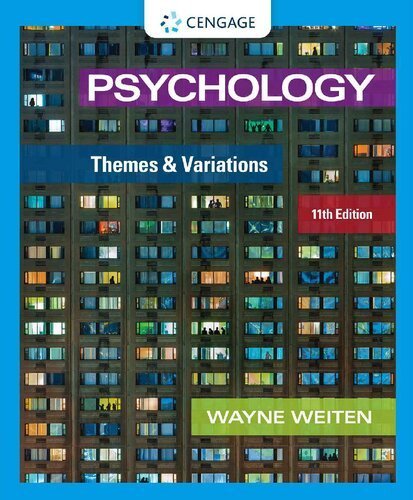
Psychology: Themes and Variations 11th Edition by Wayne Weiten, ISBN-13: 978-0357374825
Original price was: $50.00.$19.99Current price is: $19.99.
Safe & secure checkout
Description
Description
Psychology: Themes and Variations 11th Edition by Wayne Weiten, ISBN-13: 978-0357374825
[PDF eBook eTextbook] – Available Instantly
- Publisher: Cengage Learning; 11th edition (January 24, 2021)
- Language: English
- 752 pages
- ISBN-10: 0357374827
- ISBN-13: 978-0357374825
Weiten’s PSYCHOLOGY: THEMES AND VARIATIONS, 11th Edition immerse you in the excitement of this fascinating field while helping you study and retain what you learn. Filled with practical ways that you can apply psychology to your everyday life, this bestselling textbook is an experience in learning that you’ll remember long after you complete your Introductory Psychology course. Critical Thinking Applications in every chapter give you specific strategies you can apply in all of your courses and in your personal life. Reality Checks, many of which may surprise you, address common misconceptions about psychology. Every chapter of this book offers tools — such as Concept Charts that provide colorful visual snapshots of key points — to help you focus on what’s important, showing you how to maximize your study time and course success.
A fusion of the full-length and briefer versions that preceded it, Weiten’s PSYCHOLOGY: THEMES AND VARIATIONS, 11th Edition combines a superb thematic organization with practical applications and examples that help readers see beyond research to big-picture concepts. Often described as challenging yet easy to learn from, the book surveys psychology’s broad range of content while illuminating the process of research and its relationship to application, showing both the unity and diversity of psychology’s subject matter and helping learners master the basic concepts and principles of psychology with as little struggle as possible. Weiten’s themes provide unifying threads across chapters that help readers to see the connections among different research areas in psychology. A dynamic illustration program further enhances these themes.
Table of Contents:
Dedication
About the Author
To the Instructor
Acknowledgments
Chapter Consultants
Reviewers
Brief Contents
Contents
To the Student
Chapter 1: The Evolution of Psychology
1.1: Psychology’s Early History
1.2: Psychology’s Modern History
1.3: Psychology Today: Vigorous and Diversified
1.4: Seven Unifying Themes
1.5: Personal Application
1.6: Critical Thinking Application
Concept Chart
Chapter 2: The Research Enterprise in Psychology
2.1: Looking for Laws: The Scientific Approach to Behavior
2.2: Looking for Causes: Experimental Research
2.3: Looking for Links: Descriptive/ Correlational Research
2.4: Looking for Flaws: Evaluating Research
2.5: Looking at Ethics: Do the Ends
2.6: Justify the Means?
2.7: Reflecting on the Chapter’s Themes
2.8: Personal Application
2.9: Critical Thinking Application
Concept Chart
Chapter 3: The Biological Bases of Behavior
3.1: Communication in the Nervous System
3.2: Organization of the Nervous System
3.3: The Brain and Behavior
3.4: Right Brain/Left Brain: Cerebral Specialization
3.5: The Endocrine System: Another Way to Communicate
3.6: Heredity and Behavior: Is It All in the Genes?
3.7: The Evolutionary Bases of Behavior
3.8: Reflecting on the Chapter’s Themes
3.9: Personal Application
3.10: Critical Thinking Application
Concept Chart
Chapter 4: Sensation and Perception
4.1: The Visual System: Essentials of Sight
4.2: The Visual System: Perceptual Processes
4.3: The Auditory System: Hearing
4.4: The Other Senses: Taste, Smell, and Touch
4.5: Reflecting on the Chapter’s Themes
4.6: Personal Application
4.7: Critical Thinking Application
Concept Chart
Chapter 5: Variations in Consciousness
5.1: On the Nature of Consciousness
5.2: Biological Rhythms and Sleep
5.3: The Sleep and Waking Cycle
5.4: The World of Dreams
5.5: Hypnosis: Altered Consciousness or Role Playing?
5.6: Meditation: Pursuing Higher Consciousness
5.7: Altering Consciousness with Drugs
5.8: Reflecting on the Chapter’s Themes
5.9: Personal Application
5.10: Critical Thinking Application
Concept Chart
Chapter 6: Learning
6.1: Classical Conditioning
6.2: Operant Conditioning
6.3: Changing Directions in the Study of Conditioning
6.4: Observational Learning
6.5: Reflecting on the Chapter’s Themes
6.6: Personal Application
6.7: Critical Thinking Application
Concept Chart
Chapter 7: Human Memory
7.1: Encoding: Getting Information into Memory
7.2: Storage: Maintaining Information in Memory
7.3: Retrieval: Getting Information out of Memory
7.4: Forgetting: When Memory Lapses
7.5: In Search of the Memory Trace: The Physiology of Memory
7.6: Different Types of Memory Systems
7.7: Reflecting on the Chapter’s Themes
7.8: Personal Application
7.9: Critical Thinking Application
Concept Chart
Chapter 8: Cognition and Intelligence
8.1: Language: Turning Thoughts into Words
8.2: Problem Solving: In Search of Solutions
8.3: Decision Making: Choices and Chances
8.4: Measuring Intelligence
8.5: Heredity and Environment as Determinants of Intelligence
8.6: New Directions in the Study of Intelligence
8.7: Reflecting on the Chapter’s Themes
8.8: Personal Application
8.9: Critical Thinking Application
Chapter 9: Motivation and Emotion
9.1: Motivational Theories
9.2: The Motivation of Hunger and Eating
9.3: Sexual Motivation and Behavior
9.4: The Achievement Motive
9.5: Elements of Emotional Experience
9.6: Theories of Emotion
9.7: Reflecting on the Chapter’s Themes
9.8: Personal Application
9.9: Critical Thinking Application
Concept Chart
Chapter 10: Human Development across the Life Span
10.1: Progress Before Birth: Prenatal Development
10.2: Motor, Social, and Language Development in Childhood
10.3: Personality, Cognitive, and Moral Development in Childhood
10.4: The Transition of Adolescence
10.5: The Expanse of Adulthood
10.6: Personal Application
10.7: Reflecting on the Chapter’s Themes
10.8: Critical Thinking Application
Concept Chart
Chapter 11: Personality
11.1: The Nature of Personality
11.2: Psychodynamic Perspectives
11.3: Behavioral Perspectives
11.4: Humanistic Perspectives
11.5: Biological Perspectives
11.6: Contemporary Empirical Approaches to Personality
11.7: Culture and Personality
11.8: Reflecting on the Chapter’s Themes
11.9: Personal Application
11.10: Critical Thinking Application
Concept Chart
Chapter 12: Social Behavior
12.1: Person Perception: Forming Impressions of Others
12.2: Attribution Processes: Explaining Behavior
12.3: Interpersonal Attraction: Liking and Loving
12.4: Attitudes: Making Social Judgments
12.5: Conformity and Obedience: Yielding to Others
12.6: Behavior in Groups: Joining with Others
12.7: Reflecting on the Chapter’s Themes
12.8: Personal Application
12.9: Critical Thinking Application
Concept Chart
Chapter 13: Stress, Coping, and Health
13.1: The Nature of Stress
13.2: Responding to Stress
13.3: Stress and Physical Health
13.4: Health-Impairing Behavior
13.5: Reactions to Illness
13.6: Reflecting on the Chapter’s Themes
13.7: Personal Application
13.8: Critical Thinking Application
Concept Chart
Chapter 14: Psychological Disorders
14.1: General Concepts
14.2: Anxiety Disorders, OCD, and PTSD
14.3: Dissociative Disorders
14.4: Depressive and Bipolar Disorders
14.5: Schizophrenic Disorders
14.6: Autism Spectrum Disorders
14.7: Personality Disorders
14.8: Eating Disorders
14.9: New Directions in the Study of Psychological Disorders
14.10: Reflecting on the Chapter’s Themes
14.11: Personal Application
14.12: Critical Thinking Application
Chapter 15: Treatment of Psychological Disorders
15.1: Elements of the Treatment Process
15.2: Insight Therapies
15.3: Behavior Therapies
15.4: Biomedical Therapies
15.5: Current Trends in Treatment
15.6: Institutional Treatment in Transition
15.7: Reflecting on the Chapter’s Themes
15.8: Personal Application
15.9: Critical Thinking Application
Concept Chart
Appendix A: Practice Tests, Answers to the Concept Checks, and Answers to Indentifying Independent a
Appendix B: Statistical Methods
Glossary
References
Name Index
Subject Index
Integrated Coverage Index
Wayne Weiten teaches psychology and mentors teaching assistants at the University of Nevada, Las Vegas. He has received distinguished teaching awards from Division 2 of the American Psychological Association(APA) and from the College of DuPage, where he taught until 1991. He is a Fellow of Divisions 1 and 2 of the APA. In 19961997, Weiten served as president of the Society for Teaching Psychology. A trained social psychologist with a very strong quantitative background, his primary area of research is stress and health psychology. Weiten has also conducted research on a wide range of topics, including educational measurement, jury decision-making, attribution theory, stress, and cerebral specialization. He is the co-author of PSYCHOLOGY APPLIED TO MODERN LIFE (Thomson Wadsworth, 2006) and the creator of PSYKTREK: A MULTIMEDIA INTRODUCTION TO PSYCHOLOGY.
What makes us different?
• Instant Download
• Always Competitive Pricing
• 100% Privacy
• FREE Sample Available
• 24-7 LIVE Customer Support



Reviews
There are no reviews yet.