

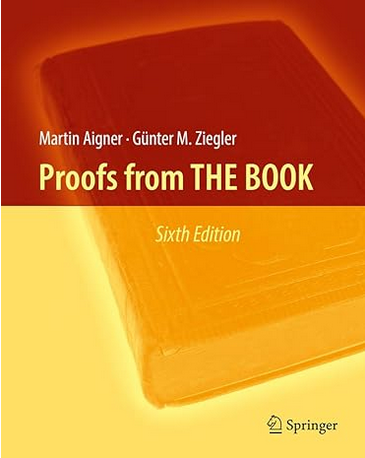
Proofs from THE BOOK 6th Edition by Martin Aigner, ISBN-13: 978-3662572641
Original price was: $50.00.$14.99Current price is: $14.99.
Safe & secure checkout
Description
Description
Proofs from THE BOOK 6th Edition by Martin Aigner, ISBN-13: 978-3662572641
[PDF eBook eTextbook]
- Publisher: Springer; 6th ed. 2018 edition (July 6, 2018)
- Language: English
- 334 pages
- ISBN-10: 3662572648
- ISBN-13: 978-3662572641
This revised and enlarged sixth edition of Proofs from THE BOOK features an entirely new chapter on Van der Waerden’s permanent conjecture, as well as additional, highly original and delightful proofs in other chapters.
From the citation on the occasion of the 2018 “Steele Prize for Mathematical Exposition”
“… It is almost impossible to write a mathematics book that can be read and enjoyed by people of all levels and backgrounds, yet Aigner and Ziegler accomplish this feat of exposition with virtuoso style. This book does an invaluable service to mathematics, by illustrating for non-mathematicians what it is that mathematicians mean when they speak about beauty.”
Table of Contents:
Preface
Preface to the Sixth Edition
Table of Contents
Number Theory
Chapter 1 Six proofs of the infinity of primes
Appendix: Infinitely many more proofs
References
Chapter 2 Bertrand’s postulate
Appendix: Some estimates
Estimating via integrals
Estimating factorials — Stirling’s formula
Estimating binomial coefficients
References
Chapter 3 Binomial coefficients are (almost) never powers
References
Chapter 4 Representing numbers as sums of two squares
References
Chapter 5 The law of quadratic reciprocity
References
Chapter 6 Every finite division ring is a field
References
Chapter 7 The spectral theorem and Hadamard’s determinant problem
References
Chapter 8 Some irrational numbers
References
Chapter 9 Four times π2/6
Appendix: The Riemann zeta function
References
Geometry
Chapter 10 Hilbert’s third problem: decomposing polyhedra
Appendix: Polytopes and polyhedra
References
Chapter 11 Lines in the plane and decompositions of graphs
Appendix: Basic graph concepts
References
Chapter 12 The slope problem
References
Chapter 13 Three applications of Euler’s formula
1. The Sylvester–Gallai theorem, revisited
2. Monochromatic lines
3. Pick’s theorem
References
Chapter 14 Cauchy’s rigidity theorem
References
Chapter 15 The Borromean rings don’t exist
Appendix: Basic notions on knots and links
References
Chapter 16 Touching simplices
References
Chapter 17 Every large point set has an obtuse angle
Appendix: Three tools from probability
References
Chapter 18 Borsuk’s conjecture
References
Analysis
Chapter 19 Sets, functions, and the continuum hypothesis
Appendix: On cardinal and ordinal numbers
References
Chapter 20 In praise of inequalities
References
Chapter 21 The fundamental theorem of algebra
References
Chapter 22 One square and an odd number of triangles
Appendix: Extending valuations
References
Chapter 23 A theorem of Pólya on polynomials
Appendix: Chebyshev’s theorem
References
Chapter 24 Van der Waerden’s permanent conjecture
References
Chapter 25 On a lemma of Littlewood and Offord
References
Chapter 26 Cotangent and the Herglotz trick
References
Chapter 27 Buffon’s needle problem
References
Combinatorics
Chapter 28 Pigeon-hole and double counting
1. Numbers
2. Sequences
3. Sums
4. Numbers again
5. Graphs
6. Sperner’s Lemma
References
Chapter 29 Tiling rectangles
References
Chapter 30 Three famous theorems on finite sets
References
Chapter 31 Shuffling cards
References
Chapter 32 Lattice paths and determinants
References
Chapter 33 Cayley’s formula for the number of trees
References
Chapter 34 Identities versus bijections
References
Chapter 35 The finite Kakeya problem
References
Chapter 36 Completing Latin squares
References
Graph Theory
Chapter 37 Permanents and the power of entropy
Appendix: More about entropy
References
Chapter 38 The Dinitz problem
References
Chapter 39 Five-coloring plane graphs
References
Chapter 40 How to guard a museum
References
Chapter 41 Turán’s graph theorem
References
Chapter 42 Communicating without errors
References
Chapter 43 The chromatic number of Kneser graphs
Appendix: A proof sketch for the Borsuk–Ulam theorem
References
Chapter 44 Of friends and politicians
References
Chapter 45 Probability makes counting (sometimes) easy
References
About the Illustrations
Index
Martin Aigner received his Ph.D. from the University of Vienna and has been professor of mathematics at the Freie Universität Berlin since 1974. He has published in various fields of combinatorics and graph theory and is the author of several monographs on discrete mathematics, among them the Springer books Combinatorial Theory and A Course on Enumeration. Martin Aigner is a recipient of the 1996 Lester R. Ford Award for mathematical exposition of the Mathematical Association of America MAA.
Günter M. Ziegler received his Ph.D. from M.I.T. and has been professor of mathematics in Berlin – first at TU Berlin, now at Freie Universität – since 1995. He has published in discrete mathematics, geometry, topology, and optimization, including the Lectures on Polytopes with Springer, as well as „Do I Count? Stories from Mathematics“. Günter M. Ziegler is a recipient of the 2006 Chauvenet Prize of the MAA for his expository writing and the 2008 Communicator award of the German Science Foundation.
Martin Aigner and Günter M. Ziegler have started their work on Proofs from THE BOOK in 1995 together with Paul Erdös. The first edition of this book appeared in 1998 – it has since been translated into 13 languages: Brazilian, Chinese, German, Farsi, French, Hungarian, Italian, Japanese, Korean, Polish, Russian, Spanish, and Turkish.
What makes us different?
• Instant Download
• Always Competitive Pricing
• 100% Privacy
• FREE Sample Available
• 24-7 LIVE Customer Support
Reviews
There are no reviews yet.