

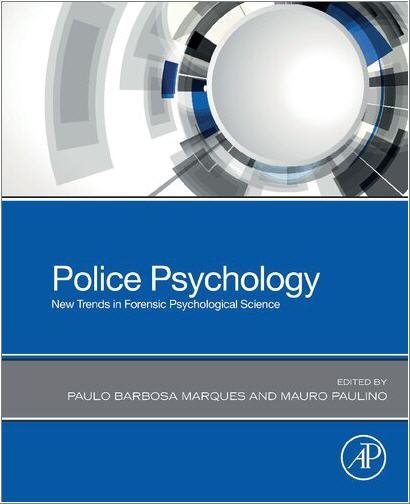
Police Psychology: New Trends in Forensic Psychological Science by Paulo Barbosa Marques, ISBN-13: 978-0128165447
Original price was: $50.00.$14.99Current price is: $14.99.
Safe & secure checkout
Description
Description
Police Psychology: New Trends in Forensic Psychological Science by Paulo Barbosa Marques, ISBN-13: 978-0128165447
[PDF eBook eTextbook]
- Publisher: Academic Press; 1st edition (October 1, 2021)
- Language: English
- 462 pages
- ISBN-10: 0128165448
- ISBN-13: 978-0128165447
Comprehensive guide that bridges the gap between researchers, practitioners and policymakers regarding the intersection of psychological sciences and law enforcement.
Table of Contents:
Cover image
Title page
Table of Contents
Copyright
Dedication
Notes on editors
About the contributors
Foreword
Introduction Police Psychology and the Impact of Psychological Science on Policing
Part I. Psychology in police culture and law enforcement agencies
Chapter 1. The ethical practice of police psychology
Introduction
Professional ethics codes and demands on police psychologists
Evidence-based policing and ethical practice
Alignment of procedural justice theory with ethical principles
Conclusions
Chapter 2. The role of the psychologist in the screening and selection of law enforcement applicants
Introduction
Selecting in applicants
Assessments that predict law enforcement performance
Screening out applicants: postconditional offer psychological evaluations
Conclusions
Chapter 3. Incorporating psychological skills in police academy training
Introduction
Cognitive skills
Emotional skills
Social skills
Moral skills
Conclusions
Chapter 4. Burnout and the psychological impact of policing: trends and coping strategies
Introduction
Defining occupational stress: burnout, compassion fatigue, and psychological trauma
Burnout, compassion fatigue, and police: review of current evidence
Personal characteristics
The impact of emotions
Moral injury
Police culture, perceptions, and risks of the job
Organizational psychology perspectives on what makes a job less stressful and more sustainable
Interventions
Not just what but how: process as well as effect
Recommendations for future research
Conclusions
Chapter 5. Trauma and critical incident exposure in law enforcement
Introduction
The nature of police traumatization
Risk and protective factors
Prevention and treatment
Conclusions
Chapter 6. From ideation to realization: exploring the problem of police officer suicide
Introduction
Are police at heightened risk of suicide? Epidemiological research
Demographics of police suicide
Factors associated with police suicide
Reducing the risk of police suicide
Conclusions
Part II. Psychology applied to policing issues
Chapter 7. Psychological jurisprudence and the role of police psychology in community psychology
Introduction
Policing youth: A police psychology review
The perceptual cues and interpersonal skills of police officers
The attributions, prejudices, and stereotypes/typing by police officers
The personality of law enforcement personnel
Policing, stress management, and exposure to aggression and violence
The psychology of recruiting, selecting, and training police officers
Psychological jurisprudence: on theory, method, and practice
Psychological jurisprudence: bridging police psychology and community psychology
Conclusions
Chapter 8. The role of psychological science in public order policing
Introduction
Classical perspectives and reactionary policing
The social identity approach—a new way of understanding the crowd
ESIM and football crowds: policing and self-regulation
Euro 2000: High and low-profile policing
Application Euro 2004—changing police psychology of the crowd
The challenge of change
Conclusions
Chapter 9. Improving police procedures for dealing with mental illness
Introduction
Public perceptions of the police
Use of force
Police training
Conclusions
Chapter 10. Communication as a weapon for resolving hostage and barricaded situations
Introduction
“Talk to Me”: A new approach
Crisis/hostage negotiation strategies
From “talk to me” to “text me”
Risk assessment in crisis/hostage negotiation
Conclusions
Chapter 11. Contributions of psychological science to enhancing law enforcement agencies’ response to intimate partner violence
Introduction
Particularities of police intervention in the context of intimate partner violence
Prediction and management of risk for intimate partner violence
Children of intimate partner violence: victims that cannot be forgotten
Communication with victims of intimate partner violence
Comparing intimate partner violence perceptions: experts, victims, and police officers
Conclusions
Chapter 12. The contribution of psychological science in police responses of sexual assaults
Introduction
Misconceptions about sex offenders
Suspect prioritization
Investigative interview
False confessions
False rape allegations
Strategies used in sexually related online crimes
Conclusions
Part III. Psychology in criminal investigation
Chapter 13. Beyond reasonable doubt: how to think like an expert detective
Introduction
Lessons from a craft tradition
Detectives are simply human
Research on detectives’ decision-making
How should good detectives think?
Generic models and supporting tools for investigative judgments and decision-making
Conclusions
Chapter 14. Developing a psychological research base for criminal investigations: academics and practitioners working together
Introduction
A model for “real-world” enquiry
Formulation
Design
Reporting, selling, and implementing the results
Conclusions
Chapter 15. Threat assessment in law enforcement: advances in the appraisal and management of violence risk by police
Introduction
Preventing harm: the convergence of risk and threat assessment and management in modern law enforcement
Principles of threat assessment and management
Methods of threat assessment and management: tradecraft for law enforcement professionals
The challenges of threat assessment and management in a law enforcement setting
Conclusions
Chapter 16. Investigative interviewing: exploring the contamination timeline of witness memory
Introduction
On the phone: the call handler interview
At the scene: the frontline interview
At the police station: the formal interview
Conclusions
Chapter 17. Is confession really necessary? The use of effective interviewing techniques to maximize disclosure from suspects
Introduction
Developing an evidence base for the PEACE framework
Conclusions
Chapter 18. Offender profiling: a review of the research and state of the field
Introduction
Origins of offender profiling
Statistical offender profiling
State of the field of offender profiling
Conclusions
Conclusion Police psychology and contemporary challenges in an uncertain world
Afterword Contributions of psychology to policing
Index
Paulo Barbosa Marques is a chartered clinical and forensic psychologist and a law enforcement officer. He began his law enforcement career serving as a frontline police officer in the Polícia de Segurança Pública (PSP) and later as a criminal investigator at the Criminal Investigation Department – Organized Crime Brigade. Paulo is now an inspector at the Serviço de Estrangeiros e Fronteiras (SEF), the Portuguese Immigration and Borders Service. He holds a Master’s in Law and Security from the Faculty of Law – NOVA University of Lisbon, a postgraduate diploma in Internal Security, and a Licentiate degree in Psychology. Over the past years, his research has focused on the police officers, prosecutors and judges perceptions of investigative interviewing operational practices and training needs in Portugal. Paulo regularly presents at conferences to both academics and practitioners.
Mauro Paulino is currently a coordinator at Mind, Institute of Clinical and Forensic Psychology (Lisbon, Portugal). He is also a forensic psychologist consultant at the Instituto Nacional de Medicina Legal e Ciências Forenses, I.P. (Gabinete Médico-Legal e Forense Península Setúbal). Mauro received his Master’s degree in Legal Medicine and Forensic Sciences at the University of Lisbon, Faculty of Medicine completing his research in the field of spousal violence. He is a PhD student at the Faculty of Psychology and Education Sciences, University of Coimbra (Portugal). He is also a member of the Center for Research in Neuropsychology and Cognitive Behavioral Intervention (CINEICC) and the Psychological Assessment and Psychometrics Laboratory (PsyAssessmentLab). He is an author and coordinator of several books and is a guest lecturer at various national and international universities.
What makes us different?
• Instant Download
• Always Competitive Pricing
• 100% Privacy
• FREE Sample Available
• 24-7 LIVE Customer Support
Reviews
There are no reviews yet.