

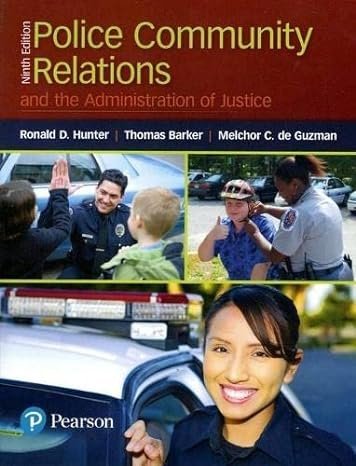
Police Community Relations and the Administration of Justice 9th Edition by Ronald Hunter, ISBN-13: 978-0134548043
$50.00 Original price was: $50.00.$19.99Current price is: $19.99.
Safe & secure checkout
Description
Description
Police Community Relations and the Administration of Justice 9th Edition by Ronald Hunter, ISBN-13: 978-0134548043
[PDF eBook eTextbook]
- Publisher: Pearson; 9th edition (January 13, 2017)
- Language: English
- 368 pages
- ISBN-10: 9780134548043
- ISBN-13: 978-0134548043
For courses in Police Community Relations or Community Policing.
An up-to-date, interdisciplinary approach to understanding and practicing positive police-community relations
Police-Community Relations and the Administration of Justice, Ninth Edition, continues the theme of citizen participation, emphasizes why it is critical to the effectiveness of the criminal justice system, and addresses the dynamic nature of police-community relations. The book focuses on the importance of and strategies for positive police-community interactions and addresses the internal and external communities the police serve. The text’s interdisciplinary approach draws data and discussions from a wide range of disciplines and gives students a well-rounded perspective to help them better understand and practice positive police-community relations. The Ninth Edition includes updated data and references throughout; new ideas for addressing the ongoing changes in police-community relations; new insights on how the police organization fits with the community it serves; enhanced information on the dynamics of policing realities; a look at the different levels of communication and how to improve communications; the relationships between the media and the police; and more.
Table of Contents:
Preface
New to This Edition
Instructor Supplements
Alternate Versions
Chapter 1 The Administration of Justice and the Police
Key Concepts
The Idea of Justice
The Need for Justice
Human Rights
Civil Rights
Justice Defined
Types of Justice
Social Justice
Civil Justice
Restorative Justice
Criminal Justice
The Core Mission and Role of the Police in the Administration of Justice
The Rule of Law
Vengeance/Retribution
Deterrence/Prevention
Treatment
Incapacitation
Reparations
Social Stability
Maintenance of Order
Equitable Social Control
Symbolic Reassurance
The Challenges of Administering Justice in a Free Society
Crime Control versus Due Process
Rights of Society
Rights of Individuals
Balancing the Rights of Society with Those of Individuals.
The Components of the U.S. Justice System
The Federalist System
Lawmaking
Law Enforcement
Prosecution
Adjudication
Corrections
The Structure of the Police System in America
Federal Police Agencies
Department of Treasury Agencies
Department of Justice Agencies
Bureau of Alcohol, Tobacco, Firearms, and Explosives.
Drug Enforcement Administration.
U.S. Marshals Service.
Federal Bureau of Investigation.
Department of Homeland Security Agencies
Customs and Border Protection.
Immigration and Customs Enforcement.
Transportation Security Administration.
The U.S. Coast Guard.
U.S. Secret Service.
Uniformed Division.
State Police Agencies
County Law Enforcement
Municipal Police
Where the Police “Fit” Within the U.S. Justice System
Conclusions
Student Checklist
Topics for Discussion
Bibliography
Appendix 1 The U.N. Universal Declaration of Human Rights
Chapter 2 Police Role Concept in a Changing Society
Key Concepts
Great Expectations
Perception
Seeing and Perceiving
Perception Is Personal
Role Concept
The Police Officer’s Roles
Crime Control
Order Maintenance
Service
Other Roles
Police Role Conflict
Formation of Role Concepts
The Sources of Role Concepts
Lack of Information
How Police Respond
The Media and Role Concepts
Factors and Conditions of Change
Reassessing the Dimensions
A World of Infinite Choices
The Paradoxes of Police Practice
Community Relations: Residue from the Past
Toward a Realistic Role Concept
The Police Officer’s Working Personality and Reality
Service versus Crime Fighting
Toward a Congruent Role
Elements of Change
Criteria for Change
Policing in a Changing Society
Conclusions
Student Checklist
Topics for Discussion
Bibliography
Chapter 3 Police–Community Relations: An Overview
Key Concepts
Understanding Community Variations
The Police–Community Environment
Defining Police–Community Relations
Acceptance of the Concept of Police–Community Relations
Acceptance as a Sign of Progress
A Historical Perspective
Nineteenth-Century Origins
Selling the Police to the People
The 1960s: From Public Relations to Community Relations
The San Francisco Community Relations Unit
Police–Community Relations since the 1960s
The Police and Social Work
The Success of Police–Community Relations
Internalizing Community Relations
What “Community Relations” Does Not Mean
What “Community Relations” Does Mean
Systems and Communities
Feedback/Input
The Many Communities in Community Relations
External Communities
The Justice Community
The Political Community
The Human Services Community
Citizens and the Police
Internal Communities
The Personal Support Community
The Police Community
Conclusions
Student Checklist
Topics for Discussion
Bibliography
Chapter 4 Public Relations and Community Relations: A Contrast
Key Concepts
Public Relations and/or Community Relations?
The Relationship
Defining Community Relations
Defining Public Relations
Common Framework for Analyzing Community and Public Relations
The Purpose of the Activity
Public Relations
Public Information
Image Enhancement
Community Relations
Processes Involved in the Activity
Public Relations
Standardization
Agency Oriented, Community Oriented, or Both
Information Flow
Hierarchical Level of Involvement
Breadth of Agency Involvement
Community Relations
Standardization
Agency Oriented, Community Oriented, or Both
Information Flow
Hierarchical Level of Involvement
Breadth of Agency Involvement
Citizen Involvement
Emerging Models of Policing and Community Participation in Policing
Public Relations
Community Relations
Why Public Relations is not Enough
Failing to Provide True Problem-Solving Mechanisms.
Reaching the Wrong Targets.
Alienating Concerned Citizens.
Dealing Ineptly with Crucial Issues.
Limited Decision-Making Power.
How Public Relations Can Strengthen Community Relations
Informing the Public About Crucial Issues
Developing Community Support
Supplementing Agency Operations and Programs
Presenting an Accurate Picture of the Agency and Its Functions
Enhancing the Agency’s Image
Program Examples
Programs with a Major Community Relations Focus
Rumor Control
Community Advisory Councils/Committees
Storefront Centers
Neighborhood Team Policing
Foot Patrol Programs
Physical Decentralization of Command
Problem-Oriented Policing
Crime Prevention: Another Name for Community Relations?
Neighborhood Watch
Operation Identification
Police Auxiliary Volunteers
Community Crime Watch
Crime Stoppers
Conclusions
Student Checklist
Topics for Discussion
Bibliography
Chapter 5 The Public and the Police: A Consortium of Communities
Key Concepts
External Communities
Ethnic/Racial Minorities
Women
Gays and Lesbians
Youth
The Elderly
The Poor
Mentally Ill
The Addicted Population
The Media
Religious Organizations
Civic Organizations
Public Service Organizations
Political Organizations
Labor Unions
Economic/Business Organizations
Community Interest Organizations
Clients
Governmental Agencies
For Better, for Worse
Internal Communities
Minorities
Gender
Sexual Preference
Police Unions
Conclusions
Student Checklist
Topics for Discussion
Bibliography
Chapter 6 Relations within the Police Organization
Key Concepts
Life Inside a Police Organization
The Formal Organization
Communications and Accountability
Structure
Organizational Components
Operations
Administration
Auxiliary Services
The Informal Organization
Activities and Effects
Police Organizational Considerations
Staff versus Line Personnel
Sworn versus Civilian Personnel
Interunit Competition
Union Issues
Managing Change
Dealing with other Employees
Dealing with Superiors
Immediate Superiors
Distant Superiors
Dealing with Subordinates
Immediate Subordinates
Distant Subordinates
Dealing with Peers
Interrelationships
Conclusions
Student Checklist
Topics for Discussion
Bibliography
Chapter 7 Coping with the Human Experience of Being a Cop
Key Concepts
The Paradoxes in Policing
What Policing Does to the Police
The Working Personality
Selection or Socialization
Social Hazards of Policing
Alienation from the Public
Police as a Minority Group
Isolation from the Family
Economic Hazards of Policing
Salary Limitations
Career Limitations
Liability Issues
Health Hazards
Violence
Accidents
Contagious Diseases
Emotional Distress Resulting from On-the-Job Stress
Mental Illness
Suicide
Post-Traumatic Stress Disorder (PTSD)
Substance Abuse
Physical Wellness Issues
Coping with Being a Cop
Selection
Training
Family Programs
Wellness Programs
Nonprofit Police Assistance Groups
The Challenges of Being a Cop and Doing Community Relations
Conclusions
Student Checklist
Topics for Discussion
Bibliography
Chapter 8 The Communication Process
Key Concepts
Communication in Action
Levels of Communication
Skin-Deep Communication (No Communication)
Intellectual Level or Cognitive Communication (Argumentation)
Heart Level or Affective Communication (Therapeutic Communication)
Gut Level or Brutally Honest Communication (Emphatic Communication)
The Process of Communication
The Elements of Communication
Sources of Distortion
A Continuing Process
Modes of Interpersonal Communication
Verbal and Paralanguage Cues
Articulation
Volume and Rate
Language
Tone of Voice
Telephone Cues
Kinesics and Proxemics Cues
Body Language
The Meaning of the Message
The Officer’s Message
Personal Space
A Territorial Imperative
Identifying Territory
Interpersonal Space
The Message of Proxemics
Symbolic Cues
Official Communication
Effective Listening
Listening as a Mental Exercise
Nonjudgmental Listening
Listening Efficiency
Some Effective Listening Facilitators
Empathy
Blocks to Effective Communication
Community Distrust of Police
Police Distrust of Community
Poor Training
Organizational Structure
Scapegoating
Simple Preferences
Active Biases
Prejudice
Discrimination
Full-Fledged Scapegoating
Why Scapegoating Occurs
Tabloid Thinking
Self-Enhancement
Peer Pressure and Conformity
Communication in a Digital Age
Strategies of Change
Achieving Mutual Respect
Improving Training
Rethinking Police Organization
Preventing Scapegoating
Conclusions
Student Checklist
Topics for Discussion
Bibliography
Chapter 9 Police Discretion and Community Relations
Key Concepts
Discretion in the System
Defining Discretion
The Elements of Discretion
Exercising Discretion in the System
Selective and Discriminatory Enforcement
A Modern Tightrope
The Administrative Choice
Operational-Level Choices
The Police Officer as Legislator, Prosecutor, and Judge
The Invisibility of the Police Officer’s Choices
Decision Making at an Administrative Level
Finding the Optimum Law Enforcement Level
Community Input
Bargaining and Law Enforcement
The Rule of Silence
Exceptions to the Rule
Decision Making at an Operational Level
Community Input
Situational Factors
Environmental Factors
Educational and Experiential Factors
Police Work Rules
Justifications for Selective Enforcement
Justification by Administration
Justification by Officers
A Question of Injustice
Four Other Common Justifications
The Question of Professionalism
Legal Authority for Selective Enforcement
What the Law Says
What the Courts Say
Writs of Mandamus
Selective Enforcement and Appropriate Guidelines
Abuse of Power
Racially Biased Policing
Lack of Support
Impact on Public Image
Structuring Police Discretion
Recognizing Discretion in Law Enforcement
Enforcement Policy Boards
Composition of the Board
Policy Implementation Units
The Courts
Review
Internal Review
Legislative Review
The Community
Looking Toward Tomorrow
Some Recommendations
A Lesson from the Past
Conclusions
Student Checklist
Topics for Discussion
Bibliography
Chapter 10 Community-Oriented Policing
Key Concepts
The Evolution of Police Service Models
The Watch and Ward
The Peelian Model
The Traditional Model
The Professional Model
The Development of Community-Oriented Police Models
Team Policing
Integrated Criminal Apprehension Program
Neighborhood Foot Patrol
Community-Oriented Policing
The Philosophical Dimension
The Strategic Dimension
The Tactical Dimension
The Organizational Dimension
Problem-Oriented Policing
Technological Advances and Community Policing
Crime Analysis Programs
Computer-Aided Dispatching
Crime Mapping
The Current Status of Community Policing
Community-Oriented Policing and Problem Solving (COPPS)
Computerized Statistics Program (COMPSTAT)
Community-Oriented Policing Applications
Forms of Patrol
Substations
Citizens Police Academies and Citizen Volunteers
Resident Officer Program
Community Action Groups
Problem-Specific Techniques
Recommendations for Implementing Community-Oriented Policing
Preparation
Gathering Information
Organizational Review
The Community
Initiation
Reorganization
Education
Training
Implementation
Preliminary Evaluation
Full Implementation
Evaluation and Monitoring
Analysis of Efforts
Conclusions
Student Checklist
Topics for Discussion
Bibliography
Chapter 11 Police–Community Relations and the Media
Key Concepts
Community Relations Context
Commitment to Crime Coverage
The Subjectivity Factor
Restricting Coverage Argument
Heavy Coverage Argument
Exploitation of Crime News
Public Reaction to Media Coverage
Conflict Between Media and Police
A Hindrance and a Help
Champions of the Innocent
A Clear Need for Guidelines
The Background
Competing Rights
Recognizing the Need for Guidelines
The Bruno Hauptmann Trial
The Assassination of President John F. Kennedy
The Trial of Dr. Sam Sheppard
The Trial of O. J. Simpson
More Recent Cases
Complicating Issues
Concerns of Victims and Witnesses
The Need to Get the Full Story
Crisis Situations
Disturbances and Unrest
Hostage and Terrorist Activity
Setting Guidelines
Information Release
The Wisconsin Guidelines
What Can be Released
What Cannot be Released
Problem Areas
Police Operational Response
Advantages of Guidelines
Crisis Guidelines for the Media
A Common Interest
A Proposal for Hostage–Terrorist Situations
Police–Community Relations
Public Information Officer
Marketing Police–Community Relations
Conclusions
Student Checklist
Topics for Discussion
Bibliography
Chapter 12 Special Populations and the Police
Key Concepts
Special Problems for the Police
Understanding the Young
The First Ten Years
Meeting Basic Needs
Children As Police Clients
The Teenage Years
A Time of Rapid Change
Development Tasks
Meeting Basic Needs
Understanding the Elderly
A Profile
Transitions into Late Adulthood
Facts about the Elderly
Physical Facts
Emotional and Functional Facts
Meeting Basic Needs
Understanding the Handicapped
The Physically Handicapped
Physiological Disorders
Physical Incapacitation
The Blind
The Deaf
The Mentally Handicapped
Learning Disorders
Mental Illness
Persons with Intellectual Disability
Understanding the Homeless
A Profile
Facts About the Homeless
Meeting Basic Needs
Youth, the Elderly, the Handicapped, and the Homeless: Shared Problems
Dependency Issues
Personal Identity Issues
Where Do I Fit?
Self-Image and Self-Esteem
Stereotyping Issues
Myths about Youth
Myth 1: All Teenagers Who Commit Delinquent Acts are Going to Be Adult Criminals
Myth 2: All Teenagers Have Severe Adjustment Problems During Adolescence
Myth 3: Teenagers Cannot Be Trusted
Myth 4: All Teenage Groups are Gangs
Myths about the Elderly
Myth 1: People Over 65 are More Often Victimized By Crime Than the Rest of the Population
Myth 2: Women Over the Age of 65 are Frequently Rape Victims
Myth 3: The Elderly are Totally Dependent on Others for Their Care And Offer No Contribution to Society
Myth 4: The Elderly Cannot Enjoy Sex Because of Physiological Difficulties
Myth 5: Intelligence Reaches A Peak in the Twenties and Declines at a Steady Rate
Myths about the Handicapped
Myth 1: Handicapped People Cannot Take Care of Themselves
Myth 2: The Mentally Ill are Dangerous and Cannot Be Trusted
Myth 3: The Mentally Retarded Do Not Know What is Going On
Myth 4: The Police Should Not Treat the Handicapped Differently from Anyone Else
Myths about the Homeless
Myth 1: Homeless People Commit More Violent Crime Than Housed People
Myth 2: Magnet Theory: Setting Up Services for Homeless People Will Cause Homeless People from All Around to Migrate to A City
Myth 3: The Chronic Theory: Homeless People are A Fixed Population Who are Usually Homeless for Long Periods of Time
Myth 4: Homeless People are Mostly Single Men
Myth 5: Homeless People Don’t Work and Get Most of Their Money from Public Assistance
Myth 6: All Homeless People are Mentally Ill Or Substance Abusers
Youth, the Elderly, the Handicapped, and the Homeless: A Few Contrasts
Interactions with the Criminal Justice System
Maturity and Life Experience
Looking Toward the Future
The Problems with Programs
Knowledge of Resources Available
Some Do Not Reach the Population They Hope to Serve
A New Approach
Police–Senior Partnerships
TRIAD Programs
Specialized Units
R.U.O.K. (Are You Okay?)
Citizens on Patrol
Senior Citizens Police Academy
Conclusions
Student Checklist
Topics for Discussion
Bibliography
Chapter 13 Community Relations in the Context of Culture
Key Concepts
The Cultural Context of Community Relations
Being Culturally Appropriate
Theories of Assimilation and the Problems of the Police
Understanding Crime
Providing Services to the Community
Overcoming Stereotypes
Discretionary Decision Making
Space
Time
Appearance
Characteristics of Culture
Cross-Cultural Factors
African Americans
New Immigrants
Hispanic Americans
Mexican Americans
Puerto Ricans
Cuban Americans
Asian Americans
Chinese Americans
Filipino Americans
Asian Indians
Vietnamese Americans
Korean Americans
Japanese Americans
Native Americans
Pacific Islanders
Hawaiian Americans
Samoan Americans
Guamanian Americans
American Indians
Eskimos and Aleuts
White Americans
European Americans
Jewish Americans
Middle-Easterners and Northern Africans
A Perspective on Diverse Cultures
Improving Community Relations in the Context of Culture
Appreciating Culture
Understanding Language
Getting Involved in Meaningful Ways
Affecting Public Policy
Making a Firm, Full Commitment
Multicultural Advisory Committees
Specific Targets
Recruitment
Training
Public Information Bulletins for Language Minorities
Ongoing Community Participation
Cultural Citizens Police Academies
The Community Relations Service (CRS)
Advocacy
Police–Community Relations Committees
Conclusions
Student Checklist
Topics for Discussion
Bibliography
Chapter 14 Maintaining Order: Dissent and Conflict Management
Key Concepts
Maintaining an Orderly Community
A New Philosophy for Conflict Management
Community Concerns and Changing Priorities
A Partnership
Exemplary Projects
Policing Political Dissent: Catalyst of Progress
Change versus Order
Why Seek Change?
The Right to Dissent
Keeping Dissent Peaceful
Acceptable Dissent
A Legalistic Position
A Pragmatic Position
A Classic Argument
Arenas for Dissent
Political Dissent
Social Dissent
Economic Dissent
Religious Dissent
Environmental Dissent
Strategies of Dissent and Response
The Labeling Process
Strategies of Dissent
Strategies of Response
Interaction between Strategies
Changes in Orientation and Strategy
Violent Actions
Resolution of the Conflict
The Role of Third Parties
The Role of the Media
Escalation and De-Escalation of Conflict
Escalation Factors
Increase in Loyalty and Commitment
Persistence in a Course of Action
Withdrawal of Moderate Membership
An upward Spiral of Violence
De-escalation Factors
Superior Coercive Power
Divide and Conquer
Third-party Involvement
A Redefinition of “Reasonable”
Success Factors
Outcomes
Determinants of Outcomes
Differences in Power
Perceived Permanence of Conflict
Perceived Instruments of Power
The Police
Responses of Violence
Police View of Dissent
Dissenters as Deliberate Provokers of Violence
Power and the Response of Order
The Police and “Dirty Work”
Political Surveillance
Agents Provocateurs
National Security
New Limits on Political Surveillance
Systems for Solution
Awareness
Education
Planning and Preparation
Human Dynamics Versus Power Tactics
Crisis Negotiations
Qualities of a Good Negotiator
Key Elements of Negotiation Training
Domestic Disturbances
Individuals in Crisis
Hostage Negotiations
A Broader Concept
Disputes between a Few People
Disputes Between Neighbors
Disputes Between Youths and Merchants
Landlord–Tenant Disputes
Disputes between Hundreds of People
Civil Disturbances Following the First Rodney King Verdict
Disputes over the Use of Public Space
Homeless People
Young People
Poor and Working-Class People
Conflict Intervention at the Community Level
Conflict Intervention Teams
The Defusement Process
Major Aspects of Conflict Intervention
SLO Solutions Program: A Community Conflict Resolution Partnership
Conclusions
Student Checklist
Topics for Discussion
Bibliography
Chapter 15 Community Participation in the New Millennium
Key Concepts
The Concept of Community Participation
What Is Community Participation?
Police Models and Community Participation
New Demands
A Clear Necessity
An Old Concept
Systems and Community Values
Problems of Community Participation
Community Resistance to Community Participation
Professional Resistance to Community Participation
Two Types of Community Participation
Regulatory Participation
Civilian Review Boards
Origins
The Controversy over the Boards
Civilian Oversight Agencies
New Concept
Nature of Agencies
The Ombudsman
Community Policing
Citizen and Community Alert Programs
Supportive Participation
Volunteers in Criminal Justice Agencies
Self-Protection Outside the System
Volunteer Patrols
Private Security
Guardian Angels
Police Attitudes Toward These Groups
Family Crisis Intervention Projects
Community Responsibility Programs
Victim–Witness Advocate Programs
Police–Community Relations in the New Millennium
Community Features and Social Controls
SFD Community Outreach Councils
Public Safety Project—Burlington, Vermont
The Impact of World and National Events on Communities
Globalization of Crime and Criminal Groups
Globalization of Protest Issues and Protest Groups
The War on Terror and Impacts of Homeland Security
Warring Against Foreign Terrorists
Al-Quaida
Iraq
Imprisoning “Foreign Combatants”
Homeland Security
Increased Security Efforts
Domestic Eavesdropping
Improving Police–Community Relations in the New Millennium
Understanding What the Police Do for Their Communities
Crime Prevention and Control
Emergency Responders to Crisis Situations
Community Problem Solvers
Choosing Community-Specific Strategies
No One Solution
Problem-Solving Policing and Community Policing
Local Strategies for Local Problems
Conclusions
Student Checklist
Topics for Discussion
Bibliography
Recommended Police-Related Web Sites
Civil/Constitutional Rights Sites
Community Policing Sites
Federal Law Enforcement Sites
Legal Organizations Sites
Legal Reference Sites
Police Employment Sites
Police Ethics Sites
Police Information Sites
Police Professional Organizations Sites
Police Publications Sites
Police Research Sites
Police Support Sites
Police Training Sites
Index
Dr. Ron Hunter holds the rank of Professor and founded the Criminal Justice and Criminology program at Georgia Gwinnett College. He received his Ph.D. in Criminology from Florida State University. He previously taught at Western Carolina University, the University of West Georgia, Jacksonville State University, and the University of North Carolina at Charlotte. He has held administrative positions of program coordinator, department head, and associate dean. Prior to entering academia Dr. Hunter was a sergeant with the Tallahassee (Florida) Police Department. Assignments included supervising the joint Tallahassee-Leon County Robbery Task Force, the Managing Criminal Information Unit, the Career Criminal Unit, the Records Section and a squad of Officers within Uniformed Patrol. He also served seven years as a part-time Municipal Judge in Cave Spring, Georgia. Dr. Hunter is a Past President of the Southern Criminal Justice Association and of the Academy of Criminal Justice Sciences. His research interests are primarily in the areas of crime prevention and law enforcement. He has published textbooks on research methods, criminological theories, robbery prevention, and police-community relations. He has published articles and presented numerous papers on a myriad of criminal justice issues.
Dr. Thomas “Tom” Barker, Professor Emeritus, School of Justice Studies from Eastern Kentucky University, has been busy since his “retirement” from teaching and moving to San Antonio, Texas in December 2013 to be close to his granddaughter. He has revised two books on Outlaw Motorcycle Gangs and North American Criminal Gangs and published another book on Biker Gangs. He has completed a book on Police Sexual Misconduct currently being reviewed for publication, and is researching and writing a book, Outlaw Bikers Legacy of Violence: Altamont to Waco, Texas. He has published an article on the Massacre at Waco―police biker shootout and the overreaction by the police. He has presented three papers at professional meetings on police misconduct and outlaw bikers and filmed a narrative for the Las Vegas Mob Museum on their Outlaw Biker display.
Melchor C. de Guzman is a professor of Criminal Justice and Criminology at Georgia Gwinnett College. He earned his doctorate degree in criminal justice from the University of Cincinnati with concentration on policing in 2001. He has extensive experiences working in the criminal justice field in the U.S. and the Philippines. Dr. de Guzman was a police instructor for middle managers and senior police officials as a lecturer with the Philippine Public Safety College. He had also formulated policies for the Philippine National Police as the Secretary of the Senate Committee on National Defense and Security in the Philippines. He has worked with the evaluation of community policing in South Bend, Indiana and the shoplifting phenomenon in Cheektowaga, NY with the Cheektowaga Police Department. Dr. de Guzman’s research includes the examination of citizen participation in the control of the police. He also investigates organizational and environmental factors that influence police behavior. He has published two edited books examining international policing practices. He has also published several articles in policing journals. His most recent research includes the utilization of websites by police departments in the delivery of police services, the implementation of policing models, and the role of the police in homeland security. Dr. de Guzman is currently involved in a National Science Foundation (NSF) grant investigating insider threats in financial institutions. He is also the current managing editor of Police Practice and Research: An International Journal and the book editor for the International Police Executive Symposium.
What makes us different?
• Instant Download
• Always Competitive Pricing
• 100% Privacy
• FREE Sample Available
• 24-7 LIVE Customer Support
Reviews
There are no reviews yet.