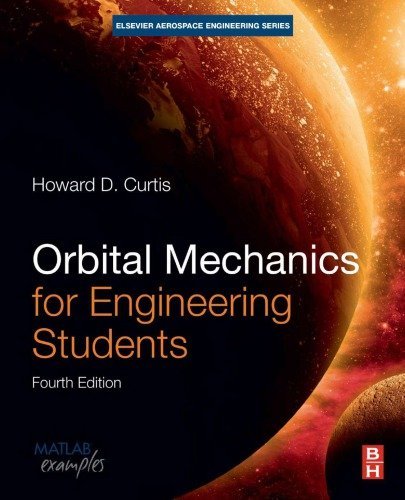
Orbital Mechanics for Engineering Students 4th Edition by Howard Curtis, ISBN-13: 978-0081021330
Original price was: $50.00.$14.99Current price is: $14.99.
Safe & secure checkout
Description
Description
Orbital Mechanics for Engineering Students 4th Edition by Howard Curtis, ISBN-13: 978-0081021330
[PDF eBook eTextbook] – Available Instantly
- Publisher: Butterworth-Heinemann; 4th edition (July 24, 2019)
- Language: English
- 792 pages
- ISBN-10: 008102133X
- ISBN-13: 978-0081021330
Visit SOLUTIONS MANUAL to accompany Orbital Mechanics for Engineering Students 4th Edition here:
https://ebookold.7hubwebsolution.com/product/solutions-manual-to-accompany-orbital-mechanics-for-engineering-students-4th-edition-isbn-13-978-0128240250/
Includes all the necessary tools to learn orbital mechanics in one volume―theory and practical examples.
Orbital Mechanics for Engineering Students, Fourth Edition, is a key text for students of aerospace engineering. While this latest edition has been updated with new content and included sample problems, it also retains its teach-by-example approach that emphasizes analytical procedures, computer-implemented algorithms, and the most comprehensive support package available, including fully worked solutions, PPT lecture slides, and animations of selected topics. Highly illustrated and fully supported with downloadable MATLAB algorithms for project and practical work, this book provides all the tools needed to fully understand the subject.
Table of Contents:
Cover image
Title page
Table of Contents
Copyright
Dedication
Preface
Supplements to the text
Acknowledgements
Chapter 1: Dynamics of point masses
Abstract
1.1: Introduction
1.2: Vectors
1.3: Kinematics
1.4: Mass, force, and Newton’s law of gravitation
1.5: Newton’s law of motion
1.6: Time derivatives of moving vectors
1.7: Relative motion
1.8: Numerical integration
Problems
Chapter 2: The two-body problem
Abstract
2.1: Introduction
2.2: Equations of motion in an inertial frame
2.3: Equations of relative motion
2.4: Angular momentum and the orbit formulas
2.5: The energy law
2.6: Circular orbits (e=0)
2.7: Elliptical orbits (0<e<1)
2.8: Parabolic trajectories (e=1)
2.9: Hyperbolic trajectories (e>1)
2.10: Perifocal frame
2.11: The Lagrange coefficients
2.12: Circular restricted three-body problem
Problems
Chapter 3: Orbital position as a function of time
Abstract
3.1: Introduction
3.2: Time since periapsis
3.3: Circular orbits (e=0)
3.4: Elliptical orbits (e<1)
3.5: Parabolic trajectories (e=1)
3.6: Hyperbolic trajectories (e>1)
3.7: Universal variables
Problems
Chapter 4: Orbits in three dimensions
Abstract
4.1: Introduction
4.2: Geocentric right ascension-declination frame
4.3: State vector and the geocentric equatorial frame
4.4: Orbital elements and the state vector
4.5: Coordinate transformation
4.6: Transformation between geocentric equatorial and perifocal frames
4.7: Effects of the earth’s oblateness
Problems
Chapter 5: Preliminary orbit determination
Abstract
5.1: Introduction
5.2: Gibbs method of orbit determination from three position vectors
5.3: Lambert’s problem
5.4: Sidereal time
5.5: Topocentric coordinate system
5.6: Topocentric equatorial coordinate system
5.7: Topocentric horizon coordinate system
5.8: Orbit determination from angle and range measurements
5.9: Angles-only preliminary orbit determination
5.10: Gauss method of preliminary orbit determination
Problems
Chapter 6: Orbital maneuvers
Abstract
6.1: Introduction
6.2: Impulsive maneuvers
6.3: Hohmann transfer
6.4: Bielliptic Hohmann transfer
6.5: Phasing maneuvers
6.6: Non-Hohmann transfers with a common apse line
6.7: Apse line rotation
6.8: Chase maneuvers
6.9: Plane change maneuvers
6.10: Nonimpulsive orbital maneuvers
Problems
Chapter 7: Relative motion and rendezvous
Abstract
7.1: Introduction
7.2: Relative motion in orbit
7.3: Linearization of the equations of relative motion in orbit
7.4: Clohessy-Wiltshire equations
7.5: Two-impulse rendezvous maneuvers
7.6: Relative motion in close-proximity circular orbits
Problems
Chapter 8: Interplanetary trajectories
Abstract
8.1: Introduction
8.2: Interplanetary Hohmann transfers
8.3: Rendezvous opportunities
8.4: Sphere of influence
8.5: Method of patched conics
8.6: Planetary departure
8.7: Sensitivity analysis
8.8: Planetary rendezvous
8.9: Planetary flyby
8.10: Planetary ephemeris
8.11: Non-Hohmann interplanetary trajectories
Problems
Chapter 9: Lunar trajectories
Abstract
9.1: Introduction
9.2: Coplanar patched conic lunar trajectories
9.3: A simplified lunar ephemeris
9.4: Patched conic lunar trajectories in three dimensions
9.5: Lunar trajectories by numerical integration
Problems
Chapter 10: Introduction to orbital perturbations
Abstract
10.1: Introduction
10.2: Cowell’s method
10.3: Encke’s method
10.4: Atmospheric drag
10.5: Gravitational perturbations
10.6: Variation of parameters
10.7: Gauss’ variational equations
10.8: Method of averaging
10.9: Solar radiation pressure
10.10: Lunar gravity
10.11: Solar gravity
Problems
Chapter 11: Rigid body dynamics
Abstract
11.1: Introduction
11.2: Kinematics
11.3: Equations of translational motion
11.4: Equations of rotational motion
11.5: Moments of inertia
11.6: Euler equations
11.7: Kinetic energy
11.8: The spinning top
11.9: Euler angles
11.10: Yaw, pitch, and roll angles
11.11: Quaternions
Problems
Chapter 12: Spacecraft attitude dynamics
Abstract
12.1: Introduction
12.2: Torque-free motion
12.3: Stability of torque-free motion
12.4: Dual-spin spacecraft
12.5: Nutation damper
12.6: Coning maneuver
12.7: Attitude control thrusters
12.8: Yo-yo despin mechanism
12.9: Gyroscopic attitude control
12.10: Gravity gradient stabilization
Problems
Chapter 13: Rocket vehicle dynamics
Abstract
13.1: Introduction
13.2: Equations of motion
13.3: The thrust equation
13.4: Rocket performance
13.5: Restricted staging in field-free space
13.6: Optimal staging
Problems
Appendix A: Physical data
Appendix B: A road map
Appendix C: Numerical integration of the n-body equations of motion
Appendix D: MATLAB scripts
Appendix outline
Chapter 1: Dynamics of Point Masses
Chapter 2: The Two-body Problem
Chapter 3: Orbital Position as a Function of Time
Chapter 4: Orbits in Three Dimensions
Chapter 5: Preliminary Orbit Determination
Chapter 6: Orbital Maneuvers
Chapter 7: Relative Motion and Rendezvous
Chapter 8: Interplanetary Trajectories
Chapter 9: Lunar Trajectories
Chapter 10: Introduction to Orbital Perturbations
Chapter 11: Rigid Body Dynamics
Chapter 12: Spacecraft Attitude Dynamics
Chapter 13: Rocket Vehicle Dynamics
Appendix E: Gravitational potential of a sphere
Appendix F: Computing the difference between nearly equal numbers
Appendix G: Direction cosine matrix in terms of the unit quaternion
Index
Professor Howard Curtis is former professor and department chair of Aerospace Engineering at Embry-Riddle Aeronautical University. He is a licensed professional engineer and is the author of two textbooks (Orbital Mechanics 3e, Elsevier 2013, and Fundamentals of Aircraft Structural Analysis, McGraw Hill 1997). His research specialties include continuum mechanics, structures, dynamics, and orbital mechanics.
What makes us different?
• Instant Download
• Always Competitive Pricing
• 100% Privacy
• FREE Sample Available
• 24-7 LIVE Customer Support