

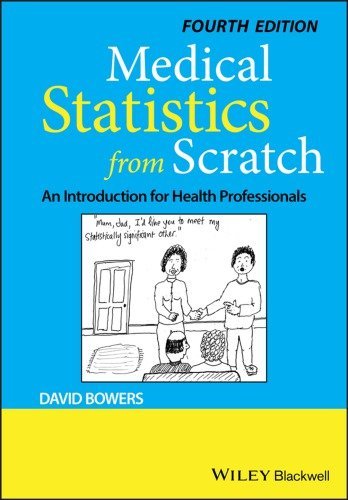
Medical Statistics from Scratch: An Introduction for Health Professionals 4th Edition, ISBN-13: 978-1119523888
Original price was: $50.00.$14.99Current price is: $14.99.
Safe & secure checkout
Description
Description
Trustpilot
Medical Statistics from Scratch: An Introduction for Health Professionals 4th Edition, ISBN-13: 978-1119523888
[PDF eBook eTextbook] – Available Instantly
- Publisher: Wiley; 4th edition (October 7, 2019)
- Language: English
- 495 pages
- ISBN-10: 1119523885
- ISBN-13: 978-1119523888
Correctly understanding and using medical statistics is a key skill for all medical students and health professionals.
In an informal and friendly style, Medical Statistics from Scratch provides a practical foundation for everyone whose first interest is probably not medical statistics. Keeping the level of mathematics to a minimum, it clearly illustrates statistical concepts and practice with numerous real-world examples and cases drawn from current medical literature.
Medical Statistics from Scratch is an ideal learning partner for all medical students and health professionals needing an accessible introduction, or a friendly refresher, to the fundamentals of medical statistics.
Table of Contents:
Cover
Preface to the 4th Edition
Preface to the 3rd Edition
Preface to the 2nd Edition
Preface to the 1st Edition
Introduction
I: Some Fundamental Stuff
1 First things first – the nature of data
Variables and data
Where are we going …?
The good, the bad, and the ugly – types of variables
Categorical data
Ordinal categorical data
Metric data
Continuous metric data
How can I tell what type of variable I am dealing with?
The baseline table
II: Descriptive Statistics
2 Describing data with tables
Descriptive statistics. What can we do with raw data?
Frequency tables – nominal data
The frequency distribution
Relative frequency
Frequency tables – ordinal data
Frequency tables – metric data
Frequency tables with discrete metric data
Cumulative frequency
Frequency tables with continuous metric data – grouping the raw data
Open‐ended groups
Cross‐tabulation – contingency tables
Ranking data
3 Every picture tells a story – describing data with charts
Picture it!
Charting nominal and ordinal data
The simple bar chart
The clustered bar chart
The stacked bar chart
Charting discrete metric data
Charting continuous metric data
The box (and whisker) plot
Charting cumulative data
The cumulative frequency curve with continuous metric data
Charting time‐based data – the time series chart
The scatterplot
The bubbleplot
4 Describing data from its shape
The shape of things to come
Skewness and kurtosis as measures of shape
Kurtosis
Symmetric or mound‐shaped distributions
Normalness – the Normal distribution
Bimodal distributions
Determining skew from a box plot
5 Measures of location – Numbers R Us
Numbers, percentages, and proportions
Preamble
Numbers, percentages, and proportions
Handling percentages – for those of us who might need a reminder
Summary measures of location
The mode
The median
The mean
Percentiles
Calculating a percentile value
What is the most appropriate measure of location?
6 Measures of spread – Numbers R Us – (again)
Preamble
The range
The interquartile range (IQR)
Estimating the median and interquartile range from the cumulative frequency curve
The boxplot (also known as the box and whisker plot)
Standard deviation
Standard deviation and the Normal distribution
Testing for Normality
Transforming data
7 Incidence, prevalence, and standardisation
Preamble
The incidence rate and the incidence rate ratio (IRR)
Prevalence
Some other useful rates
Age‐specific mortality rate
Standardisation – the age‐standardised mortality rate
The direct method
The standard population and the comparative mortality ratio (CMR)
The indirect method
The standardised mortality rate
III: The Confounding Problem
8 Confounding – like the poor, (nearly) always with us
Preamble
What is confounding?
Confounding by indication
Residual confounding
Detecting confounding
Dealing with confounding – if confounding is such a problem, what can we do about it?
Using restriction
Using matching
Using stratification
Using adjustment
Using randomisation
IV: Design and Data
9 Research design – Part I
Preamble
Hey ho! Hey ho! It’s off to work we go
Types of study
Observational studies
Ecological studies
The ecological fallacy
10 Research design – Part II: Getting stuck in – experimental studies
Clinical trials
Randomisation and the randomised controlled trial (RCT)
Block randomisation
Stratification
Blinding
The crossover RCT
Selection of participants for an RCT
Intention to treat analysis (ITT)
11 Getting the participants for your study
From populations to samples – statistical inference
Collecting the data – types of sample
The simple random sample and its offspring
The systematic random sample
The stratified random sample
The cluster sample
Consecutive and convenience samples
How many participants should we have? Sample size
Inclusion and exclusion criteria
Getting the data
V: Chance Would Be a Fine Thing
12 The idea of probability
Preamble
Calculating probability – proportional frequency
Two useful rules for simple probability
Conditional and Bayesian statistics
Probability distributions
Discrete versus continuous probability distributions
The binomial probability distribution
The Poisson probability distribution
The Normal probability distribution
13 Risk and odds
Absolute risk and the absolute risk reduction (ARR)
The risk ratio
The reduction in the risk ratio (or relative risk reduction (RRR))
A general formula for the risk ratio
Reference value
Number needed to treat (NNT)
What happens if the initial risk is small?
Confounding with the risk ratio
Odds
Why you can’t calculate risk in a case–control study
The link between probability and odds
The odds ratio
Confounding with the odds ratio
Approximating the risk ratio from the odds ratio
VI: The Informed Guess – An Introduction to Confidence Intervals
14 Estimating the value of a single population parameter – the idea of confidence intervals
Confidence interval estimation for a population mean
The standard error of the mean
How we use the standard error of the mean to calculate a confidence interval for a population mean
An example from practice
An example from practice
Confidence interval for a population proportion
Estimating a confidence interval for the median of a single population
15 Using confidence intervals to compare two population parameters
What’s the difference?
Comparing two independent population means
An example using birthweights
Assessing the evidence using the confidence interval (and was the sample size large enough?)
Comparing two paired population means
Within‐subject and between‐subject variations
Comparing two independent population proportions
An example from practice
Comparing two independent population medians – the Mann–Whitney rank sums method
An example from practice
Comparing two matched population medians – the Wilcoxon signed‐ranks method
An example from practice
16 Confidence intervals for the ratio of two population parameters
Getting a confidence interval for the ratio of two independent population means
An example from practice
Confidence interval for a population risk ratio
An example from practice
An example from practice
Confidence intervals for a population odds ratio
An example from practice
Confidence intervals for hazard ratios
VII: Putting it to the Test
17 Testing hypotheses about the difference between two population parameters
Answering the question
The hypothesis
The null hypothesis
The hypothesis testing process
The p‐value and the decision rule
A brief summary of a few of the commonest tests
Using the p‐value to compare the means of two independent populations
Interpreting computer hypothesis test results for the difference in two independent population means – the two‐sample t test
Output from Minitab – two‐sample t test of difference in mean birthweights of babies born to white mothers and to non‐white mothers
Output from SPSS: two‐sample t test of difference in mean birthweights of babies born to white mothers and to non‐white mothers
Comparing the means of two paired populations – the matched‐pairs t test
Using p‐values to compare the medians of two independent populations: the Mann–Whitney rank‐sums test
How the Mann–Whitney test works
Correction for multiple comparisons
The Bonferroni correction for multiple testing
Interpreting computer output for the Mann–Whitney test
Two matched medians – the Wilcoxon signed‐ranks test
Confidence intervals versus hypothesis testing
What could possibly go wrong?
Types of error
The power of a test
An example from practice
Maximising power – calculating sample size
Rule of thumb 1. Comparing the means of two independent populations (metric data)
Rule of thumb 2. Comparing the proportions of two independent populations (binary data)
18 The Chi‐squared (χ2) test – what, why, and how?
Of all the tests in all the world – you had to walk into my hypothesis testing procedure
Using chi‐squared to test for related‐ness or for the equality of proportions
Calculating the chi‐squared statistic
Using the chi‐squared statistic
Yate’s correction (continuity correction)
Fisher’s exact test
The chi‐squared test with Minitab
The chi‐squared test with SPSS
The chi‐squared test for trend
SPSS output for chi‐squared trend test
19 Testing hypotheses about the ratio of two population parameters
Preamble
The chi‐squared test with the risk ratio
The chi‐squared test with odds ratios
The chi‐squared test with hazard ratios
VIII: Becoming Acquainted
20 Measuring the association between two variables
Preamble – plotting data
Association
The scatterplot
The correlation coefficient
Pearson’s correlation coefficient
Is the correlation coefficient statistically significant in the population?
An example from practice
Spearman’s rank correlation coefficient
An example from practice
21 Measuring agreement
To agree or not agree: that is the question
Cohen’s kappa (κ)
Some shortcomings of kappa
Weighted kappa
Measuring the agreement between two metric continuous variables, the Bland–Altmann plot
IX: Getting into a Relationship
22 Straight line models
Health warning!
Relationship and association
A causal relationship – explaining variation
Refresher – finding the equation of a straight line from a graph
The linear regression model
First, is the relationship linear?
Estimating the regression parameters – the method of ordinary least squares (OLS)
Basic assumptions of the ordinary least squares procedure
Back to the example – is the relationship statistically significant?
Using SPSS to regress birthweight on mother’s weight
Using Minitab
Interpreting the regression coefficients
Goodness‐of‐fit, R2
Multiple linear regression
Adjusted goodness‐of‐fit:
Including nominal covariates in the regression model: design variables and coding
Building your model. Which variables to include?
Automated variable selection methods
Manual variable selection methods
Adjustment and confounding
An example from practice
Diagnostics – checking the basic assumptions of the multiple linear regression model
Analysis of variance
23 Curvy models
A second health warning!
The binary outcome variable
Finding an appropriate model when the outcome variable is binary
The logistic regression model
Estimating the parameter values
Interpreting the regression coefficients
Have we got a significant result? statistical inference in the logistic regression model
The Odds Ratio
The multiple logistic regression model
Building the model
Goodness‐of‐fit
24 Counting models
Preamble
Poisson regression
The Poisson regression equation
Estimating β1 and β2 with the estimators b0 and b1
Interpreting the estimated coefficients of a Poisson regression, b0 and b1
Model building – variable selection
Goodness‐of‐fit
Zero‐inflated Poisson regression
Negative binomial regression
Zero‐inflated negative binomial regression
X: Four More Chapters
25 Measuring survival
Preamble
Censored data
A simple example of survival in a single group
Calculating survival probabilities and the proportion surviving: the Kaplan–Meier table
The Kaplan–Meier curve
Determining median survival time
Comparing survival with two groups
The log‐rank test
An example of the log‐rank test in practice
The hazard ratio
The proportional hazards (Cox’s) regression model – introduction
The proportional hazards (Cox’s) regression model – the detail
Checking the assumptions of the proportional hazards model
An example of proportional hazards regression
26 Systematic review and meta‐analysis
Introduction
Systematic review
The forest plot
Publication and other biases
The funnel plot
Significance tests for bias – Begg’s and Egger’s tests
Combining the studies: meta‐analysis
The problem of heterogeneity – the Q and I2 tests
27 Diagnostic testing
Preamble
The measures – sensitivity and specificity
The positive prediction and negative prediction values (PPV and NPV)
The sensitivity–specificity trade‐off
Using the ROC curve to find the optimal sensitivity versus specificity trade‐off
Note
28 Missing data
The missing data problem
Types of missing data
Consequences of missing data
Dealing with missing data
Imputation methods – simple imputation
Multiple imputation
Full Information Maximum Likelihood (FIML) and other methods
Appendix Table of random numbers
References
Solutions to exercises
Chapter 1
Chapter 2
Chapter 3
Chapter 4
Chapter 5
Chapter 6. Measures of spread
Chapter 7. Incidence, prevalence, standardisation
Chapter 8. Confounding
Chapter 9. Research design Part I
Chapter 10
Chapter 11. Getting the participants
Chapter 12. The idea of probability
Chapter 13. Risk and odds
Chapter 14. Estimating the value of a single population parameter
Chapter 15
Chapter 16. Confidence intervals for ratios
Chapter 17. Testing hypotheses about the difference between two population parameters
Chapter 18. Chi‐squared test
Chapter 19. Testing hypothesis about the ratio of two population parameters
Chapter 20. Measuring association
Chapter 21. Agreement
Chapter 22. Linear regression
Chapter 23. Logistic regression
Chapter 24. Poisson regression
Chapter 25. Survival analysis
Chapter 26. Systematic review
Chapter 27. Diagnostic testing
Chapter 28. Missing data
Index
End User License Agreement
David Bowers Leeds Institute of Health Sciences, School of Medicine, University of Leeds, Leeds, UK.
What makes us different?
• Instant Download
• Always Competitive Pricing
• 100% Privacy
• FREE Sample Available
• 24-7 LIVE Customer Support


Reviews
There are no reviews yet.