

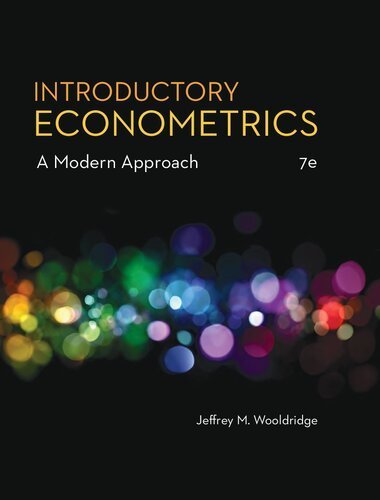
Introductory Econometrics: A Modern Approach 7th Edition by Jeffrey M. Wooldridge, ISBN-13: 978-1337558860
Original price was: $50.00.$19.99Current price is: $19.99.
Safe & secure checkout
Description
Description
Introductory Econometrics: A Modern Approach 7th Edition by Jeffrey M. Wooldridge, ISBN-13: 978-1337558860
[PDF eBook eTextbook]
- Publisher: Cengage Learning; 7th edition (January 4, 2019)
- Language: English
- 816 pages
- ISBN-10: 1337558869
- ISBN-13: 978-1337558860
Gain an understanding of how econometrics can answer today’s questions in business, policy evaluation and forecasting with Wooldridge’s INTRODUCTORY ECONOMETRICS: A MODERN APPROACH, 7E. Unlike traditional texts, this book’s practical, yet professional, approach demonstrates how econometrics has moved beyond a set of abstract tools to become genuinely useful for answering questions across a variety of disciplines. The author has organized the book’s presentation around the type of data being analyzed with a systematic approach that only introduces assumptions as they are needed. This makes the material easier to understand and, ultimately, leads to better econometric practices. Packed with relevant applications, the text incorporates more than 100 data sets in different formats. Updates introduce the latest developments in the field, including the recent advances in the so-called “causal effects” or “treatment effects,” to provide a complete understanding of the impact and importance of econometrics today.
Table of Contents:
Brief Contents
Contents
Chapter 1: The Nature of Econometrics and Economic Data
1-1 What Is Econometrics?
1-2 Steps in Empirical Economic Analysis
1-3 The Structure of Economic Data
1-3a Cross-Sectional Data
1-3b Time Series Data
1-3c Pooled Cross Sections
1-3d Panel or Longitudinal Data
1-3e A Comment on Data Structures
1-4 Causality, Ceteris Paribus, and Counterfactual Reasoning
Summary
Key Terms
Problems
Computer Exercises
Part 1: Regression Analysis with Cross-Sectional Data
Chapter 2: The Simple Regression Model
2-1 Definition of the Simple Regression Model
2-2 Deriving the Ordinary Least Squares Estimates
2-2a A Note on Terminology
2-3 Properties of OLS on Any Sample of Data
2-3a Fitted Values and Residuals
2-3b Algebraic Properties of OLS Statistics
2-3c Goodness-of-Fit
2-4 Units of Measurement and Functional Form
2-4a The Effects of Changing Units of Measurement on OLS Statistics
2-4b Incorporating Nonlinearities in Simple Regression
2-4c The Meaning of “Linear” Regression
2-5 Expected Values and Variances of the OLS Estimators
2-5a Unbiasedness of OLS
2-5b Variances of the OLS Estimators
2-5c Estimating the Error Variance
2-6 Regression through the Origin and Regression on a Constant
2-7 Regression on a Binary Explanatory Variable
2-7a Counterfactual Outcomes, Causality, and Policy Analysis
Summary
Key Terms
Problems
Computer Exercises
Chapter 3: Multiple Regression Analysis: Estimation
3-1 Motivation for Multiple Regression
3-1a The Model with Two Independent Variables
3-1b The Model with k Independent Variables
3-2 Mechanics and Interpretation of Ordinary Least Squares
3-2a Obtaining the OLS Estimates
3-2b Interpreting the OLS Regression Equation
3-2c On the Meaning of “Holding Other Factors Fixed” in Multiple Regression
3-2d Changing More Than One Independent Variable Simultaneously
3-2e OLS Fitted Values and Residuals
3-2f A “Partialling Out” Interpretation of Multiple Regression
3-2g Comparison of Simple and Multiple Regression Estimates
3-2h Goodness-of-Fit
3-2i Regression through the Origin
3-3 The Expected Value of the OLS Estimators
3-3a Including Irrelevant Variables in a Regression Model
3-3b Omitted Variable Bias: The Simple Case
3-3c Omitted Variable Bias: More General Cases
3-4 The Variance of the OLS Estimators
3-4a The Components of the OLS Variances: Multicollinearity
3-4b Variances in Misspecified Models
3-4c Estimating s2: Standard Errors of the OLS Estimators
3-5 Efficiency of OLS: The Gauss-Markov Theorem
3-6 Some Comments on the Language of Multiple Regression Analysis
3-7 Several Scenarios for Applying Multiple Regression
3-7a Prediction
3-7b Efficient Markets
3-7c Measuring the Tradeoff between Two Variables
3-7d Testing for Ceteris Paribus Group Differences
3-7e Potential Outcomes, Treatment Effects, and Policy Analysis
Summary
Key Terms
Problems
Computer Exercises
Chapter 4: Multiple Regression Analysis: Inference
4-1 Sampling Distributions of the OLS Estimators
4-2 Testing Hypotheses about a Single Population Parameter: The t Test
4-2a Testing against One-Sided Alternatives
4-2b Two-Sided Alternatives
4-2c Testing Other Hypotheses about bj
4-2d Computing p-Values for t Tests
4-2e A Reminder on the Language of Classical Hypothesis Testing
4-2f Economic, or Practical, versus Statistical Significance
4-3 Confidence Intervals
4-4 Testing Hypotheses about a Single Linear Combination of the Parameters
4-5 Testing Multiple Linear Restrictions: The F Test
4-5a Testing Exclusion Restrictions
4-5b Relationship between F and t Statistics
4-5c The R-Squared Form of the F Statistic
4-5d Computing p-values for F Tests
4-5e The F Statistic for Overall Significance of a Regression
4-5f Testing General Linear Restrictions
4-6 Reporting Regression Results
4-7 Revisiting Causal Effects and Policy Analysis
Summary
Key Terms
Problems
Computer Exercises
Chapter 5: Multiple Regression Analysis: OLS Asymptotics
5-1 Consistency
5-1a Deriving the Inconsistency in OLS
5-2 Asymptotic Normality and Large Sample Inference
5-2a Other Large Sample Tests: The Lagrange Multiplier Statistic
5-3 Asymptotic Efficiency of OLS
Summary
Key Terms
Problems
Computer Exercises
Chapter 6: Multiple Regression Analysis: Further Issues
6-1 Effects of Data Scaling on OLS Statistics
6-1a Beta Coefficients
6-2 More on Functional Form
6-2a More on Using Logarithmic Functional Forms
6-2b Models with Quadratics
6-2c Models with Interaction Terms
6-2d Computing Average Partial Effects
6-3 More on Goodness-of-Fit and Selection of Regressors
6-3a Adjusted R-Squared
6-3b Using Adjusted R-Squared to Choose between Nonnested Models
6-3c Controlling for Too Many Factors in Regression Analysis
6-3d Adding Regressors to Reduce the Error Variance
6-4 Prediction and Residual Analysis
6.4 a Confidence Intervals for Predictions
6-4b Residual Analysis
6-4c Predicting y When log(y) Is the Dependent Variable
6-4d Predicting y When the Dependent Variable Is log(y)
Summary
Key Terms
Problems
Computer Exercises
Chapter 7: Multiple Regression Analysis with Qualitative Information
7-1 Describing Qualitative Information
7-2 A Single Dummy Independent Variable
7-2a Interpreting Coefficients on Dummy Explanatory Variables When the Dependent Variable Is log(y)
7-3 Using Dummy Variables for Multiple Categories
7-3a Incorporating Ordinal Information by Using Dummy Variables
7-4 Interactions Involving Dummy Variables
7-4a Interactions among Dummy Variables
7-4b Allowing for Different Slopes
7-4c Testing for Differences in Regression Functions across Groups
7-5 A Binary Dependent Variable: The Linear Probability Model
7-6 More on Policy Analysis and Program Evaluation
7-6a Program Evaluation and Unrestricted Regression Adjustment
7-7 Interpreting Regression Results with Discrete Dependent Variables
Summary
Key Terms
Problems
Computer Exercises
Chapter 8: Heteroskedasticity
8-1 Consequences of Heteroskedasticity for OLS
8-2 Heteroskedasticity-Robust Inference after OLS Estimation
8-2a Computing Heteroskedasticity-Robust LM Tests
8-3 Testing for Heteroskedasticity
8-3a The White Test for Heteroskedasticity
8-4 Weighted Least Squares Estimation
8-4a The Heteroskedasticity Is Known up to a Multiplicative Constant
8-4b The Heteroskedasticity Function Must Be Estimated: Feasible GLS
8-4c What If the Assumed Heteroskedasticity Function Is Wrong?
8-4d Prediction and Prediction Intervals with Heteroskedasticity
8-5 The Linear Probability Model Revisited
Summary
Key Terms
Problems
Computer Exercises
Chapter 9: More on Specification and Data Issues
9-1 Functional Form Misspecification
9-1a RESET as a General Test for Functional Form Misspecification
9-1b Tests against Nonnested Alternatives
9-2 Using Proxy Variables for Unobserved Explanatory Variables
9-2a Using Lagged Dependent Variables as Proxy Variables
9-2b A Different Slant on Multiple Regression
9-2c Potential Outcomes and Proxy Variables
9-3 Models with Random Slopes
9-4 Properties of OLS under Measurement Error
9-4a Measurement Error in the Dependent Variable
9-4b Measurement Error in an Explanatory Variable
9-5 Missing Data, Nonrandom Samples, and Outlying Observations
9-5a Missing Data
9-5b Nonrandom Samples
9-5c Outliers and Influential Observations
9-6 Least Absolute Deviations Estimation
Summary
Key Terms
Problems
Computer Exercises
Part 2: Regression Analysis with Time Series Data
Chapter 10: Basic Regression Analysis with Time Series Data
10-1 The Nature of Time Series Data
10-2 Examples of Time Series Regression Models
10-2a Static Models
10-2b Finite Distributed Lag Models
10-2c A Convention about the Time Index
10-3 Finite Sample Properties of OLS under Classical Assumptions
10-3a Unbiasedness of OLS
10-3b The Variances of the OLS Estimators and the Gauss-Markov Theorem
10-3c Inference under the Classical Linear Model Assumptions
10-4 Functional Form, Dummy Variables, and Index Numbers
10-5 Trends and Seasonality
10-5a Characterizing Trending Time Series
10-5b Using Trending Variables in Regression Analysis
10-5c A Detrending Interpretation of Regressions with a Time Trend
10-5d Computing R-Squared When the Dependent Variable Is Trending
10-5e Seasonality
Summary
Key Terms
Problems
Computer Exercises
Chapter 11: Further Issues in Using OLS with Time Series Data
11-1 Stationary and Weakly Dependent Time Series
11-1a Stationary and Nonstationary Time Series
11-1b Weakly Dependent Time Series
11-2 Asymptotic Properties of OLS
11-3 Using Highly Persistent Time Series in Regression Analysis
11-3a Highly Persistent Time Series
11-3b Transformations on Highly Persistent Time Series
11-3c Deciding Whether a Time Series Is I(1)
11-4 Dynamically Complete Models and the Absence of Serial Correlation
11-5 The Homoskedasticity Assumption for Time Series Models
Summary
Key Terms
Problems
Computer Exercises
Chapter 12: Serial Correlation and Heteroskedasticity in Time Series Regressions
12-1 Properties of OLS with Serially Correlated Errors
12-1a Unbiasedness and Consistency
12-1b Efficiency and Inference
12-1c Goodness-of-Fit
12-1d Serial Correlation in the Presence of Lagged Dependent Variables
12-2 Serial Correlation–Robust Inference after OLS
12-3 Testing for Serial Correlation
12-3a A t Test for AR(1) Serial Correlation with Strictly Exogenous Regressors
12-3b The Durbin-Watson Test under Classical Assumptions
12-3c Testing for AR(1) Serial Correlation without Strictly Exogenous Regressors
12-3d Testing for Higher-Order Serial Correlation
12-4 Correcting for Serial Correlation with Strictly Exogenous Regressors
12-4a Obtaining the Best Linear Unbiased Estimator in the AR(1) Model
12-4b Feasible GLS Estimation with AR(1) Errors
12-4c Comparing OLS and FGLS
12-4d Correcting for Higher-Order Serial Correlation
12-4e What if the Serial Correlation Model Is Wrong?
12-5 Differencing and Serial Correlation
12-6 Heteroskedasticity in Time Series Regressions
12-6a Heteroskedasticity-Robust Statistics
12-6b Testing for Heteroskedasticity
12-6c Autoregressive Conditional Heteroskedasticity
12-6d Heteroskedasticity and Serial Correlation in Regression Models
Summary
Key Terms
Problems
Computer Exercises
Part 3: Advanced Topics
Chapter 13: Pooling Cross Sections across Time: Simple Panel Data Methods
13-1 Pooling Independent Cross Sections across Time
13-1a The Chow Test for Structural Change across Time
13-2 Policy Analysis with Pooled Cross Sections
13-2a Adding an Additional Control Group
13-2b A General Framework for Policy Analysis with Pooled Cross Sections
13-3 Two-Period Panel Data Analysis
13-3a Organizing Panel Data
13-4 Policy Analysis with Two-Period Panel Data
13-5 Differencing with More Than Two Time Periods
13-5a Potential Pitfalls in First Differencing Panel Data
Summary
Key Terms
Problems
Computer Exercises
Chapter 14: Advanced Panel Data Methods
14-1 Fixed Effects Estimation
14-1a The Dummy Variable Regression
14-1b Fixed Effects or First Differencing?
14-1c Fixed Effects with Unbalanced Panels
14-2 Random Effects Models
14-2a Random Effects or Pooled OLS?
14-2b Random Effects or Fixed Effects?
14-3 The Correlated Random Effects Approach
14-3a Unbalanced Panels
14-4 General Policy Analysis with Panel Data
14-4a Advanced Considerations with Policy Analysis
14-5 Applying Panel Data Methods to Other Data Structures
Summary
Key Terms
Problems
Computer Exercises
Chapter 15: Instrumental Variables Estimation and Two-Stage Least Squares
15-1 Motivation: Omitted Variables in a Simple Regression Model
15-1a Statistical Inference with the IV Estimator
15-1b Properties of IV with a Poor Instrumental Variable
15-1c Computing R-Squared after IV Estimation
15-2 IV Estimation of the Multiple Regression Model
15-3 Two-Stage Least Squares
15-3a A Single Endogenous Explanatory Variable
15-3b Multicollinearity and 2SLS
15-3c Detecting Weak Instruments
15-3d Multiple Endogenous Explanatory Variables
15-3e Testing Multiple Hypotheses after 2SLS Estimation
15-4 IV Solutions to Errors-in-Variables Problems
15-5 Testing for Endogeneity and Testing Overidentifying Restrictions
15-5a Testing for Endogeneity
15-5b Testing Overidentification Restrictions
15-6 2SLS with Heteroskedasticity
15-7 Applying 2SLS to Time Series Equations
15-8 Applying 2SLS to Pooled Cross Sections and Panel Data
Summary
Key Terms
Problems
Computer Exercises
Chapter 16: Simultaneous Equations Models
16-1 The Nature of Simultaneous Equations Models
16-2 Simultaneity Bias in OLS
16-3 Identifying and Estimating a Structural Equation
16-3a Identification in a Two-Equation System
16-3b Estimation by 2SLS
16-4 Systems with More Than Two Equations
16-4a Identification in Systems with Three or More Equations
16-4b Estimation
16-5 Simultaneous Equations Models with Time Series
16-6 Simultaneous Equations Models with Panel Data
Summary
Key Terms
Problems
Computer Exercises
Chapter 17: Limited Dependent Variable Models and Sample Selection Corrections
17-1 Logit and Probit Models for Binary Response
17-1a Specifying Logit and Probit Models
17-1b Maximum Likelihood Estimation of Logit and Probit Models
17-1c Testing Multiple Hypotheses
17-1d Interpreting the Logit and Probit Estimates
17-2 The Tobit Model for Corner Solution Responses
17-2a Interpreting the Tobit Estimates
17-2b Specification Issues in Tobit Models
17-3 The Poisson Regression Model
17-4 Censored and Truncated Regression Models
17-4a Censored Regression Models
17-4b Truncated Regression Models
17-5 Sample Selection Corrections
17-5a When Is OLS on the Selected Sample Consistent?
17-5b Incidental Truncation
Summary
Key Terms
Problems
Computer Exercises
Chapter 18: Advanced Time Series Topics
18-1 Infinite Distributed Lag Models
18-1a The Geometric (or Koyck) Distributed Lag Model
18-1b Rational Distributed Lag Models
18-2 Testing for Unit Roots
18-3 Spurious Regression
18-4 Cointegration and Error Correction Models
18-4a Cointegration
18-4b Error Correction Models
18-5 Forecasting
18-5a Types of Regression Models Used for Forecasting
18-5b One-Step-Ahead Forecasting
18-5c Comparing One-Step-Ahead Forecasts
18-5d Multiple-Step-Ahead Forecasts
18-5e Forecasting Trending, Seasonal, and Integrated Processes
Summary
Key Terms
Problems
Computer Exercises
Chapter 19: Carrying Out an Empirical Project
19-1 Posing a Question
19-2 Literature Review
19-3 Data Collection
19-3a Deciding on the Appropriate Data Set
19-3b Entering and Storing Your Data
19-3c Inspecting, Cleaning, and Summarizing Your Data
19-4 Econometric Analysis
19-5 Writing an Empirical Paper
19-5a Introduction
19-5b Conceptual (or Theoretical) Framework
19-5c Econometric Models and Estimation Methods
19-5d The Data
19-5e Results
19.5f Conclusions
19-5g Style Hints
Summary
Key Terms
Sample Empirical Projects
List of Journals
Data Sources
Math Refresher A Basic Mathematical Tools
A-1 The Summation Operator and Descriptive Statistics
A-2 Properties of Linear Functions
A-3 Proportions and Percentages
A-4 Some Special Functions and Their Properties
A-4a Quadratic Functions
A-4b The Natural Logarithm
A-4c The Exponential Function
A-5 Differential Calculus
Summary
Key Terms
Problems
Math Refresher B Fundamentals of Probability
B-1 Random Variables and Their Probability Distributions
B-1a Discrete Random Variables
B-1b Continuous Random Variables
B-2 Joint Distributions, Conditional Distributions, and Independence
B-2a Joint Distributions and Independence
B-2b Conditional Distributions
B-3 Features of Probability Distributions
B-3a A Measure of Central Tendency: The Expected Value
B-3b Properties of Expected Values
B-3c Another Measure of Central Tendency: The Median
B-3d Measures of Variability: Variance and Standard Deviation
B-3e Variance
B-3f Standard Deviation
B-3g Standardizing a Random Variable
B-3h Skewness and Kurtosis
B-4 Features of Joint and Conditional Distributions
B-4a Measures of Association: Covariance and Correlation
B-4b Covariance
B-4c Correlation Coefficient
B-4d Variance of Sums of Random Variables
B-4e Conditional Expectation
B-4f Properties of Conditional Expectation
B-4g Conditional Variance
B-5 The Normal and Related Distributions
B-5a The Normal Distribution
B-5b The Standard Normal Distribution
B-5c Additional Properties of the Normal Distribution
B-5d The Chi-Square Distribution
B-5e The t Distribution
B-5f The F Distribution
Summary
Key Terms
Problems
Math Refresher C Fundamentals of Mathematical Statistics
C-1 Populations, Parameters, and Random Sampling
C-1a Sampling
C-2 Finite Sample Properties of Estimators
C-2a Estimators and Estimates
C-2b Unbiasedness
C-2c The Sampling Variance of Estimators
C-2d Efficiency
C-3 Asymptotic or Large Sample Properties of Estimators
C-3a Consistency
C-3b Asymptotic Normality
C-4 General Approaches to Parameter Estimation
C-4a Method of Moments
C-4b Maximum Likelihood
C-4c Least Squares
C-5 Interval Estimation and Confidence Intervals
C-5a The Nature of Interval Estimation
C-5b Confidence Intervals for the Mean from a Normally Distributed Population
C-5c A Simple Rule of Thumb for a 95% Confidence Interval
C-5d Asymptotic Confidence Intervals for Nonnormal Populations
C-6 Hypothesis Testing
C-6a Fundamentals of Hypothesis Testing
C-6b Testing Hypotheses about the Mean in a Normal Population
C-6c Asymptotic Tests for Nonnormal Populations
C-6d Computing and Using p-Values
C-6e The Relationship between Confidence Intervals and Hypothesis Testing
C-6f Practical versus Statistical Significance
C-7 Remarks on Notation
Summary
Key Terms
Problems
Advanced Treatment D Summary of Matrix Algebra
D-1 Basic Definitions
D-2 Matrix Operations
D-2a Matrix Addition
D-2b Scalar Multiplication
D-2c Matrix Multiplication
D-2d Transpose
D-2e Partitioned Matrix Multiplication
D-2f Trace
D-2g Inverse
D-3 Linear Independence and Rank of a Matrix
D-4 Quadratic Forms and Positive Definite Matrices
D-5 Idempotent Matrices
D-6 Differentiation of Linear and Quadratic Forms
D-7 Moments and Distributions of Random Vectors
D-7a Expected Value
D-7b Variance-Covariance Matrix
D-7c Multivariate Normal Distribution
D-7d Chi-Square Distribution
D-7e t Distribution
D-7f F Distribution
Summary
Key Terms
Problems
Advanced Treatment E The Linear Regression Model in Matrix Form
E-1 The Model and Ordinary Least Squares Estimation
E-1a The Frisch-Waugh Theorem
E-2 Finite Sample Properties of OLS
E-3 Statistical Inference
E-4 Some Asymptotic Analysis
E-4a Wald Statistics for Testing Multiple Hypotheses
Summary
Key Terms
Problems
Answers to Going Further Questions
Statistical Tables
References
Glossary
Index
Jeffrey M. Wooldridge is University Distinguished Professor of Economics at Michigan State University, where he has taught since 1991. From 1986 to 1991, he was an assistant professor of economics at the Massachusetts Institute of Technology. He received his bachelor of arts, with majors in computer science and economics, from the University of California, Berkeley, in 1982, and received his doctorate in economics in 1986 from the University of California, San Diego. He has published more than 60 articles in internationally recognized journals, as well as several book chapters. He is also the author of Econometric Analysis of Cross Section and Panel Data, second edition. His awards include an Alfred P. Sloan Research Fellowship, the Plura Scripsit award from Econometric Theory, the Sir Richard Stone prize from the Journal of Applied Econometrics, and three graduate teacher-of-the-year awards from MIT. He is a fellow of the Econometric Society and of the Journal of Econometrics. He is past editor of the Journal of Business and Economic Statistics, and past econometrics coeditor of Economics Letters. He has served on the editorial boards of Econometric Theory, the Journal of Economic Literature, the Journal of Econometrics, the Review of Economics and Statistics, and the Stata Journal. He has also acted as an occasional econometrics consultant for Arthur Andersen, Charles River Associates, the Washington State Institute for Public Policy, Stratus Consulting, and Industrial Economics, Incorporated.
What makes us different?
• Instant Download
• Always Competitive Pricing
• 100% Privacy
• FREE Sample Available
• 24-7 LIVE Customer Support

Reviews
There are no reviews yet.