

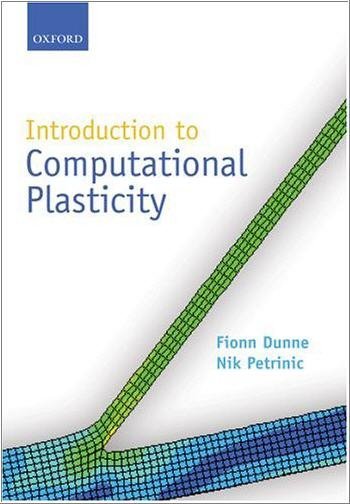
Introduction to Computational Plasticity 1st Edition by Fionn Dunne, ISBN-13: 978-0198568261
Original price was: $50.00.$14.99Current price is: $14.99.
Safe & secure checkout
Description
Description
Trustpilot
Introduction to Computational Plasticity 1st Edition by Fionn Dunne, ISBN-13: 978-0198568261
[PDF eBook eTextbook] – Available Instantly
- Publisher: Oxford University Press; 1st edition (August 18, 2005)
- Language: English
- 241 pages
- ISBN-10: 0198568266
- ISBN-13: 978-0198568261
This book gives an introduction to computational plasticity and includes the kinematics of large deformations, together with relevant continuum mechanics. Central to the book is its focus on computational plasticity, and we cover an introduction to the finite element method which includes both quasi-static and dynamic problems. We then go on to describe explicit and implicit implementations of plasticity models in to finite element software. Throughout the book, we describe the general, multiaxial form of the theory but uniquely, wherever possible, reduce the equations to their simplest, uniaxial form to develop understanding of the general theory and we hope physical insight. We provide several examples of implicit and explicit implementations of von Mises time-independent and visco-plasticity in to the commercial code ABAQUS (including the fortran coding), which should prove invaluable to research students and practicing engineers developing ABAQUS ‘UMATs’. The book bridges the gap between undergraduate material on plasticity and existing advanced texts on nonlinear computational mechanics, which makes it ideal for students and practicing engineers alike. It introduces a range of engineering applications, including superplasticity, porous plasticity, cyclic plasticity and thermo-mechanical fatigue, to emphasize the subject’s relevance and importance.
Table of Contents:
Contents
Acknowledgements
Notation
Part I. Microplasticity and continuum plasticity
1. Microplasticity
1.1 Introduction
1.2 Crystal slip
1.3 Critical resolved shear stress
1.4 Dislocations
Further reading
2. Continuum plasticity
2.1 Introduction
2.2 Some preliminaries
2.3 Yield criterion
2.4 Isotropic hardening
2.5 Kinematic hardening
2.6 Combined isotropic and kinematic hardening
2.7 Viscoplasticity and creep
Further reading
3. Kinematics of large deformations and continuum mechanics
3.1 Introduction
3.2 The deformation gradient
3.3 Measures of strain
3.4 Interpretation of strain measures
3.5 Polar decomposition
3.6 Velocity gradient, rate of deformation, and continuum spin
3.7 Elastic–plastic coupling
3.8 Objective stress rates
3.9 Summary
Further reading
4. The finite element method for static and dynamic plasticity
4.1 Introduction
4.2 Hamilton’s principle
4.3 Introduction to the finite element method
4.4 Finite element equilibrium equations
4.5 Integration of momentum balance and equilibrium equations
Further reading
5. Implicit and explicit integration of von Mises plasticity
5.1 Introduction
5.2 Implicit and explicit integration of constitutive equations
5.3 Material Jacobian
5.4 Kinematic hardening
5.5 Implicit integration in viscoplasticity
5.6 Incrementally objective integration for large deformations
Further reading
6. Implementation of plasticity models into finite element code
6.1 Introduction
6.2 Elasticity implementation
6.3 Verification of implementations
6.4 Isotropic hardening plasticity implementation
6.5 Large deformation implementations
6.6 Elasto-viscoplasticity implementation
Part II: Plasticity models
7. Superplasticity
7.1 Introduction
7.2 Some properties of superplastic alloys
7.3 Constitutive equations for superplasticity
7.4 Multiaxial constitutive equations and applications
References
8. Porous plasticity
8.1 Introduction
8.2 Finite element implementation of the porous material constitutive equations
8.3 Application to consolidation of Ti–MMCs
References
9. Creep in an aero-engine combustor material
9.1 Introduction
9.2 Physically based constitutive equations
9.3 Multiaxial implementation into ABAQUS
References
Appendix 9.1
10. Cyclic plasticity, creep, and TMF
10.1 Introduction
10.2 Constitutive equations for cyclic plasticity
10.3 Constitutive equations for C263 undergoing TMF
References
Appendix A: Elements of tensor algebra
Differentiation
The chain rule
Rotation
Appendix B: Fortran coding available via the OUP website
Index
Dr. Fionn Dunne is Reader in Engineering Science at the University of Oxford.
Dr. Nik Petrinic is Lecturer in Engineering Science at the University of Oxford.
What makes us different?
• Instant Download
• Always Competitive Pricing
• 100% Privacy
• FREE Sample Available
• 24-7 LIVE Customer Support



Reviews
There are no reviews yet.