

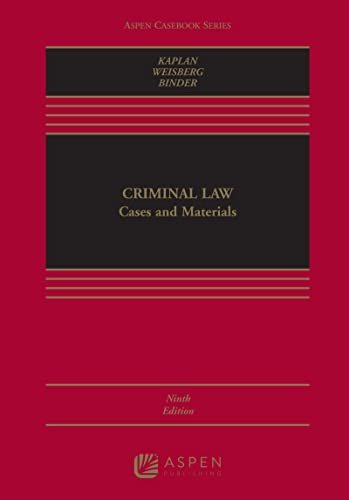
Criminal Law: Cases and Materials 9th Edition by John Kaplan, ISBN-13: 978-1543810783
Original price was: $100.00.$19.99Current price is: $19.99.
Safe & secure checkout
Description
Description
Trustpilot
Criminal Law: Cases and Materials 9th Edition by John Kaplan, ISBN-13: 978-1543810783
[PDF eBook eTextbook] – Available Instantly
- Publisher: Wolters Kluwer; 9th edition (February 19, 2021)
- Language: English
- 1218 pages
- ISBN-10: 1543810780
- ISBN-13: 978-1543810783
Criminal Law: Cases and Materials has long been respected for its distinguished authorship. The late John Kaplan’s extraordinary work continues with the scholarship of Robert Weisberg and Guyora Binder in the Ninth Edition. This casebook’s renowned interdisciplinary approach fuels class discussion as it enriches study. Logically organized, the text addresses the purposes and limits of punishment and considers the meaning and types of crime. Well-edited cases, interesting materials, and clear notes combine with cutting-edge issues and important social questions, such as whom and why we punish. Especially strong are the sections addressing the phenomenon of mass incarceration (including the movement towards prison abolition), the theme of and challenges to racial justice in our criminal law system, and the evolution of our laws on sexual assault.
New to the Ninth Edition:
- Addition of up-to-date empirical and public policy research as well as expanded discussion of the role of constitutional law in the criminalization of homelessness, and issues of racial justice on such topics as criminal liability of police for use of lethal force and the controversies over citizen’s arrest powers.
- Incorporation of new feminist research in such areas as battered women’s self-defense and sexual assault (including treatment of the ongoing efforts to revise the Model Penal Code laws on rape).
- New historically informed treatment of felony murder, including legislative and judicial developments in reform and possible abolition of felony murder doctrine.
- Updated notes and questions aimed at improving the casebook’s usefulness for exam preparation.
- New case law on the challenges of applying criminal law in the Internet world on such topics as possession of child pornography images and criminal conduct through cyber-messaging.
- A fresh new analytic guide on “impossible attempts”, designed to assist students with this perennially challenging doctrine.
Professors and student will benefit from:
- Strong authorship team: The late John Kaplan, a storied teacher and scholar; Weisberg and Binder, noted scholars in criminal law
- An interdisciplinary approach
- Well-edited cases, interesting materials, and clear notes
- Logical organization
- “Snapshot Review” exercises to aid students in exam preparation.
Table of Contents:
Cover Page
Front Matter
Editorial Advisors
Title Page
Copyright Page
About Aspen Publishing
Dedication
Summary of Contents
Contents
Preface
Acknowledgments
Special Notice
Introduction
A. The Career of a Criminal Case
1. Procedure Before Trial
Donald Dripps, Criminal Justice Process
2. Substantive Legal Issues Before Trial
3. Procedure at Trial
4. Substantive Legal Issues on Appeal
B. Sources of Criminal Law
1. Statutes
2. Precedent
3. Constitutions
C. The Analysis of Criminal Liability
1. The Purpose of Analysis
2. The Model Penal Code Scheme
3. The German Scheme
D. Burdens of Proof and Due Process
I Just Punishment
New York Penal Law (Mckinney 2020)
1 The Purposes and Limits of Punishment
A. An Introductory Problem
Notes and Questions
B. Utilitarianism and Retributivism
John Braithwaite & Philip Pettit, Not Just Deserts: A Republican Theory of Criminal Justice
C. Utilitarian Punishment
1. The Utility Principle as a Limit on Punishment
Jeremy Bentham, The Theory of Legislation
2. Deterrence
Jeremy Bentham, The Theory of Legislation
James Q. Wilson, Thinking About Crime
Anthony N. Doob & Cheryl Marie Webster, Sentence Severity and Crime: Accepting the Null Hypothesis
Louis Seidman, Soldiers, Martyrs, and Criminal Law: Utilitarianism and the Problem of Crime Control
Randolph Roth, American Homicide
Notes and Questions
3. Rehabilitation
David Rothman, The Discovery of the Asylum
Edward L. Rubin, The Inevitability of Rehabilitation
Francis A. Allen, Criminal Justice, Legal Values, and the Rehabilitative Ideal
Elliot Currie, Confronting Crime: An American Challenge
Michael Tonry, Malign Neglect: Race, Crime, and Punishment in America
Notes and Questions
4. Incapacitation
James Q. Wilson, Thinking About Crime
Alfred Blumstein & Jacqueline Cohen, Characterizing Criminal Careers
Franklin E. Zimring & Gordon Hawkins, Incapacitation: Penal Confinement and the Restraint of Crime
Markus Dirk Dubber, Recidivist Statutes as Arational Punishment
Notes and Questions
D. Retribution
1. Retribution as a Limit on Punishment
H.J. McCloskey, A Non-Utilitarian Approach to Punishment
John Rawls, Two Concepts of Rules
Guyora Binder & Nicholas J. Smith, Framed: Utilitarianism and Punishment of the Innocent
Herbert Packer, The Limits of the Criminal Sanction
Alan H. Goldman, The Paradox of Punishment
David Dolinko, Three Mistakes of Retributivism
Michael L. Corrado, The Abolition of Punishment
Kansas v. Hendricks
Notes and Questions
2. Retribution as an Affirmative Justification for Punishment
a. The Appeal to Intuition
Michael Moore, Law and Psychiatry
Notes and Questions
b. The Argument from Social Contract
Herbert Morris, On Guilt and Innocence
Jeffrie Murphy, Marxism and Retribution
Notes and Questions
c. The Expressive Argument
Joel Feinberg, Doing and Deserving
Jean Hampton, Punishment as Defeat
Notes and Questions
E. Alternatives to Mass Incarceration
John Braithwaite, Crime, Shame, and Reintegration
Angela Y. Davis, Are Prisons Obsolete?
Notes and Questions
Snapshot Review
F. Proportionality
Graham v. Florida
Notes and Questions
Kennedy v. Louisiana
Notes and Questions
Ewing v. California
Notes and Questions
Miller v. Alabama
Notes and Questions
G. Modern Guidelines Sentencing
Kevin Reitz, Sentencing: Guidelines
1. Due Process, the Jury, and Sentencing Designs
Apprendi v. New Jersey
Notes and Questions
2. The Blakely-Booker Revolution in Sentencing
Notes and Questions
Snapshot Review
II The Elements of the Criminal Offense
2 The Criminal Act
A. The Need for an Actus Reus
Proctor v. State
Notes and Questions
B. Omissions
Jones v. United States
Notes and Questions
C. Possession
United States v. Maldonado
Notes and Questions
State v. Barger
Notes and Questions
D. The Requirement of Harm
Lawrence v. Texas
Notes and Questions
E. The Requirement of Voluntariness
People v. Newton
Notes and Questions
Martin v. State
Notes and Questions
People v. Grant
Notes and Questions
F. The Prohibition of “Status” Crimes
Robinson v. California
Notes and Questions
Johnson v. State
Notes and Questions
G. Legality
Keeler v. Superior Court
Notes and Questions
United States v. Hudson and Goodwin
Notes and Questions
Rogers v. Tennessee
Notes and Questions
H. Specificity
Chicago v. Morales
Notes and Questions
Snapshot Review
3 The Guilty Mind
A. The Requirement of a Guilty Mind
People v. Dillard
Notes and Questions
United States v. Wulff
Notes and Questions
Lambert v. California
Notes and Questions
Snapshot Review
B. Categories of Culpability
Regina v. Faulkner
Notes and Questions
Model Penal Code
Notes and Questions
Snapshot Review
C. Mistake and Mens Rea Default Rules
Regina v. Prince
Notes and Questions
People v. Ryan
Notes and Questions
Elonis v. United States
Notes and Questions
Snapshot Review
D. “Mistake of Law”
1. Introduction to Mistake of Law
2. Mistake of Law and Mens Rea
People v. Bray
Notes and Questions
United States v. Baker
Notes and Questions
Cheek v. United States
Notes and Questions
3. Mistake of Law as an Excuse
Commonwealth v. Twitchell
Notes and Questions
E. Capacity for Mens Rea
Hendershott v. People
Notes and Questions
State v. Cameron
Notes and Questions
Montana v. Egelhoff
Notes and Questions
Snapshot Review
4 Causation
A. “But-For” Causation
Regina v. Martin Dyos
Notes and Questions
R. v. Benge
Notes and Questions
B. Violent Acts
Hubbard v. Commonwealth
Notes and Questions
C. Proximate Cause: Foreseeability and Related Limitations
Commonwealth v. Rhoades
Notes and Questions
Snapshot Review
D. Intervening Causes
Commonwealth v. Root
Notes and Questions
United States v. Hamilton
Notes and Questions
Stephenson v. State
Notes and Questions
People v. Kevorkian
Notes and Questions
E. Causation by Omission: Duties
Commonwealth v. Levesque
Notes and Questions
Snapshot Review
III Homicide Offenses
Kan. Stat. Ann. (West 2020)
Ala. Code (West 2020)
Cal. Penal Code (West 2020)
Pa. Cons. Stat. Ann. Tit. 18 (West 2020)
Illinois Compiled Statutes Ann. (West 2020)
Minnesota Statutes Ann. (West 2020)
Model Penal Code (1962 Official Draft, 2012 Edition)
New York Penal Code (McKinney 2020)
5 Intentional Homicide
A. Intentional Murder (Second Degree)
Francis v. Franklin
Notes and Questions
B. Premeditated Murder (First Degree)
United States v. Watson
Notes and Questions
C. Voluntary Manslaughter
1. The Theory of Mitigation
People v. Walker
Notes and Questions
2. “Cooling Time”
Ex Parte Fraley
Notes and Questions
3. Adultery as “Adequate Provocation”
Rowland v. State
Notes and Questions
Snapshot Review
4. Provocation Under Reform Rules
People v. Berry
Notes and Questions
5. Cultural Norms and the Reasonable Person
People v. Wu
Notes and Questions
Snapshot Review
6 Unintentional Homicide
A. Involuntary Manslaughter: Negligent and Reckless Homicide
Commonwealth v. Welansky
Notes and Questions
State v. Williams
Notes and Questions
B. Reckless Murder
Mayes v. The People
Notes and Questions
C. Homicide in the Course of Another Crime
1. Felony Murder: An Introduction
State v. Martin
Notes and Questions
Commonwealth v. Brown
Notes and Questions
2. Attribution of Death to the Felony
a. Felony-Murder Liability of Accomplices
Notes and Questions
b. Felony-Murder Liability for Defensive Killings
People v. Washington
Notes and Questions
People v. Hickman
Notes and Questions
c. Spatial, Temporal, and Purposive Scope of the Felony
3. The Independent Felonious Purpose Limitation
State v. Shock
Notes and Questions
4. Two Variants of Felony Murder
a. Misdemeanor Manslaughter
b. Death-Aggravated Felonies
Snapshot Review
7 Capital Murder and the Death Penalty
A. A Historical and Constitutional Summary
B. The New Capital Statutes
1. The Structure of “Guided Discretion”: An Exemplary Case
Olsen v. State
Notes and Questions
2. Mitigating Circumstances
3. Weighing the Circumstances
C. Categorical Limits on the Death Penalty
1. The Mens Rea Limit: A Reprise on Felony Murder
Tison v. Arizona
Notes and Questions
2. Victim/Race Discrimination and the Eighth Amendment
McCleskey v. Kemp
Notes and Questions
Snapshot Review
IV Justification and Excuse
A. Distinguishing Justification and Excuse
B. Justification, Excuse, and the Purposes of Punishment
C. Combining Justification and Excuse
8 Defensive Force, Necessity, and Duress
A. Defensive Force
1. Elements and Rationales
People v. La Voie
Notes and Questions
People v. Gleghorn
Notes and Questions
2. The Reasonable Self-Defender: The Case of the Battered Spouse
State v. Leidholm
Notes and Questions
3. Reprise on the Reasonable Self-Defender
People v. Goetz
Notes and Questions
4. Defensive Force to Protect Property; Defense of Habitation
People v. Ceballos
Notes and Questions
5. Defensive Force and Law Enforcement
Tennessee v. Garner
Notes and Questions
B. Choice of Evils — Necessity
1. The Moral Issue
The Queen v. Dudley & Stephens
Notes and Questions
2. Escape from Intolerable Prison Conditions
People v. Unger
Notes and Questions
3. “Political” Necessity
State v. Warshow
Notes and Questions
C. Duress
State v. Crawford
Notes and Questions
State v. Hunter
Notes and Questions
Snapshot Review
9 Mental Illness as a Defense
A. Introduction
B. The M’Naghten Rule and Cognition
People v. Serravo
Notes and Questions
C. Cognition and Volition: The Road from M’Naghten and Back
Smith v. State
Notes and Questions
D. Reprise: Reassessing the Insanity Defense
E. “Quasi-Insanity” Defenses
1. Alcohol and Other Drugs
2. Post-Traumatic Stress Disorder
3. Postpartum Psychosis
4. “Multiple Personality” Disorder
5. The Antisocial Personality
Snapshot Review
V Attribution of Criminality
10 Attempt
A. The Punishment for Attempt
1. Why Punish Attempt?
2. The Emergence of Attempt Liability
George Fletcher, Rethinking Criminal Law
3. The Grading of Attempt
Model Penal Code
B. The Mens Rea for Attempt
State v. Lyerla
Notes and Questions
People v. Bland
Notes and Questions
C. The Actus Reus of Attempt
1. Preparation vs. Attempt
People v. Murray
Notes and Questions
McQuirter v. State
Notes and Questions
People v. Rizzo
Notes and Questions
Snapshot Review
2. Abandonment
People v. Staples
Notes and Questions
3. Solicitation
People v. Lubow
Notes and Questions
D. Impossibility
Booth v. State
Notes and Questions
People v. Thousand
Notes and Questions
People v. Dlugash
Notes and Questions
Snapshot Review
11 Complicity
A. The Accessorial Act
State v. Ochoa
Notes and Questions
State v. Tally
Notes and Questions
State v. Formella
Notes and Questions
B. Mens Rea of Complicity
1. Intent to Aid or Encourage
People v. Beeman
Notes and Questions
2. The Mental Element of the Offense
Wilson v. People
Notes and Questions
3. Combined Standards and Unintended Harm
State v. Anthony
Notes and Questions
4. Culpability for Secondary Crimes
Rosemond v. United States
Notes and Questions
People v. Kessler
Notes and Questions
C. Relations of Parties
Snapshot Review
D. Criminal Liability of Corporations
1. Respondeat Superior and the Premises of Corporate Liability
State v. Christy Pontiac-GMC, Inc.
Notes and Questions
United States v. Hilton Hotels Corp.
Notes and Questions
2. The MPC and the “Corporate Mind”
Notes and Questions
Snapshot Review
12 Conspiracy
A. The Nature of Conspiracy
State v. Verive
Notes and Questions
B. The Agreement
1. Proof of Formation
Griffin v. State
Notes and Questions
2. Termination of the Agreement
United States v. Recio
Notes and Questions
C. The Mens Rea of Conspiracy
People v. Lauria
Notes and Questions
D. Special Mens Rea Problems of Conspiracy
E. The Incidents of Conspiracy
United States v. Diaz
Notes and Questions
F. The Parties to and Objects of Conspiracy
1. The Problem of Disparate Liability
a. Bilateral and Unilateral Conspiracies
2. The Scope of the Conspiracy
a. Single vs. Multiple Conspiracies
b. Chains, Wheels, Etc.
United States v. Caldwell
Notes and Questions
G. The RICO Statute and the Frontier of Conspiracy
1. The Statute
2. Elements of Racketeering
3. RICO Conspiracies
Snapshot Review
VI Additional Offenses
13 Rape
A. Introduction
1. Defining Rape
2. Some Facts About Rape in the United States
3. The Evolution of Rape Rules
B. The Requirement of “Utmost Resistance”
Brown v. State
Notes and Questions
C. “Reasonable” or “Earnest” Resistance
People v. Dorsey
Notes and Questions
D. Force
People v. Barnes
Notes and Questions
E. Nonconsent
State v. Smith
Notes and Questions
F. Lack of Affirmative Expression of Consent
In the Interest of M.T.S.
Notes and Questions
G. Mens Rea
Commonwealth v. Lopez
Notes and Questions
H. Incapacity to Consent
People v. Hernandez
Notes and Questions
State v. Jones
Notes and Questions
I. Rape by Extortion
Commonwealth v. Mlinarich
Notes and Questions
J. Rape by Fraud
Boro v. People
Notes and Questions
K. Evidentiary Reforms
Snapshot Review
14 Theft Offenses
A. Theft
1. The Meaning of Theft
Commonwealth v. Mitchneck
Notes and Questions
2. The Development of Theft Offenses
The Case of the Carrier Who Broke Bulk Anon v. the Sheriff of London
Rex v. Chisser
The King v. Pear
Notes and Questions
B. Fraud
1. False Pretenses
People v. Sattlekau
Notes and Questions
2. Scheme to Defraud in Federal Law
Durland v. United States
Notes and Questions
3. Bank Fraud
United States v. Phillips
Notes and Questions
C. Extortion
People v. Dioguardi
Notes and Questions
D. Robbery
Lear v. State
Notes and Questions
E. Burglary
State v. Colvin
Notes and Questions
Snapshot Review
15 Perjury, False Statements, and Obstruction of Justice
A. Perjury
Bronston v. United States
Notes and Questions
Stuart Green, Lying, Misleading, and Falsely Denying: How Moral Concepts Inform the Law of Perjury, Fraud, and False Statements
Notes and Questions
B. False Statements
United States v. Moore
Notes and Questions
Brogan v. United States
Notes and Questions
C. Obstruction of Justice
1. The Omnibus Provision — §1503
United States v. Aguilar
Notes and Questions
United States v. Cueto
Notes and Questions
2. Section 1512 and the Arthur Andersen Case
Arthur Andersen LLP v. United States
Notes and Questions
Snapshot Review
Appendix A A Note on the Model Penal Code
Appendix B The Model Penal Code
Table of Cases
Table of Model Penal Code Sections
Index
What makes us different?
• Instant Download
• Always Competitive Pricing
• 100% Privacy
• FREE Sample Available
• 24-7 LIVE Customer Support
Reviews
There are no reviews yet.