

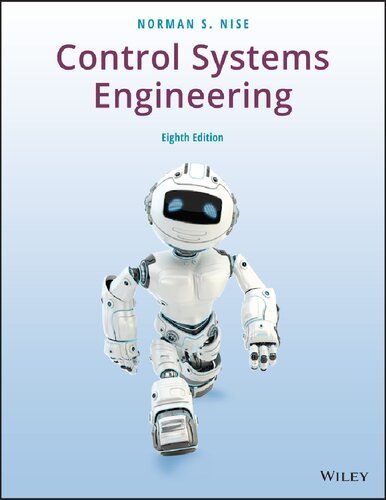
Control Systems Engineering 8th Edition by Norman S. Nise, ISBN-13: 978-1119474210
Original price was: $50.00.$14.99Current price is: $14.99.
Safe & secure checkout
Description
Description
Trustpilot
Control Systems Engineering 8th Edition by Norman S. Nise, ISBN-13: 978-1119474210
[PDF eBook eTextbook] – Available Instantly
- Publisher: Wiley; 8th edition (January 30, 2019)
- Language: English
- ISBN-10: 1119474213
- ISBN-13: 978-1119474210
Highly regarded for its accessibility and focus on practical applications, Control Systems Engineering offers students a comprehensive introduction to the design and analysis of feedback systems that support modern technology. Going beyond theory and abstract mathematics to translate key concepts into physical control systems design, this text presents real-world case studies, challenging chapter questions, and detailed explanations with an emphasis on computer aided design. Abundant illustrations facilitate comprehension, with over 800 photos, diagrams, graphs, and tables designed to help students visualize complex concepts.
Table of Contents:
Cover
Preface
Key Features
New to This Edition
Ancillary Material
Book Organization by Chapter
Acknowledgments
Chapter 1: Introduction
Chapter 1 Problems
Progressive Analysis and Design Problems
Readings
1.1 Introduction
1.2 A History of Control Systems
1.3 System Configurations
1.4 Analysis and Design Objectives
1.5 The Design Process
1.6 Computer-Aided Design
1.7 The Control Systems Engineer
Summary
Review Questions
Cyber Exploration Laboratory
Bibliography
Chapter 2: Modeling in the Frequency Domain
Chapter 2 Problems
Progressive Analysis and Design Problems
Readings
2.1 Introduction
2.2 Laplace Transform Review
2.3 The Transfer Function
2.4 Electrical Network Transfer Functions
2.5 Translational Mechanical System Transfer Functions
2.6 Rotational Mechanical System Transfer Functions
2.7 Transfer Functions for Systems with Gears
2.8 Electromechanical System Transfer Functions
2.9 Electric Circuit Analogs
2.10 Nonlinearities
2.11 Linearization
Summary
Review Questions
Cyber Exploration Laboratory
Bibliography
Chapter 3: Modeling in the Time Domain
Chapter 3 Problems
Progressive Analysis and Design Problems
Readings
3.1 Introduction
3.2 Some Observations
3.3 The General State-Space Representation
3.4 Applying the State-Space Representation
3.5 Converting a Transfer Function to State Space
3.6 Converting from State Space to a Transfer Function
3.7 Linearization
Summary
Review Questions
Cyber Exploration Laboratory
Bibliography
Chapter 4: Time Response
Chapter 4 Problems
Design Problems
Progressive Analysis and Design Problems
Readings
4.1 Introduction
4.2 Poles, Zeros, and System Response
4.3 First-Order Systems
4.4 Second-Order Systems: Introduction
4.5 The General Second-Order System
4.6 Underdamped Second-Order Systems
4.7 System Response with Additional Poles
4.8 System Response with Zeros
4.9 Effects of Nonlinearities upon Time Response
4.10 Laplace Transform Solution of State Equations
4.11 Time Domain Solution of State Equations
Summary
Review Questions
Cyber Exploration Laboratory
Bibliography
Chapter 5: Reduction of Multiple Subsystems
Chapter 5 Problems
Design Problems
Progressive Analysis and Design Problems
Readings
5.1 Introduction
5.2 Block Diagrams
5.3 Analysis and Design of Feedback Systems
5.4 Signal-Flow Graphs
5.5 Mason’s Rule
5.6 Signal-Flow Graphs of State Equations
5.7 Alternative Representations in State Space
5.8 Similarity Transformations
Summary
Review Questions
Cyber Exploration Laboratory
Bibliography
Chapter 6: Stability
Chapter 6 Problems
Design Problems
Progressive Analysis and Design Problems
Readings
6.1 Introduction
6.2 Routh–Hurwitz Criterion
6.3 Routh–Hurwitz Criterion: Special Cases
6.4 Routh–Hurwitz Criterion: Additional Examples
6.5 Stability in State Space
Summary
Review Questions
Cyber Exploration Laboratory
Bibliography
Chapter 7: Steady-State Errors
Chapter 7 Problems
Design Problems
Progressive Analysis and Design Problems
Readings
7.1 Introduction
7.2 Steady-State Error for Unity-Feedback Systems
7.3 Static Error Constants and System Type
7.4 Steady-State Error Specifications
7.5 Steady-State Error for Disturbances
7.6 Steady-State Error for Nonunity-Feedback Systems
7.7 Sensitivity
7.8 Steady-State Error for Systems in State Space
Summary
Review Questions
Cyber Exploration Laboratory
Bibliography
Chapter 8: Root Locus Techniques
Chapter 8 Problems
Design Problems
Progressive Analysis and Design Problems
Readings
8.1 Introduction
8.2 Defining the Root Locus
8.3 Properties of the Root Locus
8.4 Sketching the Root Locus
8.5 Refining the Sketch
8.6 An Example
8.7 Transient Response Design via Gain Adjustment
8.8 Generalized Root Locus
8.9 Root Locus for Positive-Feedback Systems
8.10 Pole Sensitivity
Summary
Review Questions
Cyber Exploration Laboratory
Bibliography
Chapter 9: Design via Root Locus
Chapter 9 Problems
Design Problems
Progressive Analysis and Design Problems
Readings
9.1 Introduction
9.2 Improving Steady-State Error via Cascade Compensation
9.3 Improving Transient Response via Cascade Compensation
9.4 Improving Steady-State Error and Transient Response
9.5 Feedback Compensation
9.6 Physical Realization of Compensation
Summary
Review Questions
Cyber Exploration Laboratory
Bibliography
Chapter 10: Frequency Response Techniques
Chapter 10 Problems
Progressive Analysis and Design Problems
Readings
10.1 Introduction
10.2 Asymptotic Approximations: Bode Plots
10.3 Introduction to the Nyquist Criterion
10.4 Sketching the Nyquist Diagram
10.5 Stability via the Nyquist Diagram
10.6 Gain Margin and Phase Margin via the Nyquist Diagram
10.7 Stability, Gain Margin, and Phase Margin via Bode Plots
10.8 Relation Between Closed-Loop Transient and Closed-Loop Frequency Responses
10.9 Relation Between Closed- and Open-Loop Frequency Responses
10.10 Relation Between Closed-Loop Transient and Open-Loop Frequency Responses
10.11 Steady-State Error Characteristics from Frequency Response
10.12 Systems with Time Delay
10.13 Obtaining Transfer Functions Experimentally
Summary
Review Questions
Cyber Exploration Laboratory
Bibliography
Chapter 11: Design via Frequency Response
Chapter 11 Problems
Design Problems
Progressive Analysis and Design Problems
Readings
11.1 Introduction
11.2 Transient Response via Gain Adjustment
11.3 Lag Compensation
11.4 Lead Compensation
11.5 Lag-Lead Compensation
Summary
Review Questions
Cyber Exploration Laboratory
Bibliography
Chapter 12: Design via State Space
Chapter 12 Problems
Design Problems
Progressive Analysis and Design Problems
Readings
12.1 Introduction
12.2 Controller Design
12.3 Controllability
12.4 Alternative Approaches to Controller Design
12.5 Observer Design
12.6 Observability
12.7 Alternative Approaches to Observer Design
12.8 Steady-State Error Design via Integral Control
Summary
Review Questions
Cyber Exploration Laboratory
Bibliography
Chapter 13: Digital Control Systems
Chapter 13 Problems
Design Problems
Progressive Analysis and Design Problems
Readings
13.1 Introduction
13.2 Modeling the Digital Computer
13.3 The z -Transform
13.4 Transfer Functions
13.5 Block Diagram Reduction
13.6 Stability
13.7 Steady-State Errors
13.8 Transient Response on the z-Plane
13.9 Gain Design on the z-Plane
13.10 Cascade Compensation via the s-Plane
13.11 Implementing the Digital Compensator
Summary
Review Questions
Bibliography
Appendix A1: List of Symbols
Appendix A2: Antenna Azimuth Position Control System
Layout
Schematic
Block Diagram
Schematic Parameters
Block Diagram Parameters
Appendix A3: Unmanned Free‐Swimming Submersible Vehicle
Pitch Control System
Heading Control System
Appendix A4: Key Equations
Appendix B: MATLAB Tutorial
B.1 Introduction
B.2 MATLAB Examples
B.3 Command Summary
Bibliography
Appendix C: Simulink Tutorial
C.1 Introduction
C.2 Using Simulink
C.3 Examples
C.4 Using Simulink for Control System Design
Summary
Bibliography
Appendix D: LabVIEW Tutorial
D.1 Introduction
D.2 Control Systems Analysis, Design, and Simulation
D.3 Using LabVIEW
D.4 Analysis and Design Examples
D.5 Simulation Examples
D.6 Interfacing with External Hardware
Summary
Bibliography
Appendix E: MATLAB’s GUI Tools Tutorial
E.1 Introduction
E.2 The Linear System Analyzer: Description
E.3 Using the Linear System Analyzer
E.4 Linear System Analyzer Examples
E.5 Simulink and the Linear Analysis Tool
E.6 Using the Linear Analysis Tool with Simulink to Analyze a Response
E.7 The Control System Designer: Description
E.8 Using the Control System Designer
Summary
Bibliography
Appendix F: MATLAB’s Symbolic Math Toolbox Tutorial
F.1 Introduction
F.2 Symbolic Math Toolbox Examples
F.3 Command Summary
Bibliography
Appendix G: Matrices, Determinants, and Systems of Equations
G.1 Matrix Definitions and Notations
G.2 Matrix Operations
G.3 Matrix and Determinant Identities
G.4 Systems of Equations
Bibliography
Appendix H: Control System Computational Aids
H.1 Step Response of a System Represented in State Space
H.2 Root Locus and Frequency Response
Appendix I: Derivation of a Schematic for a DC Motor
Bibliography
Appendix J: Derivation of the Time Domain Solution of State Equations
J.1 Derivation
Bibliography
Appendix K: Solution of State Equations for t0 ≠ 0
Bibliography
Appendix L: Derivation of Similarity Transformations
L.1 Introduction
L.2 Expressing Any Vector in Terms of Basis Vectors
L.3 Vector Transformations
L.4 Finding the Transformation Matrix, P
L.5 Transforming the State Equations
Bibliography
Appendix M: Root Locus Rules: Derivations
M.1 Derivation of the Behavior of the Root Locus at Infinity (Kuo, 1987)
M.2 Derivation of Transition Method for Breakaway and Break‐in Points
Bibliography
Glossary
Answers to Selected Problems
Index
End User License Agreement
What makes us different?
• Instant Download
• Always Competitive Pricing
• 100% Privacy
• FREE Sample Available
• 24-7 LIVE Customer Support


Reviews
There are no reviews yet.