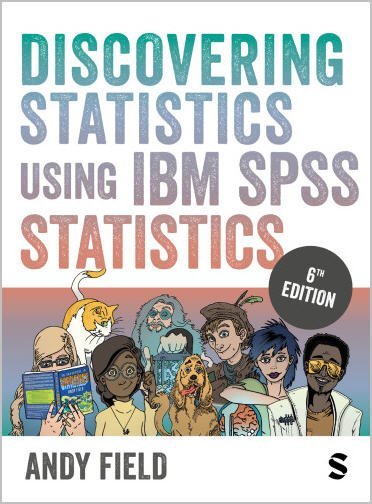
Discovering Statistics Using IBM SPSS Statistics 6th Edition by Andy Field, ISBN-13: 978-1529630008
Original price was: $50.00.$19.99Current price is: $19.99.
Safe & secure checkout
Description
Description
Discovering Statistics Using IBM SPSS Statistics 6th Edition by Andy Field, ISBN-13: 978-1529630008
[PDF eBook eTextbook] – Available Instantly
- Publisher : SAGE Publications Ltd
- Publication date : March 6, 2024
- Edition : Sixth
- Language : English
- 1144 pages
- ISBN-10 : 1529630002
- ISBN-13 : 978-1529630008
NOTE: This book is a standalone book and will not include any access codes.
With its unique combination of humor and step-by-step instruction, this award-winning book is a statistics lifesaver. From initial theory through to regression, factor analysis, and multilevel modelling, Andy Field animates statistics and SPSS software with his famously bizarre examples and activities.
Features:
• Flexible coverage to support students across disciplines and degree programmes
• Can support classroom or lab learning and assessment
• Analysis of real data with opportunities to practice statistical skills
• Highlights common misconceptions and errors
• A revamped online resource
• Covers the range of versions of IBM SPSS Statistics©.
All the online resources above can be easily integrated into your institution′s virtual learning environment or learning management system. This allows you to customize and curate content for use in module preparation, delivery and assessment.
Table of Contents:
Preface
How to use this book
Thank you
Symbols used in this book
A brief maths overview
1 Why is my evil lecturer forcing me to learn statistics?
1.1 What the hell am I doing here? I don’t belong here
1.2 The research process
1.3 Initial observation: finding something that needs explaining
1.4 Generating and testing theories and hypotheses
1.5 Collecting data: measurement
1.6 Collecting data: research design
1.7 Analysing data
1.8 Reporting data
1.9 Jane and Brian’s story
1.10 What next?
1.11 key terms that I’ve discovered
Smart Alex’s tasks
2 The SPINE of statistics
2.1 What will this chapter tell me?
2.2 What is the SPINE of statistics?
2.3 Statistical models
2.4 Populations and samples
2.5 The linear model
2.6 P is for parameters
2.7 E is for estimating parameters
2.8 S is for standard error
2.9 I is for (confidence) interval
2.10 N is for null hypothesis significance testing
2.11 Reporting significance tests
2.12 Jane and Brian’s story
2.13 What next?
2.14 Key terms that I’ve discovered
Smart Alex’s tasks
3 The phoenix of statistics
3.1 What will this chapter tell me?
3.2 Problems with NHST
3.3 NHST as part of wider problems with science
3.4 A phoenix from the EMBERS
3.5 Sense, and how to use it
3.6 Preregistering research and open science
3.7 Effect sizes
3.8 Bayesian approaches
3.9 Reporting effect sizes and Bayes factors
3.10 Jane and Brian’s story
3.11 What next?
3.12 Key terms that I’ve discovered
Smart Alex’s tasks
4 The IBM SPSS Statistics environment
4.1 What will this chapter tell me?
4.2 Versions of IBM SPSS Statistics
4.3 Windows, Mac OS and Linux
4.4 Getting started
4.5 The data editor
4.6 Entering data into IBM SPSS Statistics
4.7 SPSS syntax
4.8 The SPSS viewer
4.9 Exporting SPSS output
4.10 Saving files and restore points
4.11 Opening files and restore points
4.12 A few useful options
4.13 Extending IBM SPSS Statistics
4.14 Jane and Brian’s story
4.15 What next?
4.16 Key terms that I’ve discovered
Smart Alex’s tasks
5 Visualizing data
5.1 What will this chapter tell me?
5.2 The art of visualizing data
5.3 The SPSS Chart Builder
5.4 Histograms
5.5 Boxplots (box–whisker diagrams)
5.6 Visualizing means: bar charts and error bars
5.7 Line charts
5.8 Visualizing relationships: the scatterplot
5.9 Editing plots
5.10 Brian and Jane’s story
5.11 What next?
5.12 Key terms that I’ve discovered
Smart Alex’s tasks
6 The beast of bias
6.1 What will this chapter tell me?
6.2 Descent into statistics hell
6.3 What is bias?
6.4 Outliers
6.5 Overview of assumptions
6.6 Linearity and additivity
6.7 Spherical errors
6.8 Normally distributed something or other
6.9 Checking for bias and describing data
6.10 Reducing bias with robust methods
6.11 A final note
6.12 Jane and Brian’s story
6.13 What next?
6.14 Key terms that I’ve discovered
Smart Alex’s tasks
7 Non-parametric models
7.1 What will this chapter tell me?
7.2 When to use non-parametric tests
7.3 General procedure of non-parametric tests using SPSS
7.4 Comparing two independent conditions: the Wilcoxon rank-sum test and Mann–Whitney test
7.5 Comparing two related conditions: the Wilcoxon signed-rank test
7.6 Differences between several independent groups: the Kruskal–Wallis test
7.7 Differences between several related groups: Friedman’s ANOVA
7.8 Jane and Brian’s story
7.9 What next?
7.10 Key terms that I’ve discovered
Smart Alex’s tasks
8 Correlation
8.1 What will this chapter tell me?
8.2 Modelling relationships
8.3 Data entry for correlation analysis
8.4 Bivariate correlation
8.5 Partial and semi-partial correlation
8.6 Comparing correlations
8.7 Calculating the effect size
8.8 How to report correlation coefficients
8.9 Jane and Brian’s story
8.10 What next?
8.11 Key terms that I’ve discovered
Smart Alex’s tasks
9 The linear model (regression)
9.1 What will this chapter tell me?
9.2 The linear model (regression) … again!
9.3 Bias in linear models
9.4 Generalizing the model
9.5 Sample size and the linear model
9.6 Fitting linear models: the general procedure
9.7 Using SPSS to fit a linear model with one predictor
9.8 Interpreting a linear model with one predictor
9.9 The linear model with two or more predictors (multiple regression)
9.10 Using SPSS to fit a linear model with several predictors
9.11 Interpreting a linear model with several predictors
9.12 Robust regression
9.13 Bayesian regression
9.14 Reporting linear models
9.15 Jane and Brian’s story
9.16 What next?
9.17 Key terms that I’ve discovered
Smart Alex’s tasks
10 Categorical predictors: Comparing two means
10.1 What will this chapter tell me?
10.2 Looking at differences
10.3 A mischievous example
10.4 Categorical predictors in the linear model
10.5 The t-test
10.6 Assumptions of the t-test
10.7 Comparing two means: general procedure
10.8 Comparing two independent means using SPSS
10.9 Comparing two related means using SPSS
10.10 Reporting comparisons between two means
10.11 Between groups or repeated measures?
10.12 Jane and Brian’s story
10.13 What next?
10.14 Key terms that I’ve discovered
Smart Alex’s tasks
11 Moderation and mediation
11.1 What will this chapter tell me?
11.2 The PROCESS tool
11.3 Moderation: interactions in the linear model
11.4 Mediation
11.5 Jane and Brian’s story
11.6 What next?
11.7 Key terms that I’ve discovered
Smart Alex’s tasks
12 GLM 1: Comparing several independent means
12.1 What will this chapter tell me?
12.2 A puppy-tastic example
12.3 Compare several means with the linear model
12.4 Assumptions when comparing means
12.5 Planned contrasts (contrast coding)
12.6 Post hoc procedures
12.7 Effect sizes when comparing means
12.8 Comparing several means using SPSS
12.9 Output from one-way independent ANOVA
12.10 Robust comparisons of several means
12.11 Bayesian comparison of several means
12.12 Reporting results from one-way independent ANOVA
12.13 Jane and Brian’s story
12.14 What next?
12.15 Key terms that I’ve discovered
Smart Alex’s tasks
13 GLM 2: Comparing means adjusted for other predictors (analysis of covariance)
13.1 What will this chapter tell me?
13.2 What is ANCOVA?
13.3 The general linear model with covariates
13.4 Effect size for ANCOVA
13.5 Assumptions and issues in ANCOVA designs
13.6 Conducting ANCOVA using SPSS
13.7 Interpreting ANCOVA
13.8 The non-parallel slopes model and the assumption of homogeneity of regression slopes
13.9 Robust ANCOVA
13.10 Bayesian analysis with covariates
13.11 Reporting results
13.12 Jane and Brian’s story
13.13 What next?
13.14 Key terms that I’ve discovered
Smart Alex’s tasks
14 GLM 3: Factorial designs
14.1 What will this chapter tell me?
14.2 Factorial designs
14.3 A goggly example
14.4 Independent factorial designs and the linear model
14.5 Interpreting interaction plots
14.6 Simple effects analysis
14.7 F-statistics in factorial designs
14.8 Model assumptions in factorial designs
14.9 Factorial designs using SPSS
14.10 Output from factorial designs
14.11 Robust models of factorial designs
14.12 Bayesian models of factorial designs
14.13 More effect sizes
14.14 Reporting the results of factorial designs
14.15 Jane and Brian’s story
14.16 What next?
14.17 Key terms that I’ve discovered
Smart Alex’s tasks
15 GLM 4: Repeated-measures designs
15.1 What will this chapter tell me?
15.2 Introduction to repeated-measures designs
15.3 Emergency! The aliens are coming!
15.4 Repeated measures and the linear model
15.5 The ANOVA approach to repeated-measures designs
15.6 The F-statistic for repeated-measures designs
15.7 Assumptions in repeated-measures designs
15.8 One-way repeated-measures designs using SPSS
15.9 Output for one-way repeated-measures designs
15.10 Robust tests of one-way repeated-measures designs
15.11 Effect sizes for one-way repeated-measures designs
15.12 Reporting one-way repeated-measures designs
15.13 A scented factorial repeated-measures design
15.14 Factorial repeated-measures designs using SPSS
15.15 Interpreting factorial repeated-measures designs
15.16 Reporting the results from factorial repeated-measures designs
15.17 Jane and Brian’s story
15.18 What next?
15.19 Key terms that I’ve discovered
Smart Alex’s tasks
16 GLM 5: Mixed designs
16.1 What will this chapter tell me?
16.2 Mixed designs
16.3 Assumptions in mixed designs
16.4 A speed-dating example
16.5 Mixed designs using SPSS
16.6 Output for mixed factorial designs
16.7 Reporting the results of mixed designs
16.8 Jane and Brian’s story
16.9 What next?
16.10 Key terms that I’ve discovered
Smart Alex’s tasks
17 Multivariate analysis of variance (MANOVA)
17.1 What will this chapter tell me?
17.2 Introducing MANOVA
17.3 The theory behind MANOVA
17.4 Practical issues when conducting MANOVA
17.5 MANOVA using SPSS
17.6 Interpreting MANOVA
17.7 Reporting results from MANOVA
17.8 Following up MANOVA with discriminant analysis
17.9 Interpreting discriminant analysis
17.10 Reporting results from discriminant analysis
17.11 The final interpretation
17.12 Jane and Brian’s story
17.13 What next?
17.14 Key terms that I’ve discovered
Smart Alex’s tasks
18 Exploratory factor analysis
18.1 What will this chapter tell me?
18.2 When to use factor analysis
18.3 Factors and components
18.4 Discovering factors
18.5 An anxious example
18.6 Factor analysis using SPSS
18.7 Interpreting factor analysis
18.8 How to report factor analysis
18.9 Reliability analysis
18.10 Reliability analysis using SPSS
18.11 Interpreting reliability analysis
18.12 How to report reliability analysis
18.13 Jane and Brian’s story
18.14 What next?
18.15 Key terms that I’ve discovered
Smart Alex’s tasks
19 Categorical outcomes: chi-square and loglinear analysis
19.1 What will this chapter tell me?
19.2 Analysing categorical data
19.3 Associations between two categorical variables
19.4 Associations between several categorical variables: loglinear analysis
19.5 Assumptions when analysing categorical data
19.6 General procedure for analysing categorical outcomes
19.7 Doing chi-square using SPSS
19.8 Interpreting the chi-square test
19.9 Loglinear analysis using SPSS
19.10 Interpreting loglinear analysis
19.11 Reporting the results of loglinear analysis
19.12 Jane and Brian’s story
19.13 What next?
19.14 Key terms that I’ve discovered
Smart Alex’s tasks
20 Categorical outcomes: logistic regression
20.1 What will this chapter tell me?
20.2 What is logistic regression?
20.3 Theory of logistic regression
20.4 Sources of bias and common problems
20.5 Binary logistic regression
20.6 Interpreting logistic regression
20.7 Interactions in logistic regression: a sporty example
20.8 Reporting logistic regression
20.9 Jane and Brian’s story
20.10 What next?
20.11 Key terms that I’ve discovered
Smart Alex’s tasks
21 Multilevel linear models
21.1 What will this chapter tell me?
21.2 Hierarchical data
21.3 Multilevel linear models
21.4 Practical issues
21.5 Multilevel modelling using SPSS
21.6 How to report a multilevel model
21.7 A message from the octopus of inescapable despair
21.8 Jane and Brian’s story
21.9 What next?
21.10 Key terms that I’ve discovered
Smart Alex’s tasks
Epilogue
Appendix
Glossary
References
Index
Andy Field is Professor of Quantitative Methods at the University of Sussex. He has published widely (100+ research papers, 29 book chapters, and 17 books in various editions) in the areas of child anxiety and psychological methods and statistics. His current research interests focus on barriers to learning mathematics and statistics.
He is internationally known as a statistics educator. He has written several widely used statistics textbooks including Discovering Statistics Using IBM SPSS Statistics (winner of the 2007 British Psychological Society book award), Discovering Statistics Using R, and An Adventure in Statistics (shortlisted for the British Psychological Society book award, 2017; British Book Design and Production Awards, primary, secondary and tertiary education category, 2016; and the Association of Learned & Professional Society Publishers Award for innovation in publishing, 2016), which teaches statistics through a fictional narrative and uses graphic novel elements. He has also written the adventr and discovr packages for the statistics software R that teach statistics and R through interactive tutorials.
His uncontrollable enthusiasm for teaching statistics to psychologists has led to teaching awards from the University of Sussex (2001, 2015, 2016, 2018, 2019), the British Psychological Society (2006) and a prestigious UK National Teaching fellowship (2010).
He′s done the usual academic things: had grants, been on editorial boards, done lots of admin/service but he finds it tedious trying to remember this stuff. None of them matter anyway because in the unlikely event that you′ve ever heard of him it′ll be as the ′Stats book guy′. In his spare time, he plays the drums very noisily in a heavy metal band, and walks his cocker spaniel, both of which he finds therapeutic.
What makes us different?
• Instant Download
• Always Competitive Pricing
• 100% Privacy
• FREE Sample Available
• 24-7 LIVE Customer Support