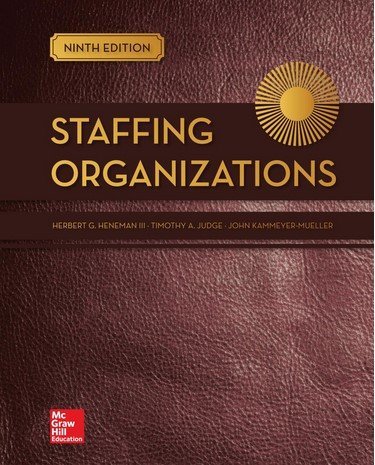
Staffing Organizations 9th Edition by Herbert G. Heneman, ISBN-13: 978-1259756559
Original price was: $100.00.$19.99Current price is: $19.99.
Safe & secure checkout
Description
Description
Staffing Organizations 9th Edition by Herbert G. Heneman, ISBN-13: 978-1259756559
[PDF eBook eTextbook] – Available Instantly
- Publisher: McGraw Hill; 9th edition (January 30, 2018)
- Language: English
- 784 pages
- ISBN-10: 1259756556
- ISBN-13: 978-1259756559
Heneman’s and Judge’s Staffing Organizations, 9e, is based on a comprehensive staffing model. Components of the model include staffing models and strategy, staffing support systems (legal compliance, planning, job analysis and rewards), core staffing systems (recruitment, selection, and employment), and staffing systems and retention management. Up-to-date research and business practices are the hallmarks of this market-leading text. In-depth applications (cases and exercises) at the end of the chapters provide students with skill-building and practice in key staffing activities and decision making. A comprehensive running case involving a fictitious retailing organization provides even greater opportunity for in-depth analysis and skill-building. Students also have the opportunity to address ethical issues at the end of each chapter.
Table of Contents:
Chapter One: Staffing Models and Strategy
• Updated workforce growth statistics throughout the chapter
• Updated list of companies that are intensively hiring
• Updated material on Gore’s position as one of Fortune magazine’s 100 Best
Companies to Work For
• New material on person-job
match and person-organization
fit
vi Preface
• New material based on a recent report on the current talent shortage in the IT,
skilled trades, and sales industries
• Added material on the distinction between the labor
force size and the labor
force participation rate
• Updated definition of staffing ethics from the Society for Human
Resource
Management
Chapter Two: Legal
Compliance
• New material on classifying individuals as either
employees or independent
contractors based on criteria from the Internal Revenue Service
and the
Department of Labor
• Guidance from the Equal Employment Opportunity Commission (EEOC) on
defining discrimination based on the meaning of race/color, national origin,
sex, religion, disability, age, pregnancy, and genetic
information
• Updated information on the protected characteristics of sexual orientation and
gender identity
Chapter Three: Planning
• Increased emphasis on organizational
culture in the planning process
• New material on executive buy-in during human
resources planning
• Updated discussion of workforce skills demand and employment patterns
• Revised exhibit showing labor
force statistics trends
• New material on trends in labor
force participation and work hours
• Streamlined discussion of forecasting techniques
• Comprehensive review of research on flexible workforce quality
• New material reviewing research on when to use outsourcing
• Updated information regarding affirmative action for veterans and qualified
individuals with disabilities
Chapter Four: Job Analysis
and Rewards
• Greater emphasis on implementing competency-based
job analysis
• New figure showing the process
of job requirements job analysis
• New figure showing the process
of competency-based
job analysis
• New figure outlining the distinctions among knowledge, skills, abilities, and
other characteristics and their workplace relevance
• Streamlined discussion of O*NET models
• Revised end-of-
chapter
cases
• Revised information on the types of evidence of essential job functions
Preface vii
Chapter Five: External Recruitment
• New material on integrating in-house
recruitment with external vendors
• Integration of online recruitment techniques across topic areas
• Comprehensive review of research on applicant reactions to the external recruitment
process
• Increased discussion of social media effects on recruitment
• Revised and updated presentation
of recruitment messages
• Increased treatment of targeted recruitment techniques
• New discussion of the transition from recruitment to selection
• Updated discussion regarding policies about written job applicants
• Revised material on best-practice
recruitment ideas from the EEOC
• Updated information on recruitment using social media and job advertisements
Chapter Six: Internal Recruitment
• New material describing best practices in the strategic policy development
process
• Revised and updated presentation
of recruitment messages
• Revised and updated discussion of replacement and succession plans
• New discussion of the transition from recruitment to selection
• New material on best-practice
promotion ideas from the EEOC
• New discussion of barriers to upward mobility and improving upward mobility
Chapter Seven: Measurement
• Updated example of the nominal level of measurement
• New material on biases in subjective measurement
and rater training
• Revised percentiles example
• New discussion of the role of biases and contextual factors
in interrater reliability
• New material on how construct-,
content-,
and criterion-related
validation evidence
should be amassed and interpreted together
• New material on the situational appropriateness of predictive versus concurrent
validation designs
• Revised definition and discussion of content validity
• Updated illustrative study of the Maryland
Department of Transportation
• New material reviewing the meta-analytic
work on prior validity generalization
and the gaps in our current understanding
• New example using insights from Glassdoor to highlight practical considerations
in staffing
• New discussion of mobile and Internet-based
test administration
viii Preface
Chapter Eight: External Selection
I
• New material on applicant reactions toward
performance
tests and the validity
of such tests
• Updated discussion of video résumés
• New material on the adverse impact of résumés, letters of recommendation,
credit checks, and biodata
• New discussion of the “double jeopardy” effect
• New discussion of the usefulness of a college education and quality of school
as educational requirements, including examples
• New material on how studying abroad leads to an expanded cultural intelligence,
an area of extracurricular activities that may be important
for staffing
• New material on how experience is multidimensional, with many characteristics
and levels of analysis
• New discussion of “Ban the Box” legislation
• New material on initial impressions as bias in initial interviews
• Updated material on applicant reactions and attraction from meta-analytic
research
• Updated list of states that currently limit the use of credit information in
staffing
• New material on social media screening and safeguards
• New discussion of bona fide occupational qualification claims and their
justification
Chapter Nine: External Selection
II
• Updated Big Five stability and heritability estimates with the most recent
meta-analytic
research
• Updated website links and test information throughout the chapter
• New material and discussion on the “too much of a good thing”
effect with
conscientiousness
• New material and discussion on the “trivial validities” of personality, including
updated meta-analytic
research and additional personality frameworks
• New material and meta-analytic
evidence on personality test faking
• New material and discussion on when socially desirable behavior
is not desirable
for job performance
• Updated Exhibits 9.2 and 9.13 based on new evidence
• Updated evaluation of cognitive ability tests with newest meta-analytic
research
on organizational citizenship behavior and counterproductive work behavior
• Revised adverse impact evidence for cognitive ability tests
• New material on how “star applicants” can become offended by having to take
cognitive ability tests
Preface ix
• New material and discussion on physical abilities tests that draw from the
most recent meta-analytic
estimates
• New material and discussion on performance-based
emotional intelligence
measurement
and emotional intelligence validity
• Updated meta-analytic
validity estimates of work sample tests
• New material and discussion on the “situational” perspective on situational
judgment tests
• New material on integrity test validity and faking
• New material on vocational congruence and attained vocational aspirations
• Updated meta-analytic
research and other material for interviews, including
structured interview characteristics, behavioral and situational interview comparisons,
validity, and interviewer characteristics
• New material on the National Football League (NFL) and how OCBs matters
less to outsiders (e.g., external consultants)
than to insiders in team selection
• Updated statistics and figures on drug testing
• Revised material on the Uniform Guidelines on Employee Selection
Procedures
• New discussion of marijuana and other drug testing
Chapter Ten: Internal Selection
• Updated peer assessment section with meta-analytic
results
• New material on the impact of self-assessments
on biased promotion judgments
• New material on the impact of biases such as political
skill on promotability
ratings
• New meta-analytic
material on the characteristics of assessment centers
• New material and discussion on solutions for the assessment center construct
validity dilemma
• Revised the validity ranges to match traditional standards
Chapter Eleven: Decision Making
• New section on predictive analytics
• New section describing the interface between organizational
leaders and HR
representatives based on best practices in the field
• New material covering techniques for assessing economic impact
• New exhibit reviewing techniques for assessing links between economic impact
analysis
and other functional areas of the business
• New exhibit covering the role of decision makers in selection
• New section covering differential weighting techniques for predictors
• Updated and revised discussion of choosing among weighting schemes
• Streamlined discussion of test score banding
x Preface
Chapter Twelve: Final Match
• New section on long-term
adjustment and the process
of new hire onboarding
over time
• Updated and revised discussion of specific onboarding practices
• Increased discussion of expatriate adjustment in staffing
• Updated and revised discussion of the strategic approach to job offers, with
increased linkages to decision making and system management
• Streamlined discussion of pay policies
• Streamlined discussion of employment contracts
• Revised material on negligent hiring and minimizing its occurrence
Chapter Thirteen: Staffing System Management
• New section describing the design and administration of staffing systems
• Emphasis on strategic fit between staffing systems and organizational
goals
and processes
• Incorporation of strategic management research regarding HR systems
• New exhibit contrasting hierarchical and participative staffing systems
• Review of techniques for defining the mission of staffing
• Updated and revised material on organizational
arrangements
• New EEO-1 report
• New discussion of incorporating implicit (hidden) bias material into EEO
training
• New and revised material on internal and external dispute resolution procedures
Chapter Fourteen: Retention Management
• Enhanced review of techniques for analyzing turnover
• Comprehensive update and reorganization
of material related to retention
initiatives
• New section on predictive analytics in retention management
• New exhibit contrasting hire, quit, and layoff differences across industries
• New exhibit demonstrating how to use turnover breakout results
• Updated exhibit describing guidelines for increasing satisfaction and retention
of employees
• Updated and revised discussion of causes
of turnover
• Updated and revised discussion of the costs and benefits of turnover
Herbert G. Heneman III is the Dickson-Bascom Professor Emeritus in the Management and Human Resources Department, School of Business, at the University of Wisconsin-Madison. He also serves as a senior researcher in the Wisconsin Center for Educational Research. Herb has been a visiting faculty member at the University of Washington and the University of Florida, and he was the University Distinguished Visiting Professor at the Ohio State University. His research is in the areas of staffing, performance management, compensation, and work motivation. He is currently investigating the design and effectiveness of teacher performance management and compensation systems. Herb is on the board of directors of the Society for Human Resource Management Foundation, and serves as its director of research. He is the senior author of three prior textbooks in human resource management. Herb is a Fellow of the Society for Industrial and Organizational Psychology, the American Psychological Association, and the Academy of Management. He is also the recipient of the career achievement award from the Human Resources Division of the Academy of Management.
John D. Kammeyer- Mueller is the Curtis L. Carlson Professor of Industrial Relations in the Department of Work and Organizations, Carlson School of Management, University of Minnesota. John’s primary research interests include the areas of organizational socialization and employee adjustment, personality and the stress process, employee retention, and career development. He has taught courses related to organizational staffing at the undergraduate, master’s, and doctoral levels. His research work has appeared in Academy of Management Journal; the Journal of Applied Psychology; Personnel Psychology; the Journal of Management; and the Journal of Organizational Behavior, among other outlets. He serves on the editorial boards of the Journal of Applied Psychology; Personnel Psychology; and Organizational Research Methods. In addition to his scholarly work, John has performed consulting work in the areas of employee satisfaction, retention, and workplace safety and health for 3M Corporation, Allegiance Healthcare, Allina Healthcare, and the State of Minnesota. He has also worked with the Florida Nurses Association and the Florida Bar on research projects of interest to their professional membership.
Timothy A. Judge is the Matherly-McKethan Eminent Scholar, Department of Management, Warrington College of Business, University of Florida. Prior to receiving his PhD at the University of Illinois, Tim was a manager for Kohl’s department stores. Tim has also served on the faculties of Cornell University and the University of Iowa. Tim’s teaching and research interests are in the areas of personality, leadership and influence behaviors, staffing, and job attitudes. He serves on the editorial review boards of Academy of Management Journal, Journal of Applied Psychology, Personnel Psychology, and Organizational Behavior and Human Decision Processes. Tim is a former program chair for the Society for Industrial and Organizational Psychology, and past chair of the Human Resources Division of the Academy of Management. Tim is Fellow of the American Psychological Association and the Society for the Industrial and Organizational Psychology, and in 1995 he received the Ernest J. McCormick Award for Distinguished Early Career Contributions from the Society for Industrial and Organizational Psychology. In 2001 he received the Cummings Scholar Award for the Academy of Management.
What makes us different?
• Instant Download
• Always Competitive Pricing
• 100% Privacy
• FREE Sample Available
• 24-7 LIVE Customer Support