

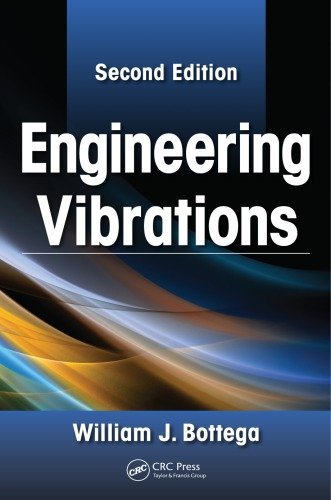
Engineering Vibrations 2nd Edition by William J. Bottega, ISBN-13: 978-1439830352
Original price was: $100.00.$24.99Current price is: $24.99.
Safe & secure checkout
Description
Description
Trustpilot
Engineering Vibrations 2nd Edition by William J. Bottega, ISBN-13: 978-1439830352
[PDF eBook eTextbook] – Available Instantly
- Publisher: CRC Press; 2nd edition (December 11, 2014)
- Language: English
- 928 pages
- ISBN-10: 1439830355
- ISBN-13: 978-1439830352
A thorough study of the oscillatory and transient motion of mechanical and structural systems, Engineering Vibrations, Second Edition presents vibrations from a unified point of view, and builds on the first edition with additional chapters and sections that contain more advanced, graduate-level topics. Using numerous examples and case studies to reinforce concepts, the author reviews basic principles, incorporates advanced abstract concepts from first principles, and weaves together physical interpretation and fundamental principles with applied problem solving. For each class of system, the text explores the fundamental dynamics and studies free and forced vibrations. This revised version combines the physical and mathematical facets of vibration, and emphasizes the connecting ideas, concepts, and techniques.
What’s New in the Second Edition:
- Includes a section on the forced response of structurally damped one-dimensional continua
- Adds three new chapters: Dynamics of Two-Dimensional Continua, Free Vibration of Two-Dimensional Continua, and Forced Vibration of Two-Dimensional Continua
- Addresses the linear and geometrically nonlinear characterization of three-dimensional deformation for mathematically two-dimensional structures, and the dynamics and vibration of various types of structures within this class
- Covers deformation, dynamics, and vibration of membranes, of Kirchhoff plates, of von Karman plates, and of Mindlin plates
- Details a full development for the characterization of deformation and motion for mathematically two-dimensional continua
- Discusses the free and forced vibration of two-dimensional continua and the steady state response of two-dimensional continua with structural damping
Engineering Vibrations, Second Edition offers a systematic and unified treatment of mechanical and structural vibrations, and provides you with a complete overview of vibration theory and analysis.
Table of Contents:
Cover
Half-Title Page
Title Page
Copyright Page
Dedication
Table of Contents
Preface To The Second Edition
Preface To The First Edition
About The Author
1. Preliminaries
1.1 Degrees of Freedom
1.2 Equivalent Systems
1.2.1 Extension/Contraction of Elastic Rods
1.2.2 Bending of Elastic Beams
1.2.3 Torsion of Elastic Rods
1.2.4 Floating Bodies
1.2.5 The Viscous Damper
1.2.6 Aero/Hydrodynamic Damping (Drag)
1.3 Springs Connected in Parallel and in Series
1.3.1 Springs in Parallel
1.3.2 Springs in Series
1.4 A Brief Review of Complex Numbers
1.5 A Review of Elementary Dynamics
1.5.1 Kinematics of Particles
1.5.2 Kinetics of a Single Particle
1.5.3 Dynamics of Particle Systems
1.5.4 Kinematics of Rigid Bodies
1.5.5 (Planar) Kinetics of Rigid Bodies
1.6 Concluding Remarks
Bibliography
Problems
2. Free Vibration Of Single Degree Of Freedom Systems
2.1 Free Vibration of Undamped Systems
2.1.1 Governing Equation and System Response
2.1.2 The Effect of Gravity
2.1.3 Work and Energy
2.1.4 The Simple Pendulum
2.2 Free Vibration of Systems with Viscous Damping
2.2.1 Equation of Motion and General System Response
2.2.2 Underdamped Systems
2.2.3 Logarithmic Decrement
2.2.4 Overdamped Systems
2.2.5 Critically Damped Systems
2.3 Coulomb (Dry Friction) Damping
2.3.1 Stick-Slip Condition
2.3.2 System Response
2.4 Concluding Remarks
Bibliography
Problems
3. Forced Vibration Of Single Degree Of Freedom Systems – 1: Periodic Excitation
3.1 Standard Form of the Equation of Motion
3.2 Superposition
3.3 Harmonic Forcing
3.3.1 Formulation
3.3.2 Steady State Response of Undamped Systems
3.3.3 Steady State Response of Systems with Viscous Damping
3.3.4 Force Transmission and Vibration Isolation
3.4 Structural Damping
3.4.1 Linear Hereditary Materials
3.4.2 Steady State Response of Linear Hereditary Materials
3.4.3 Steady State Response of Single Degree of Freedom Systems
3.5 Selected Applications
3.5.1 Harmonic Motion of the Support
3.5.2 Unbalanced Motor
3.5.3 Synchronous Whirling of Rotating Shafts
3.6 Response to General Periodic Loading
3.6.1 General Periodic Excitation
3.6.2 Steady State Response
3.7 Concluding Remarks
Bibliography
Problems
4. Forced Vibration Of Single Degree Of Freedom Systems – 2: Nonperiodic Excitation
4.1 Two Generalized Functions
4.1.1 The Dirac Delta Function (Unit Impulse)
4.1.2 The Heaviside Step Function (Unit Step)
4.1.3 Relation Between the Unit Step and the Unit Impulse
4.2 Impulse Response
4.2.1 Impulsive and Nonimpulsive Forces
4.2.2 Response to an Applied Impulse
4.3 Response to Arbitrary Excitation
4.4 Response to Step Loading
4.5 Response to Ramp Loading
4.6 Transient Response by Superposition
4.6.1 The Rectangular Pulse
4.6.2 Linear Transition to Constant Load Level
4.7 Shock Spectra
4.8 Concluding Remarks
Bibliography
Problems
5. Operational Methods
5.1 The Laplace Transform
5.1.1 Laplace Transforms of Basic Functions
5.1.2 Shifting Theorem
5.1.3 Laplace Transforms of the Derivatives of Functions
5.1.4 Convolution
5.2 Free Vibrations
5.3 Forced Vibrations
5.3.1 The Governing Equations
5.3.2 Steady State Response
5.3.3 Transient Response
5.4 Concluding Remarks
Bibliography
Problems
6. Dynamics Of Multi-Degree Of Freedom Systems
6.1 Newtonian Mechanics of Discrete Systems
6.1.1 Mass-Spring Systems
6.1.2 The Double Pendulum
6.1.3 Two-Dimensional Motion of a Rigid Frame
6.2 Lagrange’s Equations
6.2.1 Virtual Work
6.2.2 The Canonical Equations
6.2.3 Implementation
6.2.4 The Rayleigh Dissipation Function
6.3 Symmetry of the System Matrices
6.3.1 The Stiffness Matrix
6.3.2 The Mass Matrix
6.3.3 The Damping Matrix
6.4 Concluding Remarks
Bibliography
Problems
7. Free Vibration Of Multi-Degree Of Freedom Systems
7.1 The General Free Vibration Problem and Its Solution
7.2 Unrestrained Systems
7.3 Properties of Modal Vectors
7.3.1 The Scalar Product
7.3.2 Orthogonality of the Modes
7.3.3 Normalization
7.4 Systems with Viscous Damping
7.4.1 System Response
7.4.2 State Space Representation
7.5 Evaluation of Amplitudes and Phase Angles
7.5.1 Undamped Systems
7.5.2 Systems with General Viscous Damping
7.6 Concluding Remarks
Bibliography
Problems
8. Forced Vibration Of Multi-Degree Of Freedom Systems
8.1 Introduction
8.1.1 Steady State Response to Harmonic Excitation
8.1.2 The Simple Vibration Absorber
8.2 Modal Coordinates
8.2.1 Principal Coordinates
8.2.2 Coordinate Transformations
8.2.3 Modal Coordinates
8.3 General Motion in Terms of the Natural Modes
8.3.1 Linear Independence of the Set of Modal Vectors
8.3.2 Modal Expansion
8.4 Decomposition of the Forced Vibration Problem
8.5 Solution of Forced Vibration Problems
8.6 Mode Isolation
8.7 Rayleigh Damping
8.8 Systems with General Viscous Damping
8.8.1 Steady State Response to Harmonic Excitation
8.8.2 Eigenvector Expansion
8.8.3 Decomposition of the Forced Vibration Problem
8.8.4 Solution of Forced Vibration Problems
8.9 Concluding Remarks
Bibliography
Problems
9. Dynamics Of One-Dimensional Continua
9.1 Mathematical Description of 1-D Continua
9.1.1 Correspondence Between Discrete and Continuous Systems
9.1.2 The Scalar Product and Orthogonality
9.2 Characterization of Local Deformation
9.2.1 Relative Extension of a Material Line Element
9.2.2 Distortion
9.3 Longitudinal Motion of Elastic Rods
9.4 Torsional Motion of Elastic Rods
9.5 Transverse Motion of Strings and Cables
9.6 Transverse Motion of Elastic Beams
9.6.1 Kinematical and Constitutive Relations
9.6.2 Kinetics
9.6.3 Euler-Bernoulli Beam Theory
9.6.4 Rayleigh Beam Theory
9.6.5 Timoshenko Beam Theory
9.7 Geometrically Nonlinear Beam Theory
9.8 Translating 1-D Continua
9.8.1 Kinematics of a Material Particle
9.8.2 Kinetics
9.9 Concluding Remarks
Bibliography
Problems
10. Free Vibration Of One-Dimensional Continua
10.1 The General Free Vibration Problem
10.2 Free Vibration of Uniform Second Order Systems
10.2.1 The General Free Vibration Problem and Its Solution
10.2.2 Longitudinal Vibration of Elastic Rods
10.2.3 Torsional Vibration of Elastic Rods
10.2.4 Transverse Vibration of Strings and Cables
10.3 Free Vibration of Euler-Bernoulli Beams
10.4 Free Vibration of Euler-Bernoulli Beam-Columns
10.5 Free Vibration of Rayleigh Beams
10.6 Free Vibration of Timoshenko Beams
10.7 Normalization of the Modal Functions
10.8 Orthogonality of the Modal Functions
10.8.1 Systems Whose Mass Operators Are Scalar Functions
10.8.2 Second Order Systems
10.8.3 Euler-Bernoulli Beams and Beam-Columns
10.8.4 Rayleigh Beams
10.8.5 Timoshenko Beams
10.9 Evaluation of Amplitudes and Phase Angles
10.9.1 Systems Possessing a Single Scalar Mass Operator
10.9.2 Rayleigh Beams
10.9.3 Timoshenko Beams
10.10 Concluding Remarks
Bibliography
Problems
11. Forced Vibration Of One-Dimensional Continua
11.1 Modal Expansion
11.1.1 Linear Independence of the Modal Functions
11.1.2 Generalized Fourier Series
11.2 Decomposition of the Forced Vibration Problem
11.3 Solution of Forced Vibration Problems
11.3.1 Axially Loaded Elastic Rods
11.3.2 Torsion of Elastic Rods
11.3.3 Strings and Cables
11.3.4 Euler-Bernoulli Beams
11.3.5 Rayleigh Beams
11.3.6 Timoshenko Beams
11.4 Steady State Response of One-Dimensional Continua with Structural Damping
11.4.1 Stiffness Operators for 1-D Continua with Structural Damping
11.4.2 Steady State Response of 1-D Continua with Structural Damping
11.5 Concluding Remarks
Bibliography
Problems
12. Dynamics Of Two-Dimensional Continua
12.1 Characterization of Local Deformation
12.1.1 In-Plane Deformation
12.1.2 Deformation with Out-of-Plane Rotation
12.1.3 Polar Coordinates
12.1.4 Summary of Strain Measures
12.2 Membranes
12.2.1 The Infinitely Flexible Structure
12.2.2 The Ideal Membrane
12.3 Elastic Plates
12.3.1 Kinematical and Constitutive Relations
12.3.2 Kinetics
12.3.3 Kirchhoff Plate Theory
12.3.4 Mindlin Plate Theory
12.3.5 Geometrically Nonlinear (von Karman) Plate Theory
12.4 Concluding Remarks
Bibliography
Problems
13. Free Vibration Of Two-Dimensional Continua
13.1 The Scalar Product and Orthogonality
13.1.1 Systems with One Dependent Variable
13.1.2 Systems with Multiple Dependent Variables
13.2 The General Free Vibration Problem
13.2.1 Systems with One Dependent Variable
13.2.2 Systems with Multiple Dependent Variables
13.3 Free Vibration of Ideal Membranes
13.3.1 Rectangular Membranes
13.3.2 Circular Membranes
13.4 Free Vibration of Kirchhoff Plates
13.4.1 Rectangular Plates
13.4.2 Circular Plates
13.5 Free Vibration of Uniformly Stretched von Karman Plates
13.6 Free Vibration of Mindlin Plates
13.6.1 The General Solution
13.6.2 The Frequency Spectrum
13.6.3 Implementation
13.7 Normalization of the Modal Functions
13.7.1 Systems with One Dependent Variable
13.7.2 Systems with Multiple Dependent Variables
13.8 Orthogonality of the Modal Functions
13.8.1 Systems with One Dependent Variable
13.8.2 Mindlin Plates
13.9 Evaluation of Amplitudes and Phase Angles
13.9.1 Systems Possessing a Single Scalar Mass Operator
13.9.2 Mindlin Plates
13.10 Concluding Remarks
Bibliography
Problems
14. Forced Vibration Of Two-Dimensional Continua
14.1 Mathematical Representation of Point Loads for Two-Dimensional Continua
14.2 Forced Vibration of Systems with One Dependent Variable
14.3 Forced Vibration of Systems with Multiple Dependent Variables: Mindlin Plates
14.4 Steady State Response of Two-Dimensional Continua with Structural Damping
14.4.1 Stiffness Operators for 2-D Continua with Structural Damping
14.4.2 Steady State Response of Kirchhoff and von Karman Plates with Structural Damping
14.4.3 Steady State Response of Mindlin Plates with Structural Damping
14.5 Concluding Remarks
Bibliography
Problems
Index
William J. Bottega is Professor of Mechanical and Aerospace Engineering at Rutgers University, where he has been since 1984. He received his Ph.D. in applied mechanics from Yale University, his M.S. in theoretical and applied mechanics from Cornell University, and his B.E. from the City College of New York. He also spent several years in R&D at General Dynamics where he worked on vibration and sound-structure interaction problems. In addition, Dr. Bottega is the author of numerous archival publications on various areas of theoretical and applied mechanics.
What makes us different?
• Instant Download
• Always Competitive Pricing
• 100% Privacy
• FREE Sample Available
• 24-7 LIVE Customer Support


Reviews
There are no reviews yet.