

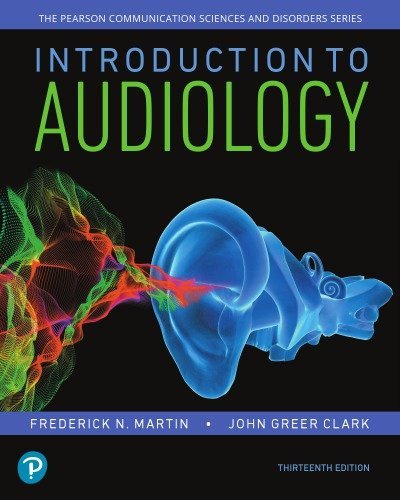
Introduction to Audiology 13th Edition by Frederick Martin, ISBN-13: 978-0134695044
Original price was: $50.00.$14.99Current price is: $14.99.
Safe & secure checkout
Description
Description
Trustpilot
Introduction to Audiology 13th Edition by Frederick Martin, ISBN-13: 978-0134695044
[PDF eBook eTextbook] – Available Instantly
- Publisher: Pearson; 13th edition (January 3, 2018)
- Language: English
- 544 pages
- ISBN-10: 0134695046
- ISBN-13: 978-0134695044
A comprehensive introduction to hearing and balance disorders.
Introduction to Audiology offers a thorough introduction to hearing and balance disorders in a user-friendly format. Extensive pedagogical tools help students better understand, retain, and analyze the material, while the presentation of topics allows instructors to adapt the content to suit their specific teaching goals. The abundance of how-to information, incorporation of current research, and updated learning aids showcase the rewarding, fascinating aspects of a career in audiology today.
The 13th Edition features:
- A new chapter on the diagnosis and management of balance, tinnitus, and sound tolerance problems that better orients students to the full range of audiologic practice (Ch. 13).
- State-of-the-art topic coverage such as over-the-counter hearing aids, high-frequency and multifrequency tympanometry, and telehealth that keeps students current with changes in the profession.
- Clinical Commentaries that drive home important concepts or expand on the material. In response to reviewer feedback, more Clinical Commentaries are infused throughout the text.
- Illustrations and figures with expanded captions which help readers visualize the conditions they are reading about.
Table of Contents:
Contents
Preface
New to This Edition
How to Use This Book
About the Authors
Introduction to Audiology
Core Competencies
PART I ELEMENTS OF AUDIOLOGY
CHAPTER 1 The Profession of Audiology
LEARNING OUTCOMES
1.1 The Evolution of Audiology
Academic Preparation in Audiology
Licensing and Certification
A Blending of Art and Science
1.2 People and Places
Prevalence and Impact of Hearing Loss
Audiology Specialties
Medical Audiology
Educational Audiology
Pediatric Audiology
Dispensing/Rehabilitative Audiology
Industrial Audiology
Recreational and Animal Audiology
Tele-Audiology
Employment Settings
Professional Societies
Summary
Websites
Frequently Asked Questions
Suggested Readings
CHAPTER 2 Sound and Its Measurement
LEARNING OUTCOMES
2.1 Sound
Waves
Transverse Waves
Longitudinal Waves
Sine Waves
Vibrations
Effects of Energy on Vibration
Free Vibrations
Forced Vibrations
Frequency
Effects of Length on Frequency
Effects of Mass on Frequency
Effects of Stiffness on Frequency
Resonance
Sound Velocity
Wavelength
Phase
Interference
Beats
Complex Sounds
Fundamental Frequency
Harmonics
Spectrum of a Complex Sound
Intensity
Force
Pressure
Work
Power
Intensity of a Sound Wave
Impedance
2.2 The Decibel
Logarithms
Intensity Level
Sound-Pressure Level
Hearing Level
Sensation Level
Environmental Sounds
2.3 Psychoacoustics
Pitch
Loudness
Localization
Masking
2.4 Sound Measurement
The Pure-Tone Audiometer
Air Conduction
Bone Conduction
The Speech Audiometer
Air Conduction
Sound Field
Sound-Level Meters
Acceptable Noise Levels for Audiometry
Calibration of Audiometers
Summary
Frequently Asked Questions
Suggested Readings
PART II HEARING ASSESSMENT
CHAPTER 3 The Human Ear, Hearing Loss, and Pure-Tone Hearing Tests
LEARNING OUTCOMES
3.1 Basics of How the Ear Works and the Hearing Losses that May Disrupt Sound Reception
Types of Hearing Loss
Conductive Hearing Loss
Sensory/Neural Hearing Loss
Mixed Hearing Loss
Central Hearing Loss
Nonorganic Hearing Loss
3.2 Testing Hearing
Tuning-Fork Tests
Pure-Tone Audiometry
Controlling the Test Environment
Earphone Attenuation Devices
Insert Earphones
Noise-Cancellation Headphones
Sound-Isolated Chambers
The Patient’s Role in Manual Pure-Tone Audiometry
Patient Response
False Responses
The Clinician’s Role in Manual Pure-Tone Audiometry
Positioning the Patient for Testing
3.3 Air- and Bone-Conduction Hearing Tests
Air-Conduction Audiometry
Procedure for Air-Conduction Audiometry
Procedure for Bone-Conduction Audiometry
The Audiometric Weber Test
Pure-Tone Audiometry with Reduced Clinician Time
Automatic Audiometry
Computerized Audiometry
3.4 Audiogram Interpretation
Air-Bone Relationships
Tactile Responses to Pure-Tone Stimuli
Cross Hearing
Case Study 1: Conductive Hearing Loss—Outer Ear Disorder
Case Study 2: Conductive Hearing Loss—Middle Ear Disorder
Case Study 3: Sensory/Neural Hearing Loss—Inner Ear Disorder
Case Study 4: Sensory/Neural Hearing Loss—Auditory Nerve Disorder
Case Study 5: Nonorganic Hearing Loss
Case Study 6: Pediatric Patient
Summary
Frequently Asked Questions
Suggested Readings
CHAPTER 4 Speech Audiometry
LEARNING OUTCOMES
4.1 Requirements for Speech Audiometric Testing
The Diagnostic Audiometer
Test Environment
The Patient’s Role in Speech Audiometry
The Clinician’s Role in Speech Audiometry
4.2 Speech-Threshold Testing
Speech-Detection Threshold
Speech-Recognition Threshold
SRT Testing with Spondaic Words
Recording SRT Results
Bone-Conduction SRT
Relationship of SRT to SDT and the Pure-Tone Audiogram.
4.3 Speech-Recognition Testing
Monosyllabic Word Lists
Testing Word Recognition with Shortened Lists
Short Isophonemic Word Lists
High-Frequency Emphasis Lists
Nonsense-Syllable Lists
Testing of Monosyllables with a Closed-Response Set
Testing Speech Recognition with Sentences
Testing Speech Recognition with Competition
Multi-Purpose Speech Recognition Testing
Recording Speech-Recognition Test Results
Administration of Speech-Recognition Tests
Selection of Stimuli, Materials, and Response Method
Performance-Intensity Functions in Speech-Recognition Testing
Test Presentation Level
Problems in Speech-Recognition Testing
Bone-Conduction Speech-Recognition Testing
Computerized Speech Audiometry
Speech-Recognition, the Audibility Index, and Implications for Speech-Language Therapy
4.4 Loudness Comfort, Discomfort and Sound Interference
Most Comfortable Loudness Level
Uncomfortable Loudness Level
Acceptable Noise Level
Dynamic Range
Case Study 1: Conductive Hearing Loss—Outer Ear Disorder
Case Study 2: Conductive Hearing Loss—Middle Ear Disorder
Case Study 3: Sensory/Neural Hearing Loss—Inner Ear Disorder
Case Study 4: Sensory/Neural Hearing Loss—Auditory Nerve Disorder
Case Study 5: Nonorganic Hearing Loss
Case Study 6: Pediatric Patient
Summary
Frequently Asked Questions
Suggested Reading
CHAPTER 5 Masking
LEARNING OUTCOMES
5.1 Why Do We Mask and How Do We Do It?
Cross Hearing in Air- and Bone-Conduction Audiometry
Masking
Noises Used in Pure-Tone Masking
Determining Effective Masking Levels
Central Masking
How Much Masking is Too Much Masking?
A Tried and True Approach to Masking: The Plateau Method
Masking for Bone Conduction
Plotting Masked Results on the Audiogram
5.2 Masking for Speech Audiometry
Cross Hearing in SRT Tests
Noises Used in Masking for Speech
Calibration of Speech-Masking Noises
Central Masking for Speech
Masking for SRT with the Plateau Method
Recording Masked SRT Results
Cross Hearing and Masking in Speech-Recognition Score Testing
Compensation for Central Masking
Maximum Masking
Case Study 1: Conductive Hearing Loss—Outer Ear Disorder
Case Study 2: Conductive Hearing Loss—Middle Ear Disorder
Case Study 3: Sensory/Neural Hearing Loss—Inner Ear Disorder
Case Study 4: Sensory/Neural Hearing Loss—Auditory Nerve Disorder
Case Study 5: Non-organic Hearing Loss
Case Study 6: Pediatric Patient
Summary
Frequently Asked Questions
Suggested Readings
CHAPTER 6 Physiological Tests of the Auditory System
LEARNING OUTCOMES
6.1 Acoustic Immittance
Measurements Made on Acoustic Immittance Meters
Factors Governing Acoustic Immittance
Equipment for Middle-Ear Immittance Measurements
Measurement of Static Acoustic Compliance
Normal Values for Static Acoustic Compliance
Recording and Interpreting Static Acoustic Compliance
Tympanometry
Recording and Qualitative Interpretation of Tympanometric Results
Objective Interpretation of Tympanometric Results
High Frequency and Multi-Frequency Tympanometry and Wideband Acoustic Immittance
Measuring the Acoustic Reflex as Part of the Acoustic Immittance Battery
Implications of the Acoustic Reflex
Interpreting the Acoustic Reflex
Acoustic Reflex Decay Test
Recording and Interpreting Acoustic Reflex Decay Test Results
Laser-Doppler Vibrometer Measurement
6.2 Otoacoustic Emissions (OAEs)
Transient-Evoked Otoacoustic Emissions
Distortion-Product Otoacoustic Emissions
Measuring OAEs
Interpreting OAEs
6.3 Auditory-Evoked Potentials
Electrocochleography
Auditory Brain-Stem Response (ABR) Audiometry
Interpreting the ABR
Auditory Steady-State Response
Interpreting the ASSR
Auditory Middle Latency Response (AMLR) Audiometry
Interpreting the AMLR.
Auditory Late Responses (ALRs)
Interpreting the Auditory Late Responses
Intraoperative Monitoring
Summary
Frequently Asked Questions
Suggested Readings
CHAPTER 7 Pediatric Hearing Loss Identification and Assessment
LEARNING OUTCOMES
7.1 Identifying Hearing Loss in Infants Under Three Months of Age
Infant Hearing Screening
The History of Neonatal Hearing Screening.
Neonatal Screening with ABR
Neonatal Screening with Otoacoustic Emissions
Meeting the Needs and Challenges of Newborn Hearing Screening
Beyond Early Identification
7.2 Pediatric Hearing Evaluation
Subjective Observations in Pediatric Hearing Evaluations
Objective Tests in Pediatric Hearing Evaluations
Behavioral Testing of Children from Birth to Approximately Two Years of Age
Auditory Responses
Sound-Field Audiometry
Sound-Field Test Stimuli
Behavioral Testing of Children Approximately Two to Five Years of Age
Speech Audiometry
Operant Conditioning Audiometry
Play Audiometry
Electrophysiological Hearing Tests
7.3 Identifying Hearing Loss in the Schools
Hearing Screening Measures
Testing the Reliability of Screening Measures
Non-organic Hearing Loss in School-aged Children
Case Study 4: Pediatric Patient
Summary
Frequently Asked Questions
Suggested Readings
PART III HEARING DISORDERS
CHAPTER 8 The Outer Ear
LEARNING OUTCOMES
8.1 Anatomy and Physiology of the Outer Ear
Development of the Outer Ear
The Auricle
The External Auditory Canal
The Tympanic Membrane
8.2 Disorders of the Outer Ear and Their Treatments
Disorders of the Auricle
Atresia of the External Auditory Canal
Collapsing External Auditory Canals
Foreign Bodies in the External Ear Canal
External Otitis
Growths in the External Auditory Canal
Earwax in the External Auditory Canal
Perforations of the Tympanic Membrane
Thickening of the Tympanic Membrane
Case Study 1: Conductive Hearing Loss—Outer Ear Disorder
Summary
Frequently Asked Questions
Suggested Readings
CHAPTER 9 The Middle Ear
LEARNING OUTCOMES
9.1 Anatomy and Physiology of the Middle Ear
Development of the Middle Ear
The Eustachian Tube
The Mastoid
Windows of the Middle Ear
Bones in the Middle Ear
The Middle-Ear Impedance Matcher
Nonauditory Structures in the Middle Ear
9.2 Disorders of the Middle Ear and Their Treatments
Negative Middle-Ear Pressure
Suppurative Otitis Media
Audiometric Findings in Suppurative Otitis Media
Antibiotic Treatment of Otitis Media
Dormant Otitis Media
Serous Effusion of the Middle Ear
Surgical Treatment for Middle-Ear Fluid
Mucous Otitis Media
Cholesteatoma
Mastoidectomy
Tympanoplasty
Facial Palsy
Patulous Eustachian Tube (PET)
Otosclerosis
Audiometric Findings in Otosclerosis
Treatment of Otosclerosis
Other Causes of Middle-Ear Hearing Loss
Case Study 2: Conductive Hearing Loss—Middle Ear Disorder
Summary
Frequently Asked Questions
Suggested Readings
CHAPTER 10 The Inner Ear
LEARNING OUTCOMES
10.1 Anatomy and Physiology of the Inner Ear
Development of the Inner Ear
The Vestibular Mechanism
The Auditory Mechanism
Basilar Membrane
Physiology of the Cochlea
The Fluids of the Cochlea
The Cochlear Microphonic
The Auditory Neuron
The Action Potential
The Efferent System of the Cochlea
Theories of Hearing
Frequency Analysis in the Cochlea
Hypotheses for Hair Cell Transduction
Otoacoustic Emissions
10.2 Hearing Loss and Disorders of the Inner Ear
Prenatal Causes of Inner Ear Hearing Loss
Perinatal Causes of Inner Ear Hearing Loss
Postnatal Causes of Inner Ear Hearing Loss
Tobacco Smoke and Sensory/Neural Hearing Loss
Otosclerosis
Barotrauma
Radiation-Induced Hearing Loss
Cochlear Hearing Loss Following Surgical Complications
Sudden Idiopathic Sensory/Neural Hearing Loss
Ménière’s Disease
Semicircular Canal Dehiscence Syndrome
Autoimmune Inner-Ear Disease
Head Trauma/Traumatic Brain Injury
Presbycusis
Noise-Induced Hearing Loss
Hidden Hearing Loss
Toxic Causes of Cochlear Hearing Loss
Case Study 3: Sensory/Neural Hearing Loss—Inner-Ear Disorder
Summary
Frequently Asked Questions
Suggested Readings
CHAPTER 11 The Auditory Nerve and Central Auditory Pathways
LEARNING OUTCOMES
11.1 Anatomy and Physiology of the Auditory Nerve and Central Auditory Pathways
Development of the Auditory Nerve and Central Auditory Nervous System
11.2 Hearing Loss and the Auditory Nerve and Central Auditory Pathways
Disorders of the Auditory Nerve
Tumor of the Auditory Nerve
Auditory Neuropathy Spectrum Disorder (ANSD)
Disorders of the Cochlear Nuclei
Causes of Cochlear Nuclei Disorders
Disorders of the Higher Auditory Pathways
Auditory Processing Disorders
Minimal Auditory Deficiency Syndrome
Central Deafness
11.3 Tests for Auditory Processing Disorders
Binaural Interaction Tests
Band-Pass Binaural Fusion
Listening in Spacialized Noise Test
Rapidly Alternating Speech Perception (RASP)
Masking-Level Difference
Temporal Patterning Tests
Gaps-in-Noise Test
Auditory Durations Patterns Test
Dichotic Tests
The Dichotic Digits Test
The Staggered Spondaic Word (SSW) Test
Synthetic Sentence Identification Test with Contralateral Competing Message
Competing Sentence Tests
Monaural Speech Tests
Synthetic Sentence Identification with Ipsilateral Competing Message
Filtered Speech Tests
Time-Compressed Speech
Performance-Intensity Function Testing
Other Indices of Central Auditory Function
Screening Test for Auditory Processing Disorders
Acoustic Reflex Test
Auditory Evoked Potentials
Otoacoustic Emissions
Approaching APD through a Battery of Tests
Case Study 4: Sensory/Neural Hearing Loss–Auditory Nerve Disorder
Summary
Frequently Asked Questions
Suggested Readings
CHAPTER 12 Nonorganic Hearing Loss
LEARNING OUTCOMES
12.1 Patients with Nonorganic Hearing Loss
Terminology
Indications of Nonorganic Hearing Loss
Tinnitus
12.2 Testing for Nonorganic Hearing Loss
Performance on Routine Hearing Tests
Objective Tests
Acoustic Reflex Tests
Auditory Evoked Potentials.
Otoacoustic Emissions
Behavioral Tests for Nonorganic Hearing Loss
The Stenger Test
The Speech Stenger Test
The Doerfler-Stewart Test
The Lombard Test
The Delayed-Speech Feedback Test
The Pure-Tone Delayed Auditory Feedback (DAF) Test
Variations on Békésy Audiometry Using a Conventional Audiometer
The Varying Intensity Story Test
Other Confusion Tests
12.3 Management of Patients with Nonorganic Hearing Loss
Case Study 5: Nonorganic Hearing Loss
Summary
Frequently Asked Questions
Suggested Readings
PART IV AUDIOLOGICAL MANAGEMENT
CHAPTER 13 Beyond Hearing: Management of Balance Disorders, Tinnitus, and Decreased Sound Tolerance
LEARNING OUTCOMES
13.1 Disturbances of Balance
Tests for Vestibular Abnormality
Vestibular Rehabilitation
13.2 Tinnitus and Its Management
Tinnitus Classifications
What Causes Tinnitus and Why Does It Bother Some but Not Others?
Tinnitus Evaluation
Tinnitus Management
13.3 Decreased Sound Tolerance (DST)
Hyperacusis
Misophonia
Case Study 3: Sensory/Neural Hearing Loss—Inner-Ear Disorder
Summary
Frequently Asked Questions
Suggested Readings
CHAPTER 14 Amplification/ Sensory Systems
LEARNING OUTCOMES
14.1 Hearing Aid Development
Hearing Aid Circuit Overview
Electroacoustic Characteristics of Hearing Aids
Output Sound-Pressure Level
Acoustic Gain
Frequency Response
Distortion
Other Hearing Aid Parameters
14.2 Types of Hearing Aids
Behind-the-Ear Hearing Aids
Receiver in Canal Hearing Aids
In-the-Ear Hearing Aids
In-the-Canal Hearing Aids
Completely in-the-Canal Hearing Aids
Invisible-in-the-Canal Hearing Aids
Light-Driven Hearing Aids
Bilateral/Binaural Amplification
CROS Hearing Aids
Bone-Conduction Hearing Aids
14.3 Implantable Hearing Assistance
Implantable Bone-Conduction Devices
Middle-Ear Implants
Cochlear Implants
Auditory Brain-Stem Implants
14.4 Hearing Aid Selection and Fitting
Working with Adults
Verification and Validation of Hearing Aid Performance for Adults
Working with Children
Verification and Validation of Hearing Aid Performance for Children
Hearing Aid Acceptance and Orientation
Dispensing Hearing Aids
Over-the-Counter Hearing Aid Sales
14.5 Personal Sound Amplification Products and Hearing Assistance Technologies
Summary
Frequently Asked Questions
Suggested Readings
CHAPTER 15 Patient Management
LEARNING OUTCOMES
15.1 Gathering and Sharing Information
Patient Histories and Perceptions
Referral to Other Specialists
Liaisons with Otolaryngologists
Liaisons with Speech-Language Pathologists
Liaisons with Clinical Psychologists
Liaisons with Genetic Counselors
Liaisons with Teachers of Children with Hearing Impairments
Liaisons with Regular School Classroom Teachers
15.2 Audiological Counseling
Diagnostic Counseling
Emotional Response to Hearing Loss
Personal Adjustment Counseling
Counseling Support Groups
15.3 Management of Adult Hearing Impairment
Communication Management
Group Intervention
Speechreading Training with Adults
Tele-audiology
Geriatric Concerns
Successful Outcomes through Evidenced-Based Practice
15.4 Management of Childhood Hearing Impairment
Remaining Cognizant of Complicating Factors
Auditory Processing Disorders
Auditory Neuropathy in Children
Developmental Disabilities
Language Disorders
Psychological Disorders
Auditory Training with Children
Speechreading Training with Children
Educational Options
Communication Methodologies
American Sign Language
Auditory-Verbal Approach
Aural/Oral Method
Cued Speech
Manually-Coded English
15.5 Management of Auditory Processing Disorders
Management of APD in Children
Management of APD in Adults
15.6 Multicultural Considerations
The Deaf Community
Case Study 1: Conductive Hearing Loss—Outer-Ear Disorder
Case Study 2: Conductive Hearing Loss—Middle-Ear Disorder
Case Study 3: Sensory/Neural Hearing Loss—Inner-Ear Disorder
Case Study 4: Sensory/Neural Hearing Loss—Auditory Nerve Disorder
Case Study 5: Nonorganic Hearing Loss
Case Study 6: Pediatric Patient
Summary
Frequently Asked Questions
Suggested Readings
Glossary
References
Author Index
Subject Index
Frederick N. Martin, PhD, is the Lillie Hage Jamail Centennial Professor Emeritus in Communication Sciences and Disorders at The University of Texas at Austin. In addition to Introduction to Audiology, he has authored 7 books, co-authored another 7, edited 13, and co-edited 3 including texts on pediatric audiology, medical audiology, and audiological counseling. He has written 24 chapters for edited texts, 122 journal articles, 104 convention or conference papers and 5 CD-ROMs. Dr. Martin was named Professor of the Year by the National Student Speech-Language-Hearing Association for 2002 to 2003 and is the recipient of numerous additional teaching awards and recognitions including the Career Award in Hearing from the American Academy of Audiology.
John Greer Clark, PhD, is a professor and director of audiology education at the University of Cincinnati. A frequent presenter at state, national and international conferences, he has served as a faculty fellow for the Ida Institute in Naerum, Denmark and a board member of the American Academy of Audiology. Dr. Clark is a past president of the Academy of Rehabilitative Audiology and past chair of the American Board of Audiology. He is the author of over 100 publications including 3 edited textbooks, a variety of coedited and coauthored texts (including the popular Counseling-Infused Audiologic Careco–authored with Dr. Kristina English and published by Pearson), 2 single-authored books and 17 book chapters. He is the recipient of the Distinguished Achievement Award from the American Academy of Audiology.
What makes us different?
• Instant Download
• Always Competitive Pricing
• 100% Privacy
• FREE Sample Available
• 24-7 LIVE Customer Support

Reviews
There are no reviews yet.