

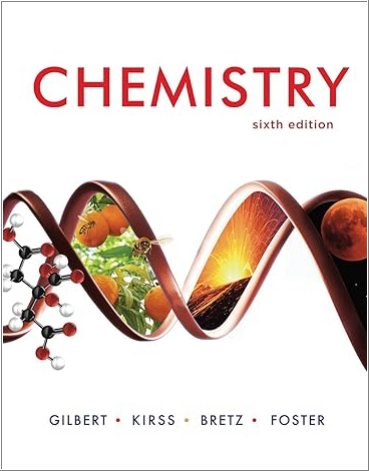
Chemistry Sixth Edition by Thomas R. Gilbert, ISBN-13: 978-0393697308
Original price was: $50.00.$19.99Current price is: $19.99.
Safe & secure checkout
Description
Description
Trustpilot
Chemistry Sixth Edition by Thomas R. Gilbert, ISBN-13: 978-0393697308
[PDF eBook eTextbook] – Available Instantly
- Publisher: W. W. Norton & Company; Sixth edition (July 1, 2020)
- Language: English
- 1312 pages
- ISBN-10: 0393697304
- ISBN-13: 978-0393697308
A research-based text and assessment package that helps students visualize chemistry as they solve problems.
The exciting new Sixth Edition expands on the visualization pedagogy from coauthor Stacey Lowery Bretz and makes it even easier to implement in the classroom. Based on her chemistry education research on how students construct and interpret multiple representations, art in the book and media has been revised to be more pedagogically effective and to address student misconceptions. New projected visualization questions help instructors assess students’ conceptual understanding in lecture or during exams. A new Interactive Instructor’s Guide provides innovative ways to incorporate research-based active learning pedagogy into the classroom.
Table of Contents:
Cover
Publisher’s Notice
Title Page
Copyright
Brief Contents
Contents
List of Applications
List of Animations
About the Authors
Preface
Half-title Page
Periodic Table of Elements
Atomic Color Palette, Units, and Constants
Chapter 1: Particles of Matter: Measurement and the Tools of Science
1.1 How and Why
1.2 Macroscopic and Particulate Views of Matter
1.3 Mixtures and How to Separate Them
1.4 A Framework for Solving Problems
1.5 Properties of Matter
1.6 States of Matter
1.7 The Scientific Method: Starting Off with a Bang
1.8 SI Units
1.9 Unit Conversions and Dimensional Analysis
1.10 Evaluating and Expressing Experimental Results
1.11 Testing a Theory: The Big Bang Revisited
Summary
Chapter 2: Atoms, Ions, and Molecules: Matter Starts Here
2.1 Atoms in Baby Teeth
2.2 Discovering the Structure of Atoms
2.3 Isotopes
2.4 Average Atomic Mass
2.5 The Periodic Table of the Elements
2.6 Trends in Compound Formation
2.7 Naming Inorganic Compounds and Writing Their Formulas
2.8 Organic Compounds: A First Look
2.9 Nucleosynthesis: The Origin of the Elements
Summary
Chapter 3: Stoichiometry: Mass, Formulas, and Reactions
3.1 Air, Life, and Molecules
3.2 The Mole
3.3 Writing Balanced Chemical Equations
3.4 Combustion Reactions
3.5 Stoichiometric Calculations and the Carbon Cycle
3.6 Limiting Reactants and Percent Yield
3.7 Determining Empirical Formulas from Percent Composition
3.8 Comparing Empirical and Molecular Formulas
3.9 Combustion Analysis
Summary
Chapter 4: Reactions in Solution: Aqueous Chemistry in Nature
4.1 Ions and Molecules in Oceans and Cells
4.2 Expressing Concentrations
4.3 Dilutions
4.4 Electrolytes and Nonelectrolytes
4.5 Acid–Base Reactions: Proton Transfer
4.6 Titrations
4.7 Precipitation Reactions
4.8 Oxidation–Reduction Reactions: Electron Transfer
Summary
Chapter 5: Properties of Gases: The Air We Breathe
5.1 Air: An Invisible Necessity
5.2 Atmospheric Pressure and Collisions
5.3 The Gas Laws
5.4 The Ideal Gas Law
5.5 Gases in Chemical Reactions
5.6 Gas Density
5.7 Dalton’s Law and Mixtures of Gases
5.8 The Kinetic Molecular Theory of Gases
5.9 Real Gases
Summary
Chapter 6: Thermochemistry: Energy Changes in Chemical Reactions
6.1 Sunlight Unwinding
6.2 Forms of Energy
6.3 Systems, Surroundings, and Energy Transfer
6.4 Enthalpy and Enthalpy Changes
6.5 Heating Curves, Molar Heat Capacity, and Specific Heat
6.6 Calorimetry: Measuring Heat Capacity and Enthalpies of Reaction
6.7 Hess’s Law
6.8 Standard Enthalpies of Formation and Reaction
6.9 Fuels, Fuel Values, and Food Values
Summary
Chapter 7: A Quantum Model of Atoms: Waves, Particles, and Periodic Properties
7.1 Rainbows of Light
7.2 Waves of Energy
7.3 Particles of Energy and Quantum Theory
7.4 The Hydrogen Spectrum and the Bohr Model
7.5 Electron Waves
7.6 Quantum Numbers and Electron Spin
7.7 The Sizes and Shapes of Atomic Orbitals
7.8 The Periodic Table and Filling the Orbitals of Multielectron Atoms
7.9 Electron Configurations of Ions
7.10 The Sizes of Atoms and Ions
7.11 Ionization Energies
7.12 Electron Affinities
Summary
Chapter 8: Chemical Bonds: What Makes a Gas a Greenhouse Gas?
8.1 Types of Chemical Bonds and the Greenhouse Effect
8.2 Lewis Structures
8.3 Polar Covalent Bonds
8.4 Resonance
8.5 Formal Charge: Choosing among Lewis Structures
8.6 Exceptions to the Octet Rule
8.7 The Lengths and Strengths of Covalent Bonds
Summary
Chapter 9: Molecular Geometry: Shape Determines Function
9.1 Biological Activity and Molecular Shape
9.2 Valence-Shell Electron-Pair Repulsion (VSEPR) Theory
9.3 Polar Bonds and Polar Molecules
9.4 Valence Bond Theory
9.5 Shape, Large Molecules, and Molecular Recognition
9.6 Molecular Orbital Theory
Summary
Chapter 10: Intermolecular Forces: The Uniqueness of Water
10.1 Intramolecular Forces versus Intermolecular Forces
10.2 Dispersion Forces
10.3 Interactions Involving Polar Molecules
10.4 Vapor Pressure of Pure Liquids
10.5 Phase Diagrams: Intermolecular Forces at Work
10.6 Some More Remarkable Properties of Water
10.7 Polarity and Solubility
10.8 Solubility of Gases in Water
Summary
Chapter 11: Solutions: Properties and Behavior
11.1 Interactions between Ions
11.2 Energy Changes during Formation and Dissolution of Ionic Compounds
11.3 Vapor Pressure of Solutions
11.4 Mixtures of Volatile Solutes
11.5 Colligative Properties of Solutions
11.6 Ion Exchange
Summary
Chapter 12: Solids: Crystals, Alloys, and Polymers
12.1 The Solid State
12.2 Structures of Metals
12.3 Alloys and Medicine
12.4 Ionic Solids and Salt Crystals
12.5 Allotropes of Carbon
12.6 Polymers
Summary
Chapter 13: Chemical Kinetics: Reactions in the Atmosphere
13.1 Cars, Trucks, and Air Quality
13.2 Reaction Rates
13.3 Effect of Concentration on Reaction Rate
13.4 Reaction Rates, Temperature, and the Arrhenius Equation
13.5 Reaction Mechanisms
13.6 Catalysts
Summary
Chapter 14: Chemical Equilibrium: How Much Product Does a Reaction Really Make?
14.1 The Dynamics of Chemical Equilibrium
14.2 The Equilibrium Constant
14.3 Relationships between Kc and Kp Values
14.4 Manipulating Equilibrium Constant Expressions
14.5 Equilibrium Constants and Reaction Quotients
14.6 Heterogeneous Equilibria
14.7 Le Châtelier’s Principle
14.8 Calculations Based on K
Summary
Chapter 15: Acid–Base Equilibria: Proton Transfer in Biological Systems
15.1 Acids and Bases: A Balancing Act
15.2 The Molecular Structures and Strengths of Acids and Bases
15.3 Conjugate Pairs and Their Complementary Strengths as Acids and Bases
15.4 pH and the Autoionization of Water
15.5 Ka and Kb, and the Ionization of Weak Acids and Bases
15.6 Calculating the pH of Acidic and Basic Solutions
15.7 Polyprotic Acids
15.8 Acidic and Basic Salts
Summary
Chapter 16: Additional Aqueous Equilibria: Chemistry and the Oceans
16.1 Ocean Acidification: Equilibrium under Stress
16.2 The Common-Ion Effect
16.3 pH Buffers
16.4 Indicators and Acid–Base Titrations
16.5 Lewis Acids and Bases
16.6 Formation of Complex Ions
16.7 Hydrated Metal Ions as Acids
16.8 Solubility Equilibria
Summary
Chapter 17: Thermodynamics: Spontaneous and Nonspontaneous Reactions and Processes
17.1 Spontaneous Processes
17.2 Entropy and the Second Law of Thermodynamics
17.3 Absolute Entropy and the Third Law of Thermodynamics
17.4 Calculating Entropy Changes
17.5 Free Energy
17.6 Temperature and Spontaneity
17.7 Free Energy and Chemical Equilibrium
17.8 Influence of Temperature on Equilibrium Constants
17.9 Driving the Human Engine: Coupled Reactions
17.10 Microstates: A Quantized View of Entropy
Summary
Chapter 18: Electrochemistry: The Quest for Clean Energy
18.1 Running on Electrons: Redox Chemistry Revisited
18.2 Voltaic and Electrolytic Cells
18.3 Standard Potentials
18.4 Chemical Energy and Electrical Work
18.5 A Reference Point: The Standard Hydrogen Electrode
18.6 The Effect of Concentration on Ecell
18.7 Relating Battery Capacity to Quantities of Reactants
18.8 Corrosion: Unwanted Electrochemical Reactions
18.9 Electrolytic Cells and Rechargeable Batteries
18.10 Fuel Cells and Flow Batteries
Summary
Chapter 19: Nuclear Chemistry: Applications in Science and Medicine
19.1 Energy and Nuclear Stability
19.2 Unstable Nuclei and Radioactive Decay
19.3 Measuring and Expressing Radioactivity
19.4 Calculations Involving Half-Lives of Radionuclides
19.5 Radiometric Dating
19.6 Biological Effects of Radioactivity
19.7 Medical Applications of Radionuclides
19.8 Nuclear Fission
19.9 Nuclear Fusion and the Quest for Clean Energy
Summary
Chapter 20: Organic and Biological Molecules: The Compounds of Life
20.1 Molecular Structure and Functional Groups
20.2 Organic Molecules, Isomers, and Chirality
20.3 The Composition of Proteins
20.4 Protein Structure and Function
20.5 Carbohydrates
20.6 Lipids
20.7 Nucleotides and Nucleic Acids
20.8 From Biomolecules to Living Cells
Summary
Chapter 21: The Main Group Elements: Life and the Periodic Table
21.1 Main Group Elements and Human Health
21.2 Periodic Properties of Main Group Elements
21.3 Major Essential Elements
21.4 Trace and Ultratrace Essential Elements
21.5 Nonessential Elements
21.6 Elements for Diagnosis and Therapy
Summary
Chapter 22: Transition Metals: Biological and Medical Applications
22.1 Transition Metals in Biology: Complex Ions
22.2 Naming Complex Ions and Coordination Compounds
22.3 Polydentate Ligands and Chelation
22.4 Crystal Field Theory
22.5 Magnetism and Spin States
22.6 Isomerism in Coordination Compounds
22.7 Coordination Compounds in Biochemistry
22.8 Coordination Compounds in Medicine
Summary
Appendix 1: Mathematical Procedures
Appendix 2: SI Units and Conversion Factors
Appendix 3: The Elements and Their Properties
Appendix 4: Chemical Bonds and Thermodynamic Data
Appendix 5: Equilibrium Constants
Appendix 6: Standard Reduction Potentials
Appendix 7: Naming Organic Compounds
Glossary
Answers to Particulate Review, Concept Tests, and Practice Exercises
Answers to Selected End-of-Chapter Questions and Problems
Credits
Index
Thomas R. Gilbert has a BS in chemistry from Clarkson and a PhD in analytical chemistry from MIT. After 10 years with the Research Department of the New England Aquarium in Boston, he joined the faculty of Northeastern University, where he is currently associate professor of chemistry and chemical biology. His research interests are in chemical and science education. He teaches general chemistry and science education courses and conducts professional development workshops for K–12 teachers. He has won Northeastern’s Excellence in Teaching Award and Outstanding Teacher of First-Year Engineering Students Award. He is a fellow of the American Chemical Society and in 2012 was elected to the ACS Board of Directors.
Rein V. Kirss received both a BS in chemistry and a BA in history as well as an MA in chemistry from SUNY Buffalo. He received his PhD in inorganic chemistry from the University of Wisconsin, Madison, where the seeds for this textbook were undoubtedly planted. After two years of postdoctoral study at the University of Rochester, he spent a year at Advanced Technology Materials, Inc., before returning to academics at Northeastern University in 1989. He is an associate professor of chemistry with an active research interest in organometallic chemistry.
Stacey Lowery Bretz is a University Distinguished Professor in the Department of Chemistry and Biochemistry at Miami University in Oxford, Ohio. She earned her BA in chemistry from Cornell University, MS from the Pennsylvania State University, and a PhD in chemistry education research (CER) from Cornell University. Stacey then spent one year at the University of California, Berkeley as a post-doc in the Department of Chemistry. Her research expertise includes the development of assessments to characterize chemistry misconceptions and measure learning in the chemistry laboratory. Of particular interest is method development with regard to the use of multiple representations (particulate, symbolic, and macroscopic) to generate cognitive dissonance, including protocols for establishing the reliability and validity of these measures. She has been honored with both of Miami University’s highest teaching awards: the E. Phillips Knox Award for Undergraduate Teaching in 2009 and the Distinguished Teaching Award for Excellence in Graduate Instruction and Mentoring in 2013. In 2015, she was honored as Chemist of the Year by the ACS Concinnati Local Section.
Natalie Foster is emeritus professor of chemistry at Lehigh University in Bethlehem, Pennsylvania. She received a BS in chemistry from Muhlenberg College and MS, DA, and PhD degrees from Lehigh University. Her research interests included studying poly(vinyl alcohol) gels by NMR as part of a larger interest in porphyrins and phthalocyanines as candidate contrast enhancement agents for MRI. She taught both semesters of the introductory chemistry class to engineering, biology, and other nonchemistry majors and a spectral analysis course at the graduate level. She is the recipient of the Christian R. and Mary F. Lindback Foundation Award for distinguished teaching.
What makes us different?
• Instant Download
• Always Competitive Pricing
• 100% Privacy
• FREE Sample Available
• 24-7 LIVE Customer Support
Reviews
There are no reviews yet.