

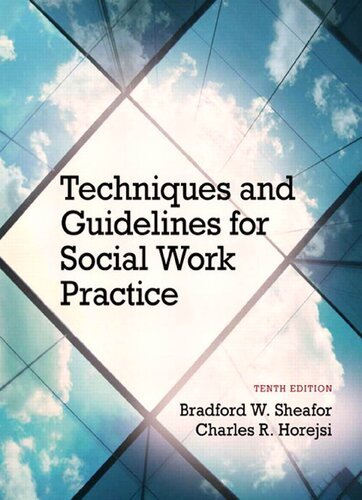
Techniques and Guidelines for Social Work Practice 10th Edition by Bradford W. Sheafor, ISBN-13: 978-0205965106
Original price was: $50.00.$19.99Current price is: $19.99.
Safe & secure checkout
Description
Description
Trustpilot
Techniques and Guidelines for Social Work Practice 10th Edition by Bradford W. Sheafor, ISBN-13: 978-0205965106
[PDF eBook eTextbook] – Available Instantly
- Publisher: Pearson; 10th edition (August 25, 2014)
- Language: English
- 592 pages
- ISBN-10: 0205965105
- ISBN-13: 978-0205965106
Emphasizes the different techniques needed for successful social work practice.
Techniques and Guidelines for Social Work Practice, 10/e demonstrates the unique place of social work among the helping professions. Readers will gain insight into the social worker’s professional roles, guiding principles, and the importance of evidence-based practice. This title provides students with easy access to the most current information on fundamental techniques and useful guidelines for social work practice from the generalist perspective. The 10th edition introduces 12 new techniques or guidelines corresponding to the national social work licensing examinations and the Council on Social Work Education’s list of essential practice behaviors.
Techniques and Guidelines for Social Work Practice is broken into five parts. Parts I and II provide knowledge, values, and competencies for effective social work practice, while Parts III through V contain 154 clear and readable descriptions of practice techniques, presented in a handbook format for convenient accessibility of information.
Table of Contents:
Title Page
Copyright Page
Acknowledgments
Contents
Preface
PART 1: SOCIAL WORK AND THE SOCIAL WORKER
1. The Domain of the Social Work Profession
The Social Work Domain
An Overview of Social Work Practice
Conclusion
Selected Bibliography
2. Merging Person with Profession
Selecting Social Work as a Career
Establishing Oneself as a Social Worker
The Interplay of One’s Personal and Professional Lives
A Self-Care Program for the Social Worker
Having Fun in Social Work
Conclusion
Selected Bibliography
3. Merging the Person’s Art with the Profession’s Science
The Social Worker as Artist
The Social Worker as Scientist
Conclusion
Selected Bibliography
PART 2: THE BUILDING BLOCKS OF SOCIAL WORK PRACTICE
4. The Roles and Functions Performed by Social Workers
Identifying Professional Roles
Conclusion
Selected Bibliography
5. Guiding Principles for Social Workers
Principles That Focus on the Social Worker
Principles That Guide Practice Activities
Conclusion
Selected Bibliography
6. Practice Frameworks for Social Work
Requirements of a Practice Framework
Guidelines for Selecting a Practice Framework
Selected Practice Frameworks
Conclusion
Selected Bibliography
7. Using Evidence in the Change Process
Conducting Evidence-Based Practice
Critical Thinking When Making Practice Decisions
Guiding the Planned Change Process
The Context of Planned Change
Identifying Actors in Planned Change
Phases of the Planned Change Process
Conclusion
Selected Bibliography
PART 3: TECHNIQUES COMMON TO ALL SOCIAL WORK PRACTICE
8. Basic Communication and Helping Skills
8.1 Creating an Effective Helping Relationship
8.2 Verbal Communication Skills
8.3 Nonverbal Communication Skills
8.4 Helping Skills
8.5 Enhancing Client Motivation
8.6 Understanding Emotions and Feelings
8.7 Responding to Defensive Communication
8.8 Applying Cultural Competence to Helping
9. Basic Skills for Agency Practice
9.1 Written Reports and Correspondence
9.2 Effective Telephone Communication
9.3 Using Information Technology
9.4 Client Records and Documentation
9.5 Dealing with Ethical Issues
9.6 Managing Time and Workload
9.7 Elements of Professional Behavior
PART 4: TECHNIQUES AND GUIDELINES FOR PHASES OF THE PLANNED CHANGE PROCESS
10. Intake and Engagement
Section A: Techniques and Guidelines for Direct Practice
10.1 Making the First Telephone Contact
10.2 Conducting the First Face-to-Face Meeting
10.3 Clarifying the Client’s Problem, Concern, or Request
10.4 Making a Referral
10.5 Obtaining, Protecting, and Releasing Client Information
10.6 Conducting an In-Home Interview
10.7 Engaging the Mandated Client
10.8 Responding to the Manipulative Client
10.9 Increasing Personal Safety in Dangerous Situations
10.10 Clarifying Roles and Responsibilities
10.11 Addressing Power Differentials with Clients
Section B: Techniques and Guidelines for Indirect Practice
10.12 Orienting Yourself to Your Agency
10.13 Selecting and Orienting New Staff and Volunteers
10.14 Orienting Yourself to Your Community
11. Data Collection and Assessment
Section A: Techniques and Guidelines for Direct Practice
11.1 Assessing a Client’s Social Functioning
11.2 The Meaning of Work in Social Functioning
11.3 The Social Assessment Report
11.4 Mapping Client Conditions
11.5 Expanding a Client’s Vision of Changes That Are Possible
11.6 Identifying Client Strengths
11.7 Assessing a Client’s Social Support
11.8 Assessing a Client’s Coping Strategies and Ego Defenses
11.9 Assessing a Client’s Role Performance
11.10 Assessing a Client’s Self-Concept
11.11 Assessing a Client’s Needed Level of Care
11.12 Using Questionnaires, Checklists, and Vignettes
11.13 Identifying Developmental Delays in Young Children
11.14 Assessing a Client’s Mental Status
11.15 Using the Diagnostic and Statistical Manual of Mental Disorders (DSM) and the Person-in-Enviro
11.16 Assessing a Child’s Need for Protection
11.17 Mandated Reporting of Abuse and Neglect
11.18 Referral for Psychological Testing
11.19 Assessing Family Functioning
11.20 Understanding the Family Life Cycle
11.21 Assessing Small-Group Functioning
11.22 Accessing Evidence-Based Information
Section B: Techniques and Guidelines for Indirect Practice
11.23 Assessing Agency Structure
11.24 Assessing Human Services Needs
11.25 Community Decision-Making Analysis
11.26 Analyzing Social Policy Implications
11.27 Conducting a Community Assets Assessment
12. Planning and Contracting
Section A: Techniques and Guidelines for Direct Practice
12.1 Selecting Target Problems and Goals
12.2 The Problem Search
12.3 The Client Needs List
12.4 Formulating Intervention Objectives
12.5 Written Service Contracts
12.6 Making Use of Informal Resources
12.7 Family Group Conferencing
12.8 The Small Group as a Resource
Section B: Techniques and Guidelines for Indirect Practice
12.9 Establishing and Changing Organizations
12.10 Agency Planning Processes
12.11 Selecting Change Issues for Advocacy
12.12 Project Planning and Evaluation
12.13 Planning a Primary Prevention Program
12.14 Participatory Action Planning
13. Intervention and Monitoring
Section A: Techniques and Guidelines for Direct Practice
13.1 Preparing for an Interview
13.2 Information, Advice, and Persuasion
13.3 Reinforcement and Related Behavioral Techniques
13.4 Behavioral Rehearsal
13.5 Behavioral Contracting
13.6 Role Reversal
13.7 Managing Self-Talk
13.8 Building Self-Esteem
13.9 Confrontation and Challenge
13.10 Reframing
13.11 Helping Clients Make Difficult Decisions
13.12 Helping Clients with Harmful Habits
13.13 Helping Clients with Financial Problems
13.14 Helping Clients in Crisis
13.15 Homework Assignments
13.16 The Feelings List
13.17 Client Advocacy
13.18 Client Empowerment
13.19 Resolving Conflict through Counseling and Mediation
13.20 Providing Support for Caregivers
13.21 Indirect Discussion of Self in Small Groups
13.22 Programming in Group Work
Section B: Techniques and Guidelines for Indirect Practice
13.23 Working with a Governing or Advisory Board
13.24 Conducting Effective Staff Meetings
13.25 Building Interprofessional Teamwork and Cooperation
13.26 Leading Small-Group Meetings
13.27 The RISK Technique
13.28 The Nominal Group Technique (NGT)
13.29 Chairing a Formal Committee
13.30 Problem Solving by a Large Group
13.31 Brainstorming
13.32 Class Advocacy
13.33 Teaching and Training
13.34 Preparing a Budget
13.35 Marketing and Fund-Raising for Human Services
13.36 Developing Grant Applications
13.37 Organizing Neighborhoods and Communities
13.38 Influencing Legislators and Other Decision Makers
14. Evaluation and Termination
Section A: Techniques and Guidelines for Direct Practice
14.1 Measuring Change with Frequency Counts
14.2 Measuring Change with Individualized Rating Scales
14.3 Measuring Change with Standardized Rating Scales
14.4 A Service Plan Outcome Checklist (SPOC)
14.5 Task Achievement Scaling (TAS)
14.6 Goal Attainment Scaling (GAS)
14.7 Single-Subject Designs (SSDs)
14.8 Termination of Service
Section B: Techniques and Guidelines for Indirect Practice
14.9 Program Evaluation
14.10 A Client Satisfaction Questionnaire (CSQ)
14.11 Agency Evaluation
PART 5: SPECIALIZED TECHNIQUES AND GUIDELINES FOR SOCIAL WORK PRACTICE
15. Guidelines for Working with Vulnerable Client Groups
15.1 The Client Experiencing Poverty
15.2 The Client Who is a Child
15.3 The Client Who is an Adolescent
15.4 The Client Who is a Parent or Grandparent
15.5 The Client Who is an Older Person
15.6 The Client Who is Experiencing Domestic Violence
15.7 The Client Who is at Risk of Suicide
15.8 The Client with an Intellectual Disability
15.9 The Client with Brain Injury
15.10 The Client with a Serious Physical Disability
15.11 The Client Who is Chemically Dependent
15.12 The Client with Serious Mental Illness
15.13 The Client with a Personality Disorder
15.14 The Client on Psychotropic Medication
15.15 The Client Who is Lesbian, Gay, Bisexual, or Transgender
15.16 The Client with an Eating Disorder
15.17 The Client Experiencing Grief or Loss
15.18 The Client with Concerns Related to Spirituality and Religion
15.19 The Client Who is Impacted by the Criminal Justice System
15.20 The Client or Family Affected by War
15.21 The Client or Family Experiencing an Adoption
15.22 The Client Who is an Immigrant or Refugee
15.23 The Client or Community Experiencing an Emergency or Disaster
16. Techniques for Sustaining Social Work Practice
16.1 Getting a Social Work Job
16.2 Preparing for Social Work Competency Exams
16.3 Developing Self-Awareness
16.4 Avoiding Compassion Fatigue and Stress Management
16.5 Dealing with Sexual Misconduct
16.6 Avoiding Malpractice Suits
16.7 Testifying in Court
16.8 Providing and Receiving Supervision
16.9 Building and Maintaining Mentoring Relationships
16.10 Consuming and Contributing to Professional Knowledge
16.11 Improving the Social Work Image
16.12 Becoming a Leader
Author Index
Subject Index
Brad W. Sheafor is Professor Emeritus of Social Work at Colorado State University where he taught a wide variety of courses in both the BSW and MSW programs. He also served in administrative positions including Director of the social work program, Associate Dean for Research and Interim Dean of the umbrella college that includes social work, Associate Director of the Human Factors Research Laboratory, and Co-Director of the Family and Youth Institute. Dr. Sheafor received Colorado State University’s Distinguished Service Award and the University Alumni Association’s Distinguished Faculty Award.
Charles Horejsi is currently Professor Emeritus at the University of Montana having served that university for a number of years as a faculty member teaching primarily child welfare and social work practice courses, as well as being involved with the Department of Social Work’s field instruction program. licensed clinical social worker, Dr. Horejsi had practice experience in marriage and family counseling, child welfare, and juvenile probation. He conducted agency staff training in more than a dozen states and received the Montana NASW’s “Social Worker of the Year” award recognizing his many contributions to strengthening the quality of social work in that state.
What makes us different?
• Instant Download
• Always Competitive Pricing
• 100% Privacy
• FREE Sample Available
• 24-7 LIVE Customer Support




Reviews
There are no reviews yet.