

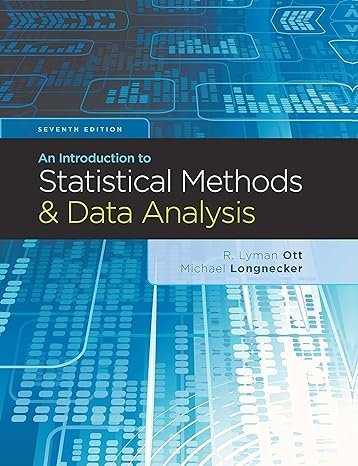
An Introduction to Statistical Methods and Data Analysis 7th Edition by R. Lyman Ott, ISBN-13: 978-1305269477
Original price was: $50.00.$14.99Current price is: $14.99.
Safe & secure checkout
Description
Description
Trustpilot
An Introduction to Statistical Methods and Data Analysis 7th Edition by R. Lyman Ott, ISBN-13: 978-1305269477
[PDF eBook eTextbook] – Available Instantly
- Publisher: Cengage Learning; 7th edition (June 11, 2015)
- Language: English
- 1296 pages
- ISBN-10: 1305269470
- ISBN-13: 978-1305269477
Ott and Longnecker’s AN INTRODUCTION TO STATISTICAL METHODS AND DATA ANALYSIS, Seventh Edition, provides a broad overview of statistical methods for advanced undergraduate and graduate students from a variety of disciplines who have little or no prior course work in statistics. The authors teach students to solve problems encountered in research projects, to make decisions based on data in general settings both within and beyond the university setting, and to become critical readers of statistical analyses in research papers and news reports. The first eleven chapters present material typically covered in an introductory statistics course, as well as case studies and examples that are often encountered in undergraduate capstone courses. The remaining chapters cover regression modeling and design of experiments.
Table of Contents:
Half Title
Title
Statement
Copyright
Contents
Preface
Part 1: Introduction
Ch 1: Statistics and the Scientific Method
1.1: Introduction
1.2: Why Study Statistics?
1.3: Some Current Applications of Statistics
1.4: A Note to the Student
1.5: Summary
1.6: Exercises
Part 2: Collecting Data
Ch 2: Using Surveys and Experimental Studies to Gather Data
2.1: Introduction and Abstract of Research Study
2.2: Observational Studies
2.3: Sampling Designs for Surveys
2.4: Experimental Studies
2.5: Designs for Experimental Studies
2.6: Research Study: Exit Polls Versus Election Results
2.7: Summary
2.8: Exercises
Part 3: Summarizing Data
Ch 3: Data Description
3.1: Introduction and Abstract of Research Study
3.2: Calculators, Computers, and Software Systems
3.3: Describing Data on a Single Variable: Graphical Methods
3.4: Describing Data on a Single Variable: Measures of Central Tendency
3.5: Describing Data on a Single Variable: Measures of Variability
3.6: The Boxplot
3.7: Summarizing Data from More Than One Variable: Graphs and Correlation
3.8: Research Study: Controlling for Student Background in the Assessment of Teaching
3.9: R Instructions
3.10: Summary and Key Formulas
3.11: Exercises
Ch 4: Probability and Probability Distributions
4.1: Introduction and Abstract of Research Study
4.2: Finding the Probability of an Event
4.3: Basic Event Relations and Probability Laws
4.4: Conditional Probability and Independence
4.5: Bayes’ Formula
4.6: Variables: Discrete and Continuous
4.7: Probability Distributions for Discrete Random Variables
4.8: Two Discrete Random Variables: The Binomial and the Poisson
4.9: Probability Distributions for Continuous Random Variables
4.10: A Continuous Probability Distribution: The Normal Distribution
4.11: Random Sampling
4.12: Sampling Distributions
4.13: Normal Approximation to the Binomial
4.14: Evaluating Whether or Not a Population Distribution Is Normal
4.15: Research Study: Inferences About Performance-Enhancing Drugs Among Athletes
4.16: R Instructions
4.17: Summary and Key Formulas
4.18: Exercises
Part 4: Analyzing the Data, Interpreting the Analyses, and Communicating the Results
Ch 5: Inferences About Population Central Values
5.1: Introduction and Abstract of Research Study
5.2: Estimation of μ
5.3: Choosing the Sample Size for Estimating μ
5.4: A Statistical Test for μ
5.5: Choosing the Sample Size for Testing μ
5.6: The Level of Significance of a Statistical Test
5.7: Inferences About μ for a Normal Population, σ Unknown
5.8: Inferences About μ When the Population Is Nonnormal and n Is Small: Bootstrap Methods
5.9: Inferences About the Median
5.10: Research Study: Percentage of Calories from Fat
5.11: Summary and Key Formulas
5.12: Exercises
Ch 6: Inferences Comparing Two Population Central Values
6.1: Introduction and Abstract of Research Study
6.2: Inferences About μ1 ― μ2: Independent Samples
6.3: A Nonparametric Alternative: The Wilcoxon Rank Sum Test
6.4: Inferences About μ1 ― μ2: Paired Data
6.5: A Nonparametric Alternative: The Wilcoxon Signed-Rank Test
6.6: Choosing Sample Sizes for Inferences About μ1 ― μ2
6.7: Research Study: Effects of an Oil Spill on Plant Growth
6.8: Summary and Key Formulas
6.9: Exercises
Ch 7: Inferences About Population Variances
7.1: Introduction and Abstract of Research Study
7.2: Estimation and Tests for a Population Variance
7.3: Estimation and Tests for Comparing Two Population Variances
7.4: Tests for Comparing t > 2 Population Variances
7.5: Research Study: Evaluation of Methods for Detecting E. coli
7.6: Summary and Key Formulas
7.7: Exercises
Ch 8: Inferences About More Than Two Population Central Values
8.1: Introduction and Abstract of Research Study
8.2: A Statistical Test About More Than Two Population Means: An Analysis of Variance
8.3: The Model for Observations in a Completely Randomized Design
8.4: Checking on the AOV Conditions
8.5: An Alternative Analysis: Transformations of the Data
8.6: A Nonparametric Alternative: The Kruskal–Wallis Test
8.7: Research Study: Effect of Timing on the Treatment of Port-Wine Stains with Lasers
8.8: Summary and Key Formulas
8.9: Exercises
Ch 9: Multiple Comparisons
9.1: Introduction and Abstract of Research Study
9.2: Linear Contrasts
9.3: Which Error Rate Is Controlled?
9.4: Scheffé’s S Method
9.5: Tukey’s W Procedure
9.6: Dunnett’s Procedure: Comparison of Treatments to a Control
9.7: A Nonparametric Multiple-Comparison Procedure
9.8: Research Study: Are Interviewers’ Decisions Affected by Different Handicap Types?
9.9: Summary and Key Formulas
9.10: Exercises
Ch 10: Categorical Data
10.1: Introduction and Abstract of Research Study
10.2: Inferences About a Population Proportion π
10.3: Inferences About the Difference Between Two Population Proportions, π1 – π2
10.4: Inferences About Several Proportions: Chi-Square Goodness-of-Fit Test
10.5: Contingency Tables: Tests for Independence and Homogeneity
10.6: Measuring Strength of Relation
10.7: Odds and Odds Ratios
10.8: Combining Sets of 2 x 2 Contingency Tables
10.9: Research Study: Does Gender Bias Exist in the Selection of Students for Vocational Education?
10.10: Summary and Key Formulas
10.11: Exercises
Ch 11: Linear Regression and Correlation
11.1: Introduction and Abstract of Research Study
11.2: Estimating Model Parameters
11.3: Inferences About Regression Parameters
11.4: Predicting New y-Values Using Regression
11.5: Examining Lack of Fit in Linear Regression
11.6: Correlation
11.7: Research Study: Two Methods for Detecting E. coli
11.8: Summary and Key Formulas
11.9: Exercises
Ch 12: Multiple Regression and the General Linear Model
12.1: Introduction and Abstract of Research Study
12.2: The General Linear Model
12.3: Estimating Multiple Regression Coefficients
12.4: Inferences in Multiple Regression
12.5: Testing a Subset of Regression Coefficients
12.6: Forecasting Using Multiple Regression
12.7: Comparing the Slopes of Several Regression Lines
12.8: Logistic Regression
12.9: Some Multiple Regression Theory (Optional)
12.10: Research Study: Evaluation of the Performance of an Electric Drill
12.11: Summary and Key Formulas
12.12: Exercises
Ch 13: Further Regression Topics
13.1: Introduction and Abstract of Research Study
13.2: Selecting the Variables (Step 1)
13.3: Formulating the Model (Step 2)
13.4: Checking Model Assumptions (Step 3)
13.5: Research Study: Construction Costs for Nuclear Power Plants
13.6: Summary and Key Formulas
13.7: Exercises
Ch 14: Analysis of Variance for Completely Randomized Designs
14.1: Introduction and Abstract of Research Study
14.2: Completely Randomized Design with a Single Factor
14.3: Factorial Treatment Structure
14.4: Factorial Treatment Structures with an Unequal Number of Replications
14.5: Estimation of Treatment Differences and Comparisons of Treatment Means
14.6: Determining the Number of Replications
14.7: Research Study: Development of a Low-Fat Processed Meat
14.8: Summary and Key Formulas
14.9: Exercises
Ch 15: Analysis of Variance for Blocked Designs
15.1: Introduction and Abstract of Research Study
15.2: Randomized Complete Block Design
15.3: Latin Square Design
15.4: Factorial Treatment Structure in a Randomized Complete Block Design
15.5: A Nonparametric Alternative—Friedman’s Test
15.6: Research Study: Control of Leatherjackets
15.7: Summary and Key Formulas
15.8: Exercises
Ch 16: The Analysis of Covariance
16.1: Introduction and Abstract of Research Study
16.2: A Completely Randomized Design with One Covariate
16.3: The Extrapolation Problem
16.4: Multiple Covariates and More Complicated Designs
16.5: Research Study: Evaluation of Cool-Season Grasses for Putting Greens
16.6: Summary
16.7: Exercises
Ch 17: Analysis of Variance for Some Fixed-, Random-, and Mixed-Effects Models
17.1: Introduction and Abstract of Research Study
17.2: A One-Factor Experiment with Random Treatment Effects
17.3: Extensions of Random-Effects Models
17.4: Mixed-Effects Models
17.5: Rules for Obtaining Expected Mean Squares
17.6: Nested Factors
17.7: Research Study: Factors Affecting Pressure Drops Across Expansion Joints
17.8: Summary
17.9: Exercises
Ch 18: Split-Plot, Repeated Measures, and Crossover Designs
18.1: Introduction and Abstract of Research Study
18.2: Split-Plot Designed Experiments
18.3: Single-Factor Experiments with Repeated Measures
18.4: Two-Factor Experiments with Repeated Measures on One of the Factors
18.5: Crossover Designs
18.6: Research Study: Effects of an Oil Spill on Plant Growth
18.7: Summary
18.8: Exercises
Ch 19: Analysis of Variance for Some Unbalanced Designs
19.1: Introduction and Abstract of Research Study
19.2: A Randomized Block Design with One or More Missing Observations
19.3: A Latin Square Design with Missing Data
19.4: Balanced Incomplete Block (BIB) Designs
19.5: Research Study: Evaluation of the Consistency of Property Assessors
19.6: Summary and Key Formulas
19.7: Exercises
Appendix: Statistical Tables
Answers to Selected Exercises
References
Index
R. Lyman Ott earned his Bachelor’s degree in Mathematics and Education and Master’s degree in Mathematics from Bucknell University, and Ph.D in Statistics from the Virginia Polytechnic Institute. After two years working in statistics in the pharmaceutical industry, Dr. Ott became assistant professor in the Statistic Department at the University of Florida in 1968 and was named associate professor in 1972. He joined Merrell-National laboratories in 1975 as head of the Biostatistics Department and then head of the company’s Research Data Center. He later became director of Biomedical Information Systems, Vice President of Global Systems and Quality Improvement in Research and Development, and Senior Vice President Business Process Improvement and Biometrics. He retired from the pharmaceutical industry in 1998, and now serves as consultant and Board of Advisors member for Abundance Technologies, Inc. Dr. Ott has published extensively in scientific journals and authored or co-authored seven college textbooks including Basic Statistical Ideas for Managers, Statistics: A Tool for the Social Sciences and An Introduction to Statistical Methods and Data Analysis. He has been a member of the Industrial Research Institute, the Drug Information Association and the Biometrics Society. In addition, he is a Fellow of the American Statistical Association and received the Biostatistics Career Achievement Award from the Pharmaceutical research and Manufacturers of America in 1998. He was also an All-American soccer player in college and is a member of the Bucknell University Athletic Hall of Fame.
Michael Longnecker currently serves as Professor and Associate Department Head at Texas A&M University. He received his B.S. at Michigan Technological University, his first M.S. at Western Michigan University, his second M.S. at Florida State University, and his Ph.D. at Florida State University. He is interested in Nonparametrics, Statistical Process Control, and Statistical Consulting.
What makes us different?
• Instant Download
• Always Competitive Pricing
• 100% Privacy
• FREE Sample Available
• 24-7 LIVE Customer Support
Reviews
There are no reviews yet.