

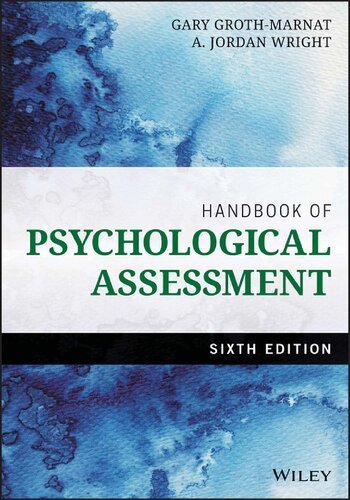
Handbook of Psychological Assessment 6th Edition by Gary Groth-Marnat, ISBN-13: 978-1118960646
Original price was: $50.00.$14.99Current price is: $14.99.
Safe & secure checkout
Description
Description
Handbook of Psychological Assessment 6th Edition by Gary Groth-Marnat, ISBN-13: 978-1118960646
[PDF eBook eTextbook] – Available Instantly
- Publisher: Wiley; 6th edition (May 2, 2016)
- Language: English
- 928 pages
- ISBN-10: 1118960645
- ISBN-13: 978-1118960646
Organized according to the sequence mental health professionals follow when conducting an assessment, this classic resource covers principles of assessment, evaluation, referral, treatment planning, and report writing. Written in a practical, skills-based manner, the sixth edition provides guidance on the most efficient methods for selecting and administering tests, interpreting assessment data, how to integrate test scores and develop treatment plans as well as instruction on ways to write effective, client-oriented psychological reports.
The latest edition provides through coverage of the most commonly used assessment instruments including the Wechsler Intelligence Scales, Wechsler Memory Scales, Minnesota Multiphasic Personality Inventory, Personality Assessment Inventory, Millon Clinical Multiaxial Inventory, NEO Personality Inventory, Rorschach, Thematic Apperception Test, and brief assessment instruments for treatment planning, monitoring, and outcome assessment. In addition, this sixth edition includes:
- Fully updated with new research and the DSM-5 and ICD-10
- New chapter on the NEO Personality Inventory-3. The NEO inventories provide a comprehensive assessment of adult and adolescent personality based on the strongly empirically supported Five Factor Model of personality.
- New chapter on the Personality Assessment Inventory (PAI), which has gained both strong empirical support and wide clinical popularity.
- Includes updated information on the newly developed Wechsler Intelligence Scale for Children, Fifth Edition (WISC-V).
- The chapter on the Minnesota Multiphasic Personality Inventory includes coverage of both the MMPI-2 and the MMPI-2-Restructured Form (MMPI-2-RF)
- The chapter on the Rorschach discusses both the Comprehensive System and the Rorschach Performance Assessment System (R-PAS).
- The “Use with Diverse Groups” sections reflect the more extensive use of assessment for a wide variety of populations and the importance of competently and sensitively working with diverse populations.
- Greater emphasis on making assessment more user friendly and consumer oriented. This is reflected in suggestions for using everyday language in reports, connecting interpretations to actual client behavior, strategies for wording interpretations in a manner likely to enhance client growth, and the importance of collaborating with clients.
- The treatment planning and clinical decision making chapter has been completely updated, and the psychological report writing chapter has been updated to include the American Psychological Association and Society for Personality Assessment’s current thinking about proficiency in personality assessment.
Table of Contents:
Title Page
Copyright
Contents
Preface
Chapter 1 Introduction
Organization of the Handbook
Role of the Clinician
Patterns of Test Usage in Clinical Assessment
Evaluating Psychological Tests
Theoretical Orientation
Practical Considerations
Standardization
Reliability
Validity
Validity in Clinical Practice
Incremental Validity
Conceptual Validity
Clinical Judgment
Data Gathering and Synthesis
Accuracy of Clinical Judgments
Clinical Versus Actuarial Prediction
Psychological Report
Phases in Clinical Assessment
Evaluating the Referral Question
Data Collection
Interpreting the Data
Recommended Reading
Chapter 2 Context of Clinical Assessment
Types of Referral Settings
Psychiatric Setting
General Medical Setting
Legal Context
Academic/Educational Context
Psychological Clinic
Ethical Practice of Assessment
Developing a Professional Relationship
Issues Related to Informed Consent
Labeling and Restriction of Freedom
Competent Use of Assessment Instruments
Interpretation and Use of Test Results
Communicating Test Results
Maintenance of Test Security and Release of Test Data
Assessing Diverse Groups
Language Skills
Cultural Competency
Cultural/Racial Identity
Test Equivalence and Appropriate Use of Instruments
Diagnostic Issues
Interpretation Guidelines
Selecting Psychological Tests
Computer-Assisted Assessment
Recommended Reading
Chapter 3 The Assessment Interview
History and Development
Early Developments
Developments during the 1940s and 1950s
Developments During the 1960s
Developments During the 1970s
Developments During the 1980s
The 1990s and Into the Millennium
Issues Related to Reliability and Validity
Assets and Limitations
The Assessment Interview and Case History
General Considerations
Interview Tactics
Mental Status Evaluation
General Appearance, Behavior, and Relatedness
Speech and Language
Feeling (Affect and Mood)
Perception and Thinking
Interpreting Interview Data
Structured Interviews
Structured Clinical Interview for the DSM
Schedule for Affective Disorders and Schizophrenia
Diagnostic Interview Schedule
Diagnostic Interview for Children and Adolescents
Recommended Reading
Chapter 4 Behavioral Assessment
History and Development
Issues Related to Reliability and Validity
Assets and Limitations
Strategies of Behavioral Assessment
Behavioral Interviewing
Behavioral Observation
Cognitive Behavioral Assessment
Cognitive Self-Report Inventories
Recording Cognitions
Psychophysiological Assessment
Recommended Reading
Chapter 5 Wechsler Intelligence Scales
Testing of Intelligence: Pros and Cons
History and Development
Reliability and Validity
WAIS-IV Reliability and Validity
WISC-V Reliability and Validity
Assets and Limitations
Use with Diverse Groups
Meaning of IQ Scores
Cautions and Guidelines in Administration
WAIS-IV/WISC-V Successive-Level Interpretation Procedure
Level I. Full Scale IQ (and Global Ability Index)
Level II. Indexes and Additional Groupings
Level III. Interpreting Subtest Variability
Level IV. Qualitative/Process Analysis
Level V. Intrasubtest Variability
Wechsler Indexes and Subtests
Verbal Comprehension Index/Subtests
Assessing Brain Damage
General Principles
Estimating Premorbid IQ
Alzheimer’s Disease
Assessing Additional Special Populations
Learning Disabilities
Intellectual Disability
Gifted Children
Short Forms
Wechsler Abbreviated Measure of Intelligence
Best Two- and Three-Subtest Short Forms
Best Four-Subtest Short Forms
Seven-Subtest Short Forms
Additional Short Forms (Satz-Mogel/Yudin and Modified Formats)
Recommended Reading
Chapter 6 Wechsler Memory Scales
History and Development
Reliability and Validity
Assets and Limitations
Use with Diverse Groups
Interpretation Procedure
Interpreting Patterns of Index Scores
Auditory Memory Index
Visual Memory Index
Auditory Memory Index versus Visual Memory Contrast Scaled Score
Visual Working Memory
Visual Working Memory Index Versus Visual Memory Index Contrast Scaled Score
Immediate Memory Index
Delayed Memory Index
Immediate Memory Index Versus Delayed Memory Index Contrast Scaled Score
Comparing Scores on the WAIS-IV and the WMS-IV
General Ability Index Versus Auditory Memory Index
General Ability Index Versus Visual Memory Index
General Ability Index Versus Visual Working Memory Index
General Ability Index Versus Immediate Memory Index
General Ability Index Versus Delayed Memory Index
Additional Considerations: Malingering and Evaluating Change
Recommended Reading
Chapter 7 Minnesota Multiphasic Personality Inventory
History and Development
Reliability and Validity
Assets and Limitations
Use with Diverse Groups
Age
Ethnicity
Administration
MMPI-2 Interpretation Procedure
Step 1. Completion Time
Step 2. Score and Plot the Profile
Step 3. Organize the Scales and Identify the Code Type
Step 4. Determine Profile Validity
Step 5. Determine Overall Level of Adjustment
Step 6. Describe Symptoms, Behaviors, and Personality Characteristics
Step 7. Provide Diagnostic Impressions
Step 8. Elaborate on Treatment Implications and Recommendations
MMPI-2 Computerized Interpretation
MMPI-2 Validity Scales
? “Scale” (Cannot Say, Cs)
VRIN (Variable Response Inconsistency Scale)
TRIN (True Response Inconsistency Scale)
F Scale (Infrequency)
Fb (F back) Scale (MMPI-2); F1 and F2 (MMPI-A)
Fp (Infrequency-Psychopathology) Scale
Fake Bad Scale (FBS)
L (Lie) Scale
K (Correction) Scale
S (Superlative) Scale
MMPI-2 Clinical Scales
Scale 1. Hypochondriasis (Hs)
Scale 2. Depression (D)
Scale 3. Hysteria (Hy)
Scale 4. Psychopathic Deviate (Pd)
Scale 5. Masculinity-Femininity (Mf)
Scale 6. Paranoia (Pa)
Scale 7. Psychasthenia (Pt)
Scale 8. Schizophrenia (Sc)
Scale 9. Hypomania (Ma)
Scale 0. Social Introversion (Si)
MMPI-2 2-Point Codes
12/21
13/31
14/41 (Rare Code)
18/81
19/91 (Rare Code)
23/32
24/42
26/62
27/72
28/82
29/92
34/43
36/63
38/83 (Rare Code)
45/54
46/64
47/74
48/84
49/94
68/86
69/96
78/87
89/98
MMPI-2 Content Scales
Internal Symptomatic Behaviors
External Aggressive Tendencies
Negative Self-View
General Problem Areas Cluster
MMPI-A Content Scales
MMPI-2 Harris-Lingoes and Si Subscales
Scale 2. Depression
Scale 3. Hysteria
Scale 4. Psychopathic Deviate
Scale 6. Paranoia
Scale 8. Schizophrenia
Scale 9. Hypomania
Scale 0. Social Introversion
MMPI-2 Critical Items
MMPI-2 and MMPI-A Supplementary Scales
MMPI-2 Supplementary Scales
MMPI-A Supplementary Scales
MMPI-2-RF Interpretation Procedure
Step 1. Score and Plot the Profile
Step 2. Determine Profile Validity
Step 3. Describe Symptoms, Behaviors, and Personality Characteristics from Substantive Scales
Step 4. Provide Diagnostic Impressions
Step 5. Elaborate on Treatment Implications and Recommendations
MMPI-2-RF Validity Scales
Content Nonresponsiveness Scales
Overreporting Scales
Underreporting Scales
MMPI-2-RF Higher-Order Scales
Emotional/Internalizing Dysfunction (EID)
Thought Dysfunction (THD)
Behavioral/Externalizing Dysfunction (BXD)
MMPI-2-RF Restructured Clinical Scales
Demoralization (RCd)
Somatic Complaints (RC1)
Low Positive Emotions (RC2)
Cynicism (RC3)
Antisocial Behavior (RC4)
Ideas of Persecution (RC6)
Dysfunctional Negative Emotions (RC7)
Aberrant Experiences (RC8)
Hypomanic Activation (RC9)
MMPI-2-RF Specific Problem Scales
Somatic/Cognitive Scales
Internalizing Scales
Externalizing Scales
Interpersonal Scales
Interest Scales
Aesthetic-Literary Interests (AES)
Mechanical-Physical Interests (MEC)
MMPI-2-RF Personality Psychopathology Five Scales (PSY-5)
Aggressiveness-Revised (AGGR-r)
Psychoticism-Revised (PSYC-r)
Disconstraint-Revised (DISC-r)
Negative Emotionality/Neuroticism-Revised (NEGE-r)
Introversion/Low Positive Emotionality-Revised (INTR-r)
Recommended Reading
Chapter 8 Personality Assessment Inventory
History and Development
Reliability and Validity
Assets and Limitations
Use with Diverse Groups
Interpretation Procedure
1. Interpreting Test Validity
2. Analysis of Critical Items
3. Full Scale Interpretation
4. Subscale Interpretation
5. Configural Interpretation
Validity Scales
Inconsistency (ICN)
Infrequency (INF)
Negative Impression (NIM, MAL, RDF)
Positive Impression (PIM, DEF, CDF, ALC Est, DRG Est)
Clinical Scales
Somatic Complaints (SOM)
Anxiety (ANX)
Anxiety-Related Disorders (ARD)
Depression (DEP)
Mania (MAN)
Paranoia (PAR)
Schizophrenia (SCZ)
Borderline Features (BOR)
Antisocial Features (ANT)
Alcohol Problems (ALC)
Drug Problems (DRG)
Treatment Scales
Aggression (AGG)
Suicidal Ideation (SUI)
Stress (STR)
Nonsupport (NON)
Treatment Rejection (RXR)
Interpersonal Scales
Dominance (DOM)
Warmth (WRM)
Additional Clusters
Self-Concept
Interpersonal Style
Environmental Perception
Potential for Dangerousness
Critical Items
Recommended Reading
Chapter 9 Millon Clinical Multiaxial Inventory
History and Development
Development of the Original MCMI
Development of the MCMI-II
Development of the MCMI-III
Development of the MCMI-IV
Theoretical Considerations
Reliability and Validity
Assets and Limitations
Use with Diverse Groups
Interpretation Procedure
1. Determine Profile Validity
2. Interpret the Personality Disorder Scales
3. Interpret Clinical Syndrome Scales
4. Review Noteworthy Responses (Critical Items)
5. Provide Diagnostic Impressions
6. Elaborate on Treatment Implications and Recommendations
Validity Scales
Invalidity Index (Scale V)
Inconsistency Index (Scale W)
Disclosure Index (X)
Desirability Index (Y)
Debasement Index (Z)
Clinical Personality Patterns
Scale 1: Apathetic-Asocial-Schizoid (AASchd)
Scale 2A: Shy-Reticent-Avoidant (SRAvoid)
Scale 2B: Dejected-Forlorn-Melancholic (DFMelan)
Scale 3: Deferential-Attached-Dependent (DADepn)
Scale 4A: Sociable-Pleasuring-Histrionic (SPHistr)
Scale 4B: Ebullient-Exuberant-Turbulent (EETurbu)
Scale 5: Confident-Egotistic-Narcissistic (CENarc)
Scale 6A: Aggrandizing-Devious-Antisocial (ADAntis)
Scale 6B: Assertive-Denigrating-Sadistic (ADSadis)
Scale 7: Reliable-Constricted-Compulsive (RCComp)
Scale 8A: Discontented-Resentful-Negativistic (DRNegat)
Scale 8B: Abused-Aggrieved-Masochistic (AAMasoc)
Severe Personality Pathology
Scale S: Eccentric-Schizotypal-Schizophrenic (ESSchizoph)
Scale C: Unstable-Borderline-Cyclophrenic (UBCycloph)
Scale P: Mistrustful-Paranoid-Paraphrenic (MPParaph)
Clinical Syndromes
Scale A: Generalized Anxiety
Scale H: Somatic Symptom
Scale N: Bipolar Spectrum
Scale D: Persistent Depression
Scale B: Alcohol Use
Scale T: Drug Use
Scale R: Posttraumatic Stress
Severe Syndromes
Scale SS: Schizophrenic Spectrum
Scale CC: Major Depression
Scale PP: Delusional
Recommended Reading
Chapter 10 NEO Personality Inventory
History and Development
Reliability and Validity
Assets and Limitations
Use with Diverse Groups
Interpretation Procedure
Individual Scales
Personality Styles
Recommended Reading
Chapter 11 The Rorschach
History and Development
Reliability and Validity
Assets and Limitations
Use with Diverse Groups
Comprehensive System: Administration
Step 1: Introducing the Respondent to the Technique
Step 2: Giving the Testing Instructions
Step 3: The Response (Association) Phase
Step 4: Inquiry
Comprehensive System: Coding
Location and Developmental Quality
Determinants, Form Quality, and Organizational Activity
Content
Popular Responses
Special Scores
Comprehensive System: Scoring the Structural Summary
Comprehensive System: Interpretation
Location
Determinants
Content
Special Scores
Ratios, Percentages, Derivations
R-PAS: Administration
Step 1: Establishing Rapport
Step 2: Giving the Testing Instructions
Step 3: The Response Phase
Step 4: The Clarification Phase
R-PAS: Coding
Location and Space
Content
Object Qualities
Form Quality
Popular Responses
Determinants
Cognitive Codes
Thematic Codes
R-PAS: Scoring the Structural Summary
R-PAS: Interpretation
Administration Behaviors and Observations
Engagement and Cognitive Processing: Page 1
Perception and Thinking Problems: Page 1
Stress and Distress: Page 1
Self and Other Representation: Page 1
Engagement and Cognitive Processing: Page 2
Perception and Thinking Problems: Page 2
Stress and Distress: Page 2
Self and Other Representation: Page 2
Recommended Reading
Chapter 12 Screening for Neuropsychological Impairment
History and Development
Interviewing for Brain Impairment
Domains of Neuropsychological Functioning
Attention
Language
Memory
Visuospatial Functions
Executive Functions
Bender Visual-Motor Gestalt Test, Second Edition
History and Development
Reliability and Validity
Assets and Limitations
Administration
Scoring
Interpretation Guidelines
Repeatable Battery for the Assessment of Neuropsychological Status~Update
History and Development
Reliability and Validity
Assets and Limitations
Administration
Interpretation Guidelines
Recommended Reading
Chapter 13 Brief Instruments for Treatment Planning, Monitoring, and Outcome Assessment
Selecting Brief Instruments
Symptom Checklist-90-R and Brief Symptom Inventory
Reliability and Validity
Use with Diverse Populations
Interpretation
Beck Depression Inventory-II
Reliability and Validity
Use with Diverse Groups
Interpretation
State Trait Anxiety Inventory
Reliability and Validity
Use with Diverse Groups
Interpretation
Recommended Reading
Chapter 14 Treatment Planning and Clinical Decision Making
Development and Approaches to Treatment Planning
Intervention Options
Clinical Decision Making
Case Formulation
Understanding the Problems
Diagnosis
Functional Impairment
Problem Complexity and Chronicity
Subjective Distress
Understanding Problem Context
Coping Style
Social Support
Current Life Circumstances
Treatment-Specific Client Characteristics
Resistance
Stage of Change
Other Client Characteristics
The Systematic Treatment Selection (STS)/Innerlife Approach
Recommended Reading
Chapter 15 The Psychological Report
General Guidelines
Comprehensiveness
Feedback
Format for a Psychological Report
Referral Question
Evaluation Procedures
Background Information (also Referred to as Relevant History)
Behavioral Observations
Interpretation and Impressions
Summary and Recommendations
Sample Reports
Recommended Reading
Appendix A Test Publishers/Distributors
Appendix B Testing Organizations
References
Author Index
Subject Index
EULA
What makes us different?
• Instant Download
• Always Competitive Pricing
• 100% Privacy
• FREE Sample Available
• 24-7 LIVE Customer Support




Reviews
There are no reviews yet.