

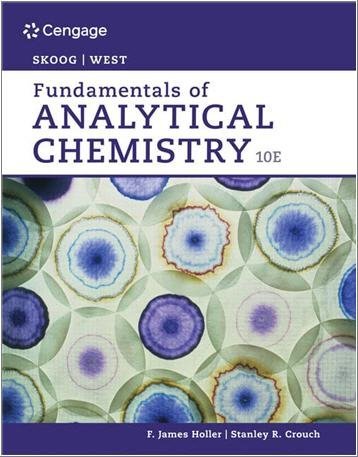
Fundamentals of Analytical Chemistry 10th Edition by Douglas A. Skoog, ISBN-13: 978-0357450390
Original price was: $50.00.$19.99Current price is: $19.99.
Safe & secure checkout
Description
Description
Fundamentals of Analytical Chemistry 10th Edition by Douglas A. Skoog, ISBN-13: 978-0357450390
[PDF eBook eTextbook]
- Publisher: Cengage Learning; 10th edition (August 4, 2021)
- Language: English
- 1072 pages
- ISBN-10: 0357450396
- ISBN-13: 978-0357450390
Discover the principles and practices behind analytical chemistry as you study its applications in medicine, industry and the sciences with Skoog/West/Holler/Crouch’s FUNDAMENTALS OF ANALYTICAL CHEMISTRY, 10th Edition. This award-winning author team presents the latest developments in analytical chemistry today using a reader-friendly yet systematic and thorough approach. Each chapter begins with a compelling story and stunning visuals. Dynamic photos from renowned chemistry photographer Charlie Winters capture attention while reinforcing key principles. New features highlight chemistry-related careers. You also learn how to use Excel 2019 as a problem-solving tool in analytical chemistry with new exercises, examples and a no-cost supplement by the text authors. OWLv2 online homework tool is also available to help you master the principles of analytical chemistry today.
Table of Contents:
Contents in Brief
Contents
Preface
Chapter 1: The Nature of Analytical Chemistry
1A The Role of Analytical Chemistry
1B Quantitative Analytical Methods
1C A Typical Quantitative Analysis
1D An Integral Role for Chemical Analysis: Feedback Control Systems
Part I: Quality of Analytical Measurements
Chapter 2: Calculations Used in Analytical Chemistry
2A Some Important Units of Measurement
2B Solutions and Their Concentrations
2C Chemical Stoichiometry
2D Calculations Using Microsoft Excel
Chapter 3: Precision and Accuracy of Chemical Analyses
3A Some Important Terms
3B Systematic Errors
Chapter 4: Random Errors in Chemical Analysis
4A The Nature of Random Errors
4B Statistical Treatment of Random Errors
4C Standard Deviation of Calculated Results
4D Reporting Computed Data
Chapter 5: Statistical Data Treatment and Evaluation
5A Confidence Intervals
5B Statistical Aids to Hypothesis Testing
5C Analysis of Variance
5D Detection of Gross Errors
Chapter 6: Sampling, Standardization, and Calibration
6A Analytical Samples and Methods
6B Sampling
6C Automated Sample Handling
6D Standardization and Calibration
6E Figures of Merit for Analytical Methods
Part II: Chemical Equilibria
Chapter 7: Aqueous Solutions and Chemical Equilibria
7A The Chemical Composition of Aqueous Solutions
7B Chemical Equilibrium
7C Buffer Solutions
Chapter 8: Effect of Electrolytes on Chemical Equilibria
8A The Effect of Electrolytes on Chemical Equilibria
8B Activity Coefficients
Chapter 9: Solving Equilibrium Problems for Complex Systems
9A Solving Multiple-Equilibrium Problems Using a Systematic Method
9B Calculating Solubilities by the Systematic Method
9C Separation of Ions by Control of the Concentration of the Precipitating Agent
Part III: Classical Methods of Analysis
Chapter 10: Gravimetric Methods of Analysis
10A Precipitation Gravimetry
10B Calculation of Results from Gravimetric Data
10C Applications of Gravimetric Methods
Chapter 11: Titrations in Analytical Chemistry
11A Some Terms Used in Volumetric Titrations
11B Standard Solutions
11C Volumetric Calculations
11D Gravimetric Titrations
11E Titration Curves
Chapter 12: Principles of Neutralization Titrations
12A Solutions and Indicators for Acid-Base Titrations
12B Titration of Strong Acids and Bases
12C Titration Curves for Weak Acids
12D Titration Curves for Weak Bases
12E The Composition of Solutions During Acid-Base Titrations
Chapter 13: Complex Acid-Base Systems
13A Mixtures of Strong and Weak Acids or Strong and Weak Bases
13B Polyfunctional Acids and Bases
13C Buffer Solutions Involving Polyprotic Acids
13D Calculation of the pH of Solutions of NaHA
13E Titration Curves for Polyfunctional Acids
13F Titration Curves for Polyfunctional Bases
13G Titration Curves for Amphiprotic Species
13H Composition of Polyprotic Acid Solutions as a Function of pH
Chapter 14: Applications of Neutralization Titrations
14A Reagents for Neutralization Titrations
14B Typical Applications of Neutralization Titrations
Chapter 15: Complexation and Precipitation Reactions and Titrations
15A The Formation of Complexes
15B Titrations with Inorganic Complexing Agents
15C Organic Complexing Agents
15D Aminocarboxylic Acid Titrations
Part IV: Electrochemical Methods
Chapter 16: Introduction to Electrochemistry
16A Characterizing Oxidation/Reduction Reactions
16B Electrochemical Cells
16C Electrode Potentials
Chapter 17: Applications of Standard Electrode Potentials
17A Calculating Potentials of Electrochemical Cells
17B Determining Standard Potentials Experimentally
17C Calculating Redox Equilibrium Constants
17D Constructing Redox Titration Curves
17E Oxidation/Reduction Indicators
17F Potentiometric End Points
Chapter 18: Applications of Oxidation/Reduction Titrations
18A Auxiliary Oxidizing and Reducing Reagents
18B Applying Standard Reducing Agents
18C Applying Standard Oxidizing Agents
Chapter 19: Potentiometry
19A General Principles
19B Reference Electrodes
19C Liquid Junction Potentials
19D Indicator Electrodes
19E Instruments for Measuring Cell Potential
19F Direct Potentiometry
19G Potentiometric Titrations
19H Potentiometric Determination of Equilibrium Constants
Chapter 20: Bulk Electrolysis: Electrogravimetry and Coulometry
20A The Effect of Current on Cell Potential
20B The Selectivity of Electrolytic Methods
20C Electrogravimetric Methods
20D Coulometric Methods
Chapter 21: Voltammetry
21A Excitation Signals in Voltammetry
21B Voltammetric Instrumentation
21C Hydrodynamic Voltammetry
21D Polarography
21E Cyclic Voltammetry
21F Pulse Voltammetry
21G Applications of Voltammetry
21H Stripping Methods
21I Voltammetry with Microelectrodes
Part V: Spectrochemical Analysis
Chapter 22: Introduction to Spectrochemical Methods
22A Properties of Electromagnetic Radiation
22B Interaction of Radiation and Matter
22C Absorption of Radiation
22D Emission of Electromagnetic Radiation
Chapter 23: Instruments for Optical Spectrometry
23A Instrument Components
23B Ultraviolet/Visible Photometers and Spectrophotometers
23C Infrared Spectrophotometers
Chapter 24: Molecular Absorption Spectrometry
24A Ultraviolet and Visible Molecular Absorption Spectroscopy
24B Automated Photometric and Spectrophotometric Methods
24C Infrared Absorption Spectroscopy
Chapter 25: Molecular Fluorescence Spectroscopy
25A Theory of Molecular Fluorescence
25B Effect of Concentration on Fluorescence Intensity
25C Fluorescence Instrumentation
25D Applications of Fluorescence Methods
25E Molecular Phosphorescence Spectroscopy
25F Chemiluminescence Methods
Chapter 26: Atomic Spectroscopy
26A Origins of Atomic Spectra
26B Production of Atoms and Ions
26C Atomic Emission Spectrometry
26D Atomic Absorption Spectrometry
26E Atomic Fluorescence Spectrometry
Chapter 27: Mass Spectrometry
27A Principles of Mass Spectrometry
27B Mass Spectrometers
27C Atomic Mass Spectrometry
27D Molecular Mass Spectrometry
Part VI: Kinetics and Separations
Chapter 28: Kinetic Methods of Analysis
28A Rates of Chemical Reactions
28B Determining Reaction Rates
28C Applications of Kinetic Methods
Chapter 29: Introduction to Analytical Separations
29A Separation by Precipitation
29B Separation of Species by Distillation
29C Separation by Extraction
29D Separating Ions by Ion Exchange
29E Chromatographic Separations
Chapter 30: Gas Chromatography
30A Instruments for Gas-Liquid Chromatography
30B Gas Chromatographic Columns and Stationary Phases
30C Applications of Gas-Liquid Chromatography
30D Gas-Solid Chromatography
Chapter 31: High-Performance Liquid Chromatography
31A Instrumentation
31B Partition Chromatography
31C Adsorption Chromatography
31D Ion Chromatography
31E Size-Exclusion Chromatography
31F Affinity Chromatography
31G Chiral Chromatography
31H Comparison of High-Performance Liquid Chromatography and Gas Chromatography
Chapter 32: Miscellaneous Separation Methods
32A Supercritical Fluid Separations
32B Planar Chromatography
32C Capillary Electrophoresis
32D Capillary Electrochromatography
32E Field-Flow Fractionation
Glossary
Appendix 1: The Literature of Analytical Chemistry
Appendix 2: Solubility Product Constants at 25 Degrees Celsius
Appendix 3: Acid Dissociation Constants at 25 Degrees Celsius
Appendix 4: Formation Constants at 25 Degrees Celsius
Appendix 5: Standard and Formal Electrode Potentials
Appendix 6: Use of Exponential Numbers and Logarithms
Appendix 7: Volumetric Calculations Using Normality and Equivalent Weight
Appendix 8: Compounds Recommended for the Preparation of Standard Solutions of Some Common Elements
Appendix 9: Derivation of Error Propagation Equations
Answers to Selected Questions and Problems
Index
Douglas A. Skoog (deceased) was a professor of chemistry at Stanford University and the lead author of several best-selling texts during his career. He earned a B.S. in chemistry from Oregon State University and his Ph.D. in analytical chemistry from the University of Illinois. Dr. Skoog was the 1999 recipient of the American Chemical Society award in analytical chemistry, sponsored by the Fisher Scientific Company. The same year, he was named a fellow of the American Association for the Advancement of Science. In 1993, he received the ACS Division of Analytical Chemistry Award for Excellence in Teaching.
Donald M. West (deceased) was a professor of chemistry at San Jose State University.
F. James Holler is professor emeritus of chemistry and is a recipient of the Alumni Association Great Teacher Award at the University of Kentucky. He received his Ph.D. from Michigan State University. In addition to his role as co-author of several bestselling texts, he is co-creator of the world-famous Periodic Table of Comic Books.
Stanley R. Crouch is professor emeritus at Michigan State University. He received his undergraduate and M.S. degrees from Stanford University and his Ph.D. in analytical chemistry from the University of Illinois. He is the recipient of the 2001 American Chemical Society Division of Analytical Chemistry Award in Chemical Instrumentation and the 1996 ACS Division of Analytical Chemistry Award for Excellence in Teaching.
What makes us different?
• Instant Download
• Always Competitive Pricing
• 100% Privacy
• FREE Sample Available
• 24-7 LIVE Customer Support
Reviews
There are no reviews yet.