

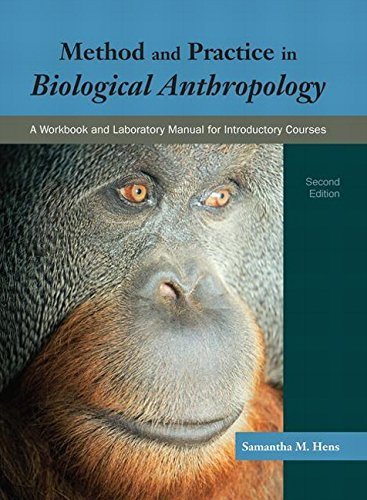
Method and Practice in Biological Anthropology 2nd Edition by Samantha M. Hens, ISBN-13: 978-0133825862
Original price was: $50.00.$14.99Current price is: $14.99.
Safe & secure checkout
Description
Description
Method and Practice in Biological Anthropology: A Workbook and Laboratory Manual for Introductory Courses 2nd Edition by Samantha M. Hens, ISBN-13: 978-0133825862
[PDF eBook eTextbook]
- Publisher: Pearson; 2nd edition (August 11, 2014)
- Language: English
- 320 pages
- ISBN-10: 0133825868
- ISBN-13: 978-0133825862
A valuable resource for you Biological Anthropology lab.
Method and Practice in Biological Anthropology: A Workbook and Laboratory Manual for Introductory Courses complements a wide variety of introductory level laboratory courses in biological anthropology. It easily functions with a well-equipped laboratory, or it may be used as a primary source of photos and/or exercises, providing optimum flexibility to suit most laboratory environments. The book is organized into four sections, to reflect the organization of the typical introductory biological anthropology course: genetics and evolution, the human skeleton, non human primates, and our fossil ancestors.
Table of Contents:
Contents
Preface
What’s New in the Second Edition
About the Author
Chapter 1 The Scientific Method
objectives
Reading Questions
The Nature of Science
Exercise 1
The Scientific Method
Experimental Design
Exercise 2
Exercise 3
Exercise 4
Exercise 5
The Research Article
Exercise 6
Science and Religion
Post-Lab Questions
Chapter 2 Cell Biology and DNA
objectives
Reading Questions
Cells and Cell Structure
Chromosome Structure
Exercise 1
Exercise 2
Cell Division
Exercise 3
Exercise 4
Recombination (Crossing Over)
Exercise 5
DNA Structure and Function
Exercise 6
Exercise 7
Exercise 8
Post-Lab Questions
Chapter 3 Principles of Inheritance
objectives
Reading Questions
The Basic Principles of Inheritance
Exercise 1
Exercise 2
Exercise 3
Mendel’s Laws of Inheritance
Exercise 4
Punnett Squares
Exercise 5
Exercise 6
Incomplete Dominance, Codominance, and Sex-Linked Inheritance
Exercise 7
Exercise 8
Mendelian Traits in Humans
Exercise 9
Exercise 10
Exercise 11
Dihybrid Crosses
Exercise 12
Exercise 13
Ethics and The Future
Exercise 14
Post-Lab Questions
Chapter 4 Human Variation: Blood Groups and Pedigree Analysis
objectives
Reading Questions
Blood Types and Blood Typing
Exercise 1
Exercise 2
Exercise 3
Determining Parentage
Exercise 4
Pedigree Analysis
Exercise 5
Exercise 6
Exercise 7
Exercise 8
DNA Fingerprinting
Post-Lab Questions
Chapter 5 The Hardy–Weinberg Principle: Genetics of Populations
objectives
Reading Questions
Evolution, Populations, and the Hardy–Weinberg Principle
Exercise 1
Exercise 2
Exercise 3
Exercise 4
Forces of Evolution (Evolutionary Agents)
Exercise 5
Exercise 6
Post-Lab Questions
Chapter 6 Introduction to the Human Skeleton
objectives
Reading Questions
Introduction
The Skeletal System
Exercise 1
Bone Structure
Exercise 2
Exercise 3
Directional Terminology
Exercise 4
Body Movements
Post-Lab Questions
Chapter 7 The Axial Skeleton
objectives
Reading Questions
Introduction
The Skull
Exercise 1
Exercise 2
Exercise 3
Exercise 4
The Human Dentition
The Vertebral Column
Exercise 5
The Thorax
The Ribs
Exercise 6
Post-Lab Questions
Chapter 8 The Appendicular Skeleton
objectives
Reading Questions
Introduction
The Pectoral Girdle
Exercise 1
Exercise 2
The Upper Limb
Exercise 3
Exercise 4
The Pelvic Girdle
Exercise 5
Exercise 6
The Lower Limb
Exercise 7
Exercise 8
Exercise 9
Post-Lab Questions
Chapter 9 Forensic Anthropology and Bioarchaeology
objectives
Reading Questions
Human Skeletal Variation
Osteometry: Postcranial Measurements
Exercise 1
Stature Estimation
Exercise 2
Osteometry: Cranial Measurements
Exercise 3
Indices
Exercise 4
Exercise 5
Sex Determination
Exercise 6
Exercise 7
Exercise 8
Exercise 9
Population Affinity: Ancestry or Race
Exercise 10
Exercise 11
Age at Death Estimation: Juvenile
Exercise 12
Exercise 13
Exercise 14
Age at Death Estimation: Adult
Exercise 15
Exercise 16
Exercise 17
Trauma Analysis
Exercise 18
Pathology
Exercise 19
Post-Lab Questions
Chapter 10 Primate Classification
objectives
Reading Questions
Introduction
Exercise 1
Exercise 2
Taxonomy and Phylogeny
Primate Taxonomy
Exercise 3
Exercise 4
Exercise 5
Exercise 6
Exercise 7
Exercise 8
Exercise 9
Exercise 10
Post-Lab Questions
Chapter 11 Comparative Primate Anatomy
objectives
Reading Questions
Introduction
Locomotion
Exercise 1
Exercise 2
Exercise 3
Exercise 4
Exercise 5
Exercise 6
Exercise 7
Exercise 8
Sexual Dimorphism
Exercise 9
Exercise 10
Exercise 11
Primate Dentition and Diet
Exercise 12
Exercise 13
Exercise 14
Social Structure
Exercise 15
Post-Lab Questions
Chapter 12 Primate Behavior
objectives
Reading Questions
Primate Sociality
Exercise 1
Primate Communication
Exercise 2
Primate Intelligence
Exercise 3
Observing Living Primates
Exercise 4
Exercise 5
Post-Lab Questions
Supplemental Post-Lab Exercise
Primate Observations at the Zoo
Scan Sampling Technique: Focal Animal or Group
Supplemental Post-Lab Exercise
Primate Observations at the Zoo
Supplemental Post-Lab Exercise
Primate Observations at the Zoo
Chapter 13 The Bipedal Adaptation and Our Earliest Ancestors
objectives
Reading Questions
Recognizing the Hominini
Exercise 1
Exercise 2
Bipedal Morphology
Exercise 3
Exercise 4
The Earliest Possible Hominins
Sahelanthropus tchadensis: 7 to 6 Million Years Ago
Orrorin tugenensis: About 6 Million Years Ago
Ardipithecus ramidus 4.4 Million Years Ago and Ardipithecus kadabba 5.8 to 5.2 Million Years Ago
The Australopithecines
Exercise 5
Australopithecus anamensis: Approximately 4 Million Years Ago
Australopithecus afarensis: Approximately 4 to 3 Million Years Ago
Exercise 6
Kenyanthropus platyops: 3.5 Million Years Ago
Australopithecus garhi: 2.5 Million Years Ago
Australopithecus africanus: Approximately 3.5 to 2 Million Years Ago
Australopithecus sediba: Approximately 2.0 to 1.8 Million Years Ago
Exercise 7
Robust Australopithecines
Australopithecus (Paranthropus) robustus: Approximately 2 to 1.5 Million Years Ago
Australopithecus (P.) boisei: Approximately 2.3 to 1.2 Million Years Ago
Australopithecus (P.) aethiopicus: Approximately 2.6 Million Years Ago
Exercise 8
Exercise 9
Exercise 10
Post-Lab Questions
Chapter 14 The Rise of the Genus Homo
objectives
Reading Questions
The Earliest Members of Our Genus
Homo habilis: Approximately 2.4 to 1.6 Million Years Ago
Exercise 1
Exercise 2
Exercise 3
Homo erectus: Out of Africa
Exercise 4
Exercise 5
Exercise 6
Stone Tools
Exercise 7
Exercise 8
Post-Lab Questions
Chapter 15 Later Homo and Modern Human Origins
objectives
Reading Questions
Anatomical Moderns
Archaic Homo Sapiens
Exercise 1
Late Archaic Homo Sapiens: The Neanderthals
Exercise 2
Exercise 3
Exercise 4
Exercise 5
The Rise of Modern Humans
Stone Tools and Cultural Behavior
Post-Lab Questions
Chapter 16 Modern Human Variation: Biomedical Anthropology, Anthropometry, and Adaptation
objectives
Reading Questions
Anthropometry
Measurements of the Head
Measurements of the Post-Cranium
Exercise 1
Exercise 2
Exercise 3
Human Adaptation
Exercise 4
The Thermal Environment
Exercise 5
Post-Lab Questions
Glossary
Bibliography
Credits
Index
Samantha M. Hens is an associate professor of anthropology at California State University in Sacramento. Her research interests cover an array of topics in biological anthropology including osteology and skeletal biology, skeletal growth and development, morphometrics, functional anatomy, human evolution and forensic anthropology. She has published several journal articles on stature estimation in fossil hominids and sex estimation from the human pelvis and skull. Her most recent area of study has focused on three-dimensional analyses of growth and the development of sexual dimorphism in orangutan crania, and comparisons of sexual dimorphism between the orangutan and the gorilla. Samantha received the Outstanding Teacher Award in her college in 2006. She lives in northern California where she actively enjoys the outdoors and practices yoga.
What makes us different?
• Instant Download
• Always Competitive Pricing
• 100% Privacy
• FREE Sample Available
• 24-7 LIVE Customer Support



Reviews
There are no reviews yet.