

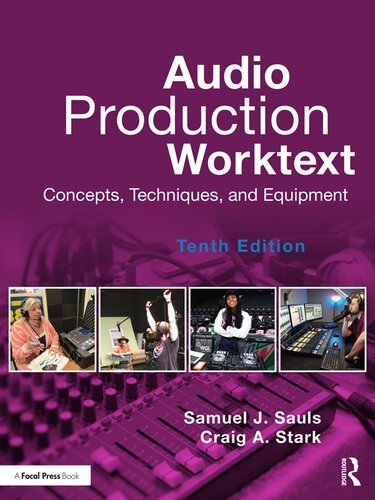
Audio Production Worktext: Concepts, Techniques, and Equipment 10th Edition by Samuel Sauls, ISBN-13: 978-0367640378
Original price was: $50.00.$14.99Current price is: $14.99.
Safe & secure checkout
Description
Description
Audio Production Worktext: Concepts, Techniques, and Equipment 10th Edition by Samuel Sauls, ISBN-13: 978-0367640378
[PDF eBook eTextbook]
- Publisher: Routledge; 10th edition (April 5, 2022)
- Language: English
- 266 pages
- ISBN-10: 0367640376
- ISBN-13: 978-0367640378
Now in its tenth edition, the Audio Production Worktext offers a comprehensive introduction to audio production in radio, television, and film.
Table of Contents:
Cover
Half Title
Title
Copyright
Contents
Preface
Acknowledgments
Chapter 1 Production Planning
1.1 Introduction
1.2 The Idea
1.3 Goals and Objectives
1.4 The Target Audience
1.5 Style
1.6 Production Personnel
1.7 Production Elements
Production Tip 1A—Pick Any Two
1.8 The Script
1.9 Paperwork
1.10 The Importance of Voice
Production Tip 1B—Copy Marking
1.11 Equipment and Facilities
1.12 Laws
1.13 Ethics
1.14 Conclusion
Self-Study
Questions
Answers
Projects
Project 1
Project 2
Chapter 2 The Studio Environment
2.1 Introduction
2.2 The Audio Chain
2.3 The Studio Layout
2.4 Production Studio Furniture
2.5 Studio Sound Considerations
2.6 Studio Construction Materials
2.7 Studio Size and Shape
2.8 Studio Aesthetics
Production Tip 2A—Static Electricity
2.9 On-Air/Recording Lights
2.10 Hand Signals
2.11 Noise and Distortion
2.12 Is It a Sound Signal or an Audio Signal?
2.13 Sound Defined
2.14 Key Characteristics of Sound Waves
2.15 Frequency Response
2.16 Conclusion
Self-Study
Questions
Answers
Projects
Project 1
Project 2
Project 3
Chapter 3 Digital Audio Production
3.1 Introduction
3.2 The Analog Roots of Digital Production
3.3 The Digital Process
3.4 Reasons for Editing
3.5 Desktop Audio Production: The Digital Audio Editor
Production Tip 3A—Audacity
3.6 Digital Audio Workstations and Other Digital Editing Solutions
3.7 Strong Points and Weak Points of Digital Production
Production Tip 3B—Maintaining Digital Equipment
3.8 Audio Synchronization
3.9 Latency Issues
3.10 Digital Audio Editing
Production Tip 3C—What’s up with Adobe® Creative Cloud®?
3.11 Multitrack Editing Techniques
3.12 Multitrack Voice Effects
3.13 Track Sheets
3.14 The Mix Down
3.15 Multitrack Spot Production
3.16 Conclusion
Self-Study
Questions
Answers
Projects
Project 1
Project 2
Project 3
Project 4
Project 5
Chapter 4 Microphones
4.1 Introduction
4.2 Classifying Microphones
4.3 Dynamic Microphones
4.4 Condenser Microphones
4.5 Microphone Pickup Patterns
4.6 The Omnidirectional Pickup Pattern
4.7 The Cardioid Pickup Pattern
4.8 Polar Response Patterns
4.9 Impedance of Microphones
4.10 Sensitivity of Microphones
4.11 Proximity Effect and Bass Roll-Off
4.12 Microphone Feedback
4.13 Multiple-Microphone Interference
4.14 Stereo
4.15 Stereo Miking Techniques
4.16 Surround Sound
4.17 Special Purpose and Other Types of Microphones
4.18 Microphone Accessories
4.19 Microphone Usage
Production Tip 4A—Microphone-to-Mouth Relationship and Setting Levels
4.20 Conclusion
Self-Study
Questions
Answers
Projects
Project 1
Project 2
Project 3
Project 4
Chapter 5 The Audio Console
5.1 Introduction
5.2 The Digital Audio Console
5.3 Audio Console Functions
5.4 Computers and Audio Consoles
5.5 Basic Audio Console Components
5.6 Input Selectors
5.7 Input Volume Control
5.8 Monitoring: Speakers and Headphones
5.9 Cue
5.10 VU Meters
5.11 Output Selectors
5.12 Output Volume Control
5.13 Remote Starts, Clocks, and Timers
5.14 Equalizers and Pan Pots
5.15 Other Features
Production Tip 5A—Manipulating Faders
5.16 Sound Transitions and Endings
5.17 Conclusion
Self-Study
Questions
Answers
Projects
Project 1
Project 2
Project 3
Chapter 6 Podcasting and Digital Audio Recording
6.1 Introduction
6.2 Podcasting
6.3 Producing Content for Podcasts
6.4 Podcasting Equipment
6.5 Data Compression
6.6 Removable Storage and Digital Recorders
6.7 Storage
6.8 MP3/Portable Audio Players
6.9 Digital Distribution Networks
Production Tip 6A
6.10 Conclusion
Self-Study
Questions
Answers
Projects
Project 1
Project 2
Project 3
Chapter 7 Monitor Speakers and Studio Accessories
7.1 Introduction
7.2 Types of Speakers
7.3 Basic Speaker System Components
7.4 Speaker System Enclosure Designs
7.5 Speaker Sound Qualities
7.6 Speaker Placement
7.7 Phase and Channel Orientation
7.8 Monitor Amplifiers
7.9 Speaker Sensitivity
7.10 Headphones
7.11 Hardwiring and Routing
7.12 Common Audio Connectors
7.13 Other Connectors and Connector Adapters
7.14 Balanced and Unbalanced Lines
7.15 Microphone, Line, and Speaker Levels
7.16 Studio Timers
7.17 Telephone Interface
7.18 Conclusion
Self-Study
Questions
Answers
Projects
Project 1
Project 2
Chapter 8 Signal Processing and Audio Processors
8.1 Introduction
8.2 Why Use Signal-Processing Effects?
8.3 Software or Black Box Signal Processing
8.4 Equalizers
8.5 The Graphic Equalizer
8.6 The Parametric Equalizer
8.7 Audio Filters
8.8 Noise Reduction
8.9 Reverb and Digital Delay
8.10 Dynamic Range
8.11 Compressors, Expanders, and Noise Gates
8.12 Limiters
8.13 Other Signal Processors
8.14 Multi-Effects Processors
8.15 Conclusion
Self-Study
Questions
Answers
Projects
Project 1
Project 2
Project 3
Chapter 9 Production Situations
9.1 Introduction
9.2 Producing Commercials
Production Tip 9A—Music Punctuators
9.3 Enhancing Image
9.4 Announcing Music
9.5 Recording Music
Production Tip 9B—Miking a Guitar
9.6 Preparing and Announcing News
9.7 Reporting Sports, Traffic, and Weather
9.8 Hosting Talk Shows
9.9 Performing Drama and Variety
9.10 Conclusion
Self-Study
Questions
Answers
Projects
Project 1
Project 2
Chapter 10 Location Sound Recording
10.1 Introduction
10.2 Types of Field Production
10.3 Common Location Sound Problems
Production Tip 10A—How to Get Rid of a Hum
10.4 Site Planning for Location Recording
10.5 Using Microphones
10.6 Using Recorders
10.7 Using Mixers
10.8 Using Headphones
10.9 Getting the Signal Back to the Studio
10.10 Handling Vehicles
10.11 Providing for Your Own Needs
Production Tip 10B—How to Pack a Survival Bag
10.12 Postproduction Concerns for Location Recording
10.13 Conclusion
Self-Study
Questions
Answers
Projects
Project 1
Project 2
Chapter 11 Sound Production for the Visual Media
11.1 Introduction
11.2 The Importance of Sound to a Visual Production
11.3 The Need to Accommodate the Picture
11.4 Recording Speech
11.5 The Boompole
Production Tip 11A—Holding a Boompole
11.6 The Lavaliere
11.7 Other Forms of Microphone Positioning
11.8 Continuity and Perspective
11.9 The Recording Procedure
Production Tip 11B—Recording with Your Eyes Shut
11.10 Recording Sound Effects
11.11 Recording Ambient Sounds
11.12 Recording Music
11.13 Recording ADR
11.14 Recording Foley
11.15 Recording Voice-Overs
11.16 Postproduction Considerations
11.17 Final Mix
11.18 Conclusion
Self-Study
Questions
Answers
Projects
Project 1
Project 2
Chapter 12 Internet Radio and Other Distribution Platforms
12.1 Introduction
Production Tip 12A—RadioFX
12.2 Web Pages
12.3 Overview of the Audio Process for Streaming
12.4 Encoders
12.5 Servers
12.6 Playback Software and Apps
12.7 Software Options
Production Tip 12B—Internet Audience and On-Air Talent Interaction
12.8 On-Demand Files
12.9 Building a Home Studio for Internet Audio Production
12.10 Copyright
12.11 Internet Radio Station Listing Sites
12.12 Other Distribution Means
12.13 Satellite Radio
12.14 Cable and Satellite TV Audio
12.15 Over-The-Air Broadcasting
12.16 HD Radio
12.17 Conclusion
Self-Study
Questions
Answers
Projects
Project 1
Project 2
Project 3
Glossary
Appendix Analog and Original Digital Audio Equipment
A.1 Introduction
A.2 Turntables
A.3 Turntable Use
A.4 Reel-to-Reel Audio Tape Recorders
A.5 Reel-to-Reel Recorder Use
Production Tip A.A—Sel Sync
A.6 Cassette Tape Recorders
A.7 Cassette Recorder Use
A.8 Cartridge Tape Recorders
A.9 Cartridge Recorder Use
A.10 Tape-Based Digital Recorders
A.11 Analog Tape Editing Tools
A.12 Making Edits
A.13 Analog Audio Consoles
A.14 Analog Audio Console Use
A.15 The MD Recorder/Player
A.16 The MiniDisc
A.17 Patching
A.18 The CD Player
A.19 CDs and Care of CDs
A.20 The CD Recorder
A.21 Conclusion
Index
Samuel J. Sauls, PhD, retired as Associate Professor from the University of North Texas, USA, in August 2013 after 29 years on the faculty in the Department of Radio, Television, and Film. During his tenure, he also held the roles of Associate Chair and Director of Graduate Studies in the department. From 1984 to 1994 he was the station manager of the university radio station, KNTU-FM. He has a combined total of 18 years’ experience in commercial and noncommercial radio and also worked for four years in Saudi Arabia producing soundtracks in English, Arabic, and French. He has served on the Broadcast Education Association board of directors, was BEA President in 2011–2012, and is a former president of the Texas Association of Broadcast Educators. His first book, The Culture of American College Radio, was published in 2000, and his co-authored book, The Sump’n Else Show, was published in 2014. Dr. Sauls has published some 16 academic articles, made over 65 conference paper and panel presentations, and reviewed over 20 journal articles and 15 books under consideration for publication. He is an adjunct professor in the Department of Communications at Susquehanna University, Pennsylvania, USA.
Craig A. Stark, PhD, is Associate Professor, Department Head of Communications, and Coordinator of the Leadership minor program at Susquehanna University, Pennsylvania, USA. He teaches courses in media law, audio production, media theory, intercultural communication, and team communication. He also serves as the faculty advisor for WQSU-FM at Susquehanna University. He has worked and taught in collegiate broadcasting for over 25 years and has worked in commercial production as an announcer, editor, reporter, and engineer. He has been active with the Broadcast Education Association, the Pennsylvania Association of Broadcasters, and the Texas Association of Broadcast Educators. He has published several journal articles and book chapters related to emerging media and HD radio technology.
What makes us different?
• Instant Download
• Always Competitive Pricing
• 100% Privacy
• FREE Sample Available
• 24-7 LIVE Customer Support



Reviews
There are no reviews yet.