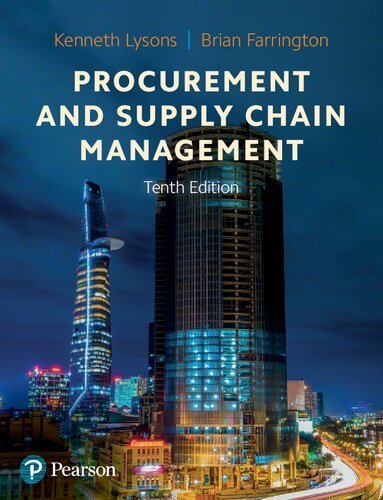
Procurement and Supply Chain Management 10th Edition by Kenneth Lysons, ISBN-13: 978-1292317915
Original price was: $50.00.$14.99Current price is: $14.99.
Safe & secure checkout
Description
Description
Procurement and Supply Chain Management 10th Edition by Kenneth Lysons, ISBN-13: 978-1292317915
[PDF eBook eTextbook]
- Publisher: Pearson (January 1, 2020)
- Language: English
- 746 pages
- ISBN-10: 1292317914
- ISBN-13: 978-1292317915
Procurement and Supply Chain Management, 10th Edition, by Farrington is the most comprehensive and accessible textbook on procurement and supply chain management currently available. It is the ideal textbook for those aspiring to be leaders in the profession, and for those who are engaged in professional studies for the Chartered Institute of Procurement and Supply examinations (at both the foundation and professional stages). It is also of value to specialists in other fields who require understanding of the role and influence of this area of business performance. Using extensive real-life examples the subject matter has been brought to life throughout the book, and provides a truly international focus on procurement and supply chain. This fully revised edition covers new developments in the procurement and supply chain field, and offers new chapters on public sector procurement and socially responsible procurement.
Table of Contents:
Cover
Procurement and Supply Chain Management
Pearson
Title
copyright
Brief Contents
Contents
preface
About The Authors
Acknowledgements
Acknowledgements
Part 1 Introduction and strategy
1 The scope and influence of procurement
Learning outcomes
Key ideas
Introduction
1.1 How to define procurement
1.2 How to define supply chain management (SCM)
1.3 Strategic roles of procurement
1.4 Procurement as organisational buying
1.5 The strategic scope of procurement
1.6 Integrated supply chain management
1.7 Procurement and change
1.8 World-class procurement
1.9 The status of procurement and supply management (PSM)
1.10 Reflections on procurement positioning in business
1.11 The scope of procurement in the public sector
Discussion questions
References
2 Strategic procurement
Learning outcomes
Key ideas
Introduction
2.1 Strategic fit between the supply chain and competitive strategies
2.2 What is strategy?
2.3 Strategy development
2.4 Levels of organisational strategy
2.5 Corporate strategy
2.6 Growth strategies
2.7 Business-level strategy
2.8 Strategic management
2.9 Strategic analysis
2.10 Important environmental factors
2.11 Internal scrutiny
2.12 Strategy formulation
2.13 The evaluation of alternative strategies
2.14 Strategy implementation
2.15 Post-implementation evaluation, control and review
2.16 Strategic procurement and supply chain process models
Discussion questions
References
3 Logistics and supply chains
Learning outcomes
Key ideas
Introduction
3.1 What is logistics?
3.2 Materials, logistics and distribution management
3.3 Reverse logistics
3.4 Supply chains
3.5 Supply chain management (SCM)
3.6 Supply chain vulnerability
3.7 Value chains
3.8 Value chain analysis
3.9 Supply chain optimisation
3.10 Procurement positioning within supply chain management
Discussion questions
References
4 Organisational and supply chain structures
Learning outcomes
Key ideas
Introduction
4.1 Organisational structures
4.2 New type organisations
4.3 The organisation of the future
4.4 Factors in configurations
4.5 Lean organisations
4.6 Agile organisations and production
4.7 Supply and value chain mapping
4.8 Types of change
4.9 Centralised procurement
4.10 Decentralised procurement
4.11 Cross-functional procurement
Discussion questions
References
5 Procurement policies, procedures and support tools
Learning outcomes
Key ideas
Introduction
5.1 Exemplar Procurement Policy – The Crossrail Project
5.2 Procurement procedures
5.3 Procurement process failures
5.4 E-commerce, e-business, e-SCM and e-procurement
5.5 The evolution of e-procurement models
5.6 Electronic data interchange (EDI)
5.7 E-hubs, exchanges, portals and marketplaces
5.8 E-catalogues
5.9 E-auctions
5.10 Reverse auctions
5.11 E-payment
5.12 Low-value purchases
5.13 Procurement manuals
5.14 Procurement playbook
Discussion questions
References
Part 2 Strategy, tactics and operations 1: Procurement factors
6 Supplier relationships and partnering
Learning outcomes
Key ideas
Introduction
6.1 Relationship procurement and procurement relationships
6.2 The application of power in relationship management
6.3 Supplier relationship management – strategic focus
6.4 The contrast between transactional and relationship procurement, taking account of contractual requirements
6.5 Collaborative business relationships
6.6 SRM model
6.7 Models of supplier relationships
6.8 Supplier relationship management – a critique
6.9 The termination of relationships
6.10 Relationship breakdown on an IT project
6.11 Further aspects of relationships
Discussion questions
References
7 Legal and contractual management
Learning outcomes
Key ideas
7.1 The procurement specialist and Contract Law
7.2 Formation of a contract
7.3 Acceptance
7.4 Contracts for the Sale of Goods
7.5 Contract for the Supply of Services
7.6 Consideration
7.7 Capacity to Contract
7.8 Drafting the detail of contract clauses
7.9 Misrepresentation
7.10 The right to terminate a contract
7.11 HOT TOPICS
7.12 Standard Forms of Contract
Discussion questions
References
8 Quality management, service and product innovation
Learning outcomes
Key ideas
8.1 What is quality?
8.2 Quality systems
8.3 Total quality management
8.4 Specifications
8.5 Alternatives to individual specifications
8.6 Standardisation
8.7 Variety reduction
8.8 Quality assurance and quality control
8.9 Tests for quality control and reliability
8.10 The cost of quality
8.11 Value management, engineering and analysis
Discussion questions
References
9 Matching supply with demand
Learning outcomes
Key ideas
9.1 Inventory, logistics and supply chain management
9.2 Reasons for keeping inventory
9.3 Inventory classifications
9.4 Scope and aims of inventory management
9.5 Some tools of inventory management
9.6 The economics of inventory
9.7 Inventory performance measures
9.8 Safety stocks and service levels
9.9 The right quantity
9.10 The nature of demand
9.11 Forecasting demand
9.12 ‘Push’ and ‘pull’ inventories
9.13 Independent demand
9.14 Dependent demand
9.15 Just-in-time (JIT)
9.16 Materials and requirements planning (MRP)
9.17 Manufacturing resource planning (MRP II)
9.18 Enterprise resource planning (ERP)
9.19 Supply chain management systems
9.20 Distribution requirements planning (DRP)
9.21 Vendor-managed inventory (VMI)
9.22 Procurement and inventory
Discussion questions
References
10 Sourcing and the management of suppliers
Learning outcomes
Key ideas
10.1 What is sourcing?
10.2 The strategic sourcing process
10.3 Sourcing information
10.4 Analysis of market conditions
10.5 Directives
10.6 E-sourcing
10.7 Supplier evaluation
10.8 Supplier approval
10.9 Evaluating supplier performance
10.10 Policy issues in sourcing
10.11 The supplier base
10.12 Outsourcing
10.13 Make vs buy
10.14 Sub-contracting
10.15 Partnering
10.16 Intellectual property rights
10.17 Procurement management of IPRs
10.18 Procurement support for in-house marketing
10.19 Intra-company trading
10.20 Procurement consortia
10.21 Sustainability
10.22 Sourcing decisions
10.23 Factors in deciding where to buy
Discussion questions
References
11 Purchase price management and long-term cost-in-use
Learning outcomes
Key ideas
11.1 What is price?
11.2 Strategic pricing – an introduction
11.3 The buyer’s role in managing purchase prices
11.4 Supplier pricing decisions
11.5 The supplier’s choice of pricing strategy
11.6 Tender pricing
11.7 Price and cost analysis
11.8 Competition legislation
11.9 Collusive tendering
11.10 Price variation formulae
Discussion questions
References
Part 3 Public sector procurement and sustainable procurement
12 Public sector procurement
Learning outcomes
Key ideas
Introduction
12.1 Understanding the context of public procurement
12.2 Procurement – an integral element of the commissioning cycle
12.3 The complexity and nature of public sector expenditure
12.4 Public Accounts Committee
12.5 Procurement of goods and services
12.6 EU financial thresholds
12.7 OJEU minimum timescale
12.8 Public procurement procedures
12.9 Pre-qualification to supply a public sector organisation
12.10 Tender evaluation
12.11 The Legal context of challenges to public sector contract award
12.12 Public sector risk
12.13 Public sector procurement fraud
12.14 Aviation Department Fraud – United States
12.15 Mighty River Power Ltd Fraud – New Zealand
12.16 The Fat Leonard Case USA
12.17 Public sector projects – procurement learning
12.18 Conclusion
Discussion questions
References
13 Sustainability and socially responsible procurement
Learning outcomes
Key ideas
13.1 What is sustainability procurement?
13.2 Sustainable Procurement Strategy
13.3 Sustainability as an objective in corporate strategy
13.4 Sustainable Procurement Policy
13.5 Sustainable Procurement Guide
13.6 Supply chain compliance
13.7 What is Social Value?
13.8 ISO 14001:2015 Environmental management systems
13.9 BS ISO 20400:2017 Sustainable Procurement
13.10 ISO 14031:2015 Environmental Management – Environmental performance evaluation: guidelines
13.11 Environmental impact of computers
13.12 Addressing environmental issues during the procurement process
13.13 Pre-qualification questionnaire – sustainability implications
13.14 New models for sustainable procurement
13.15 Environmental technical specifications
13.16 Sustainability achievements in public procurement
13.17 European Directive on clean energy-efficient vehicles
13.18 Contractual Implications of environmental and related considerations
13.19 Sustainability challenges for procurement
13.20 Multinational enterprises
13.21 The Kyoto protocol
13.22 Conclusion
Discussion questions
References
Part 4 Strategy, tactics and operations 2: Operation andstrategic performance
14 Project procurement and risk management
Learning outcomes
Key ideas
Introduction
14.1 The project lifecycle
14.2 The project procurement strategy
14.3 Role of procurement
14.4 PRINCE 2®
14.5 Project management issues
14.6 Project risk management
14.7 Corporate benefits of world-class project procurement
14.8 Project risk register
14.9 Project audit
14.10 Procurement management
Discussion questions
References
15 Global sourcing
Learning outcomes
Key ideas
15.1 Terminology
15.2 Motives for buying offshore
15.3 Sources of information for offshore suppliers
15.4 Overcoming challenges when sourcing offshore
15.5 Incoterms®
15.6 Customs and Excise
15.7 Transport systems, costs and considerations
15.8 Freight agents
15.9 Methods of payment
15.10 Countertrade
15.11 The true cost of offshore buying
15.12 Global sourcing – Boeing case study
15.13 Buying capital equipment offshore
15.14 Factors in successful offshore procurement
Discussion questions
References
Part 5 Strategy, tactics and operations 3: Negotiation skills, contract management, category and world class procurement
16 Negotiation skills, practice and business benefits
Learning outcomes
Key ideas
Introduction
16.1 Approaches to negotiation
16.2 The content of negotiation
16.3 The negotiator’s authority
16.4 The negotiation process
16.5 Pre-negotiation
16.6 The actual negotiation
16.7 Post-negotiation actions
16.8 What is effective negotiation?
16.9 Negotiation and relationships
16.10 Negotiation ethics
Discussion questions
References
17 Contract management
Learning outcomes
Key ideas
Introduction
17.1 The pre-contract award activities impact on contract management
17.2 The contract manager’s role, skills and knowledge
17.3 Contract management good practice (including VFM)
17.4 Contract management plans
17.5 Key performance indicators (KPIs) for contract management
17.6 Lapses in contract management
17.7 Social services contract monitoring audit
17.8 Contract provisions
17.9 Contract clauses and what they mean
Discussion questions
References
18 Category and commodity procurement
Learning outcomes
Key ideas
Introduction
18.1 Defining categories
18.2 Illustrations of category management issues
18.3 The talent challenge
18.4 Category management – corporate travel
18.5 Category management – ICT
18.6 Capital investment procurement
18.7 Production materials
18.8 Raw materials
18.9 Futures dealing
18.10 Methods of commodity dealing
18.11 Procurement of non-domestic gas and electricity
18.12 Energy regulation
18.13 Energy supply chains in the UK
18.14 Markets
18.15 Pricing
18.16 Procuring energy contracts
18.17 Energy consultants and management
18.18 Component parts and assemblies
18.19 Consumables and MRO items
18.20 Construction supplies and bills of quantities
18.21 Procurement of services
Discussion questions
References
19 World-class procurement to enhance business performance
Learning outcomes
Key ideas
19.1 Innovation and supplier continuous improvement
19.2 Innovation
19.3 Environmentally sensitive design
19.4 Procurement involvement in product development
19.5 Supplier development
19.6 Procurement research
19.7 Procurement performance evaluation
19.8 Accounting approaches
19.9 The procurement management audit approach
19.10 Benchmarking and ratios
19.11 Integrated benchmarking
19.12 Procurement ethics
19.13 Ethical issues relating to suppliers
19.14 Ethical codes of conduct
19.15 Procurement and fraud
19.16 Cyber security
Discussion questions
References
Appendix 1
Appendix 2
Definitions
Index
Subject Index
Dr. Brian Farrington is the Managing Director of his specialist company, Brian Farrington Limited. They provide training and consultancy support to the public and private sectors of business. They work on major projects and high-value, high-profile and high-risk procurements. He has extensive experience in the USA, Canada, Southern Africa, Hong Kong and Europe. He has resolved major disputes and negotiated complex contracts, including outsourcing key business services.
What makes us different?
• Instant Download
• Always Competitive Pricing
• 100% Privacy
• FREE Sample Available
• 24-7 LIVE Customer Support