

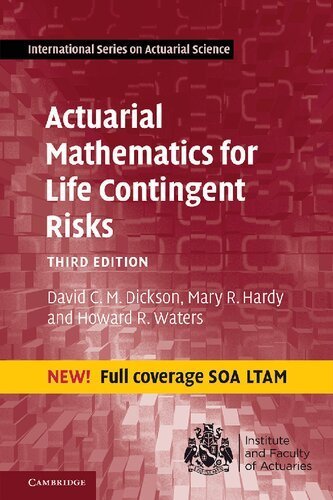
Actuarial Mathematics for Life Contingent Risks 3rd Edition by David C. M. Dickson, ISBN-13: 978-1108478083
Original price was: $50.00.$14.99Current price is: $14.99.
Safe & secure checkout
Description
Description
Actuarial Mathematics for Life Contingent Risks 3rd Edition by David C. M. Dickson, ISBN-13: 978-1108478083
[PDF eBook eTextbook]
- Publisher: Cambridge University Press; 3rd edition (January 30, 2020)
- Language: English
- 782 pages
- ISBN-10: 1108478085
- ISBN-13: 978-1108478083
The substantially updated third edition of the popular Actuarial Mathematics for Life Contingent Risks is suitable for advanced undergraduate and graduate students of actuarial science, for trainee actuaries preparing for professional actuarial examinations, and for life insurance practitioners who wish to increase or update their technical knowledge. The authors provide intuitive explanations alongside mathematical theory, equipping readers to understand the material in sufficient depth to apply it in real-world situations and to adapt their results in a changing insurance environment. Topics include modern actuarial paradigms, such as multiple state models, cash-flow projection methods and option theory, all of which are required for managing the increasingly complex range of contemporary long-term insurance products. Numerous exam-style questions allow readers to prepare for traditional professional actuarial exams, and extensive use of Excel ensures that readers are ready for modern, Excel-based exams and for the actuarial work environment.
Table of Contents:
Half-title
Series information
Title page
Copyright information
Dedication
Contents
Preface to the third edition
1 Introduction to life and long-term health insurance
1.1 Summary
1.2 Background
1.3 Traditional life insurance contracts
1.3.1 Introduction
1.3.2 Term insurance
1.3.3 Whole life insurance
1.3.4 Endowment insurance
1.3.5 Options and variations on traditional insurance
1.4 Modern insurance contracts
1.4.1 Why innovate?
1.4.2 Universal life insurance
1.4.3 Unitized with-profit
1.4.4 Equity-linked insurance
1.5 Marketing, pricing and issuing life insurance
1.5.1 Insurance distribution methods
1.5.2 Underwriting
1.5.3 Premiums
1.6 Life annuities
1.7 Long-term coverages in health insurance
1.7.1 Disability income insurance
1.7.2 Long-term care insurance
1.7.3 Critical illness insurance
1.7.4 Chronic illness insurance
1.8 Mutual and proprietary insurers
1.9 Other life contingent contracts
1.9.1 Continuing care retirement communities
1.9.2 Structured settlements
1.10 Pensions
1.10.1 Defined Benefit pensions
1.10.2 Defined Contribution
1.11 Typical problems
1.12 Notes and further reading
1.13 Exercises
2 Survival models
2.1 Summary
2.2 The future lifetime random variable
2.3 The force of mortality
2.3.1 Mortality laws
2.4 Actuarial notation
2.5 Mean and standard deviation of T[sub(x)]
2.6 Curtate future lifetime
2.6.1 K[sub(x)] and e[sub(x)]
2.6.2 Comparing [circ(e) sub(x)] and e[sub(x)]
2.7 Notes and further reading
2.8 Exercises
3 Life tables and selection
3.1 Summary
3.2 Life tables
3.3 Fractional age assumptions
3.3.1 Uniform distribution of deaths
3.3.2 Constant force of mortality
3.4 National life tables
3.5 Survival models for life insurance policyholders
3.6 Life insurance underwriting
3.7 Select and ultimate survival models
3.8 Notation and formulae for select survival models
3.9 Select life tables
3.10 Some comments on heterogeneity in mortality
3.11 Mortality improvement modelling
3.12 Mortality improvement scales
3.12.1 Single-factor mortality improvement scales
3.12.2 Two-factor mortality improvement scales
3.12.3 Cubic spline mortality improvement scales
3.13 Notes and further reading
3.14 Exercises
4 Insurance benefits
4.1 Summary
4.2 Introduction
4.3 Assumptions
4.4 Valuation of insurance benefits
4.4.1 Whole life insurance: the continuous case, [bar(A)sub(x)]
4.4.2 Whole life insurance: the annual case, [bar(A)sub(x)]
4.4.3 Whole life insurance: the 1/mthly case, A[sup((m))][sub(x)]
4.4.4 Recursions
4.4.5 Term insurance
4.4.6 Pure endowment
4.4.7 Endowment insurance
4.4.8 Deferred insurance
4.5 Relating [bar(A)sub(x)], A[sub(x)] and A[sup((m))][sub(x)]
4.5.1 Using the uniform distribution of deaths assumption
4.5.2 Using the claims acceleration approach
4.6 Variable insurance benefits
4.7 Functions for select lives
4.8 Notes and further reading
4.9 Exercises
5 Annuities
5.1 Summary
5.2 Introduction
5.3 Review of annuities-certain
5.4 Annual life annuities
5.4.1 Whole life annuity-due
5.4.2 Term annuity-due
5.4.3 Immediate life annuities
5.5 Annuities payable continuously
5.6 Annuities payable 1/mthly
5.7 Comparison of annuities by payment frequency
5.8 Deferred annuities
5.9 Guaranteed annuities
5.10 Increasing annuities
5.10.1 Arithmetically increasing annuities
5.10.2 Geometrically increasing annuities
5.11 Evaluating annuity functions
5.11.1 Recursions
5.11.2 Applying the UDD assumption
5.11.3 Woolhouse’s formula
5.12 Numerical illustrations
5.13 Functions for select lives
5.14 Notes and further reading
5.15 Exercises
6 Premium calculation
6.1 Summary
6.2 Preliminaries
6.2.1 Assumptions
6.3 The loss at issue random variable
6.4 The equivalence principle premium
6.4.1 Net premiums
6.4.2 Gross premiums
6.5 Profit
6.6 The portfolio percentile premium principle
6.7 Extra risks
6.7.1 Age rating
6.7.2 Constant addition to μ[sub(x)]
6.7.3 Constant multiple of mortality rates
6.8 Notes and further reading
6.9 Exercises
7 Policy values
7.1 Summary
7.2 Policies with annual cash flows
7.2.1 The future loss random variable
7.2.2 Policy values for policies with annual cash flows
7.2.3 Recursive formulae for policy values
7.2.4 Analysis of surplus
7.2.5 Asset shares
7.3 Policy values for policies with cash flows at 1/mthly intervals
7.3.1 Recursions with 1/mthly cash flows
7.3.2 Valuation between premium dates
7.4 Policy values with continuous cash flows
7.4.1 Thiele’s differential equation
7.4.2 Numerical solution of Thiele’s differential equation
7.5 Policy alterations
7.6 Retrospective policy values
7.6.1 Prospective and retrospective valuation
7.6.2 Defining the retrospective net premium policy value
7.7 Negative policy values
7.8 Deferred acquisition expenses and modified net premium reserves
7.8.1 Full Preliminary Term reserve
7.9 Other reserves
7.10 Notes and further reading
7.11 Exercises
8 Multiple state models
8.1 Summary
8.2 Examples of multiple state models
8.2.1 The alive–dead model
8.2.2 Term insurance with increased benefit on accidental death
8.2.3 The permanent disability model
8.2.4 The sickness–death model
8.3 Assumptions and notation
8.4 Formulae for probabilities
8.4.1 Kolmogorov’s forward equations
8.5 Numerical evaluation of probabilities
8.6 State-dependent insurance and annuity functions
8.6.1 State-dependent annuities
8.7 Premiums
8.8 Policy values
8.8.1 Recursions for state-dependent policy values
8.8.2 General recursion for h-yearly cash flows
8.8.3 Thiele’s differential equation
8.9 Applications of multiple state models in long-term health and disability insurance
8.9.1 Disability income insurance
8.9.2 Long-term care
8.9.3 Critical illness insurance
8.9.4 Continuing care retirement communities
8.9.5 Structured settlements
8.10 Markov multiple state models in discrete time
8.10.1 The Chapman–Kolmogorov equations
8.10.2 Transition matrices
8.11 Notes and further reading
8.12 Exercises
9 Multiple decrement models
9.1 Summary
9.2 Examples of multiple decrement models
9.3 Actuarial functions for multiple decrement models
9.4 Multiple decrement tables
9.4.1 Fractional age assumptions for decrements
9.5 Constructing a multiple decrement table
9.5.1 Deriving independent rates from dependent rates
9.5.2 Deriving dependent rates from independent rates
9.6 Comments on multiple decrement notation
9.7 Transitions at exact ages
9.8 Exercises
10 Joint life and last survivor benefits
10.1 Summary
10.2 Joint life and last survivor benefits
10.3 Joint life notation
10.4 Independent future lifetimes
10.5 A multiple state model for independent future lifetimes
10.6 A model with dependent future lifetimes
10.7 The common shock model
10.8 Notes and further reading
10.9 Exercises
11 Pension mathematics
11.1 Summary
11.2 Introduction
11.3 The salary scale function
11.4 Setting the contribution for a DC plan
11.5 The service table
11.6 Valuation of final salary plans
11.6.1 Accrued benefits
11.6.2 A general formula for the EPV of the projected accrued age retirement pension
11.6.3 Withdrawal benefits
11.6.4 Valuing the current accrued benefit
11.7 Valuing career average earnings plans
11.8 Funding the benefits
11.9 Projected Unit Credit funding
11.9.1 The normal contribution formula using PUC funding
11.10 Traditional Unit Credit funding
11.10.1 The normal contribution formula using TUC funding
11.11 Comparing PUC and TUC funding methods
11.12 Retiree health benefits
11.12.1 Introduction
11.12.2 Valuing retiree health benefits
11.12.3 Funding retiree health benefits
11.13 Notes and further reading
11.14 Exercises
12 Yield curves and non-diversifiable risk
12.1 Summary
12.2 The yield curve
12.3 Valuation of insurances and life annuities
12.3.1 Replicating the cash flows of a traditional non-participating product
12.4 Diversifiable and non-diversifiable risk
12.4.1 Diversifiable mortality risk
12.4.2 Non-diversifiable risk
12.5 Monte Carlo simulation
12.6 Notes and further reading
12.7 Exercises
13 Emerging costs for traditional life insurance
13.1 Summary
13.2 Introduction
13.3 Profit testing a term insurance policy
13.3.1 Time step
13.3.2 Profit test basis
13.3.3 Incorporating reserves
13.3.4 Profit signature
13.4 Profit testing principles
13.4.1 Assumptions
13.4.2 The profit vector
13.4.3 The profit signature
13.4.4 The net present value
13.4.5 Notes on the profit testing method
13.5 Profit measures
13.6 Using the profit test to calculate the premium
13.7 Using the profit test to calculate reserves
13.8 Profit testing for participating insurance
13.9 Profit testing for multiple state-dependent insurance
13.10 Notes
13.11 Exercises
14 Universal life insurance
14.1 Summary
14.2 Introduction
14.3 Universal life insurance
14.3.1 Introduction
14.3.2 Key design features
14.3.3 Projecting account values
14.3.4 Profit testing Universal life policies
14.3.5 Universal life Type B profit test
14.3.6 Universal life Type A profit test
14.3.7 No lapse guarantees
14.3.8 Comments on UL profit testing
14.4 Notes and further reading
14.5 Exercises
15 Emerging costs for equity-linked insurance
15.1 Summary
15.2 Equity-linked insurance
15.3 Deterministic profit testing for equity-linked insurance
15.4 Stochastic profit testing
15.5 Stochastic pricing
15.6 Stochastic reserving
15.6.1 Reserving for policies with non-diversifiable risk
15.6.2 Quantile reserving
15.6.3 CTE reserving
15.6.4 Comments on reserving
15.7 Notes and further reading
15.8 Exercises
16 Option pricing
16.1 Summary
16.2 Introduction
16.3 The ‘no arbitrage’ assumption
16.4 Options
16.5 The binomial option pricing model
16.5.1 Assumptions
16.5.2 Pricing over a single time period
16.5.3 Pricing over two time periods
16.5.4 Summary of the binomial model option pricing technique
16.6 The Black–Scholes–Merton model
16.6.1 The model
16.6.2 The Black–Scholes–Merton option pricing formula
16.7 Notes and further reading
16.8 Exercises
17 Embedded options
17.1 Summary
17.2 Introduction
17.3 Guaranteed minimum maturity benefit
17.3.1 Pricing
17.3.2 Reserving
17.4 Guaranteed minimum death benefit
17.4.1 Pricing
17.4.2 Reserving
17.5 Funding methods for embedded options
17.6 Risk management
17.7 Profit testing
17.8 Notes and further reading
17.9 Exercises
18 Estimating survival models
18.1 Summary
18.2 Introduction
18.3 Actuarial lifetime data
18.3.1 Left truncation
18.3.2 Right censoring
18.4 Non-parametric survival function estimation
18.4.1 The empirical distribution for seriatim data
18.4.2 The empirical distribution for grouped data
18.4.3 The Kaplan–Meier estimate
18.4.4 The Nelson–Aalen estimator
18.5 The alive–dead model
18.5.1 Notes on the alive–dead model
18.6 Estimation of transition intensities in multiple state models
18.7 Comments
18.8 Notes and further reading
18.9 Exercises
19 Stochastic longevity models
19.1 Summary
19.2 Introduction
19.3 The Lee–Carter model
19.4 The Cairns–Blake–Dowd models
19.4.1 The original CBD model
19.4.2 Actuarial applications of stochastic longevity models
19.4.3 Notes on stochastic longevity models
19.5 Notes and further reading
19.6 Exercises
Appendix A Probability and statistics
A.1 Probability distributions
A.1.1 Binomial distribution
A.1.2 Uniform distribution
A.1.3 Normal distribution
A.1.4 Lognormal distribution
A.2 The central limit theorem
A.3 Functions of a random variable
A.3.1 Discrete random variables
A.3.2 Continuous random variables
A.3.3 Mixed random variables
A.4 Conditional expectation and conditional variance
A.5 Maximum likelihood estimation
A.5.1 The likelihood function
A.5.2 Finding the maximum likelihood estimates
A.5.3 Properties of maximum likelihood estimates
A.6 Notes and further reading
Appendix B Numerical techniques
B.1 Numerical integration
B.1.1 The trapezium rule
B.1.2 Repeated Simpson’s rule
B.1.3 Integrals over an infinite interval
B.2 Woolhouse’s formula
B.3 Notes and further reading
Appendix C Monte Carlo simulation
C.1 The inverse transform method
C.2 Simulation from a normal distribution
C.2.1 The Box–Muller method
C.2.2 The polar method
C.3 Notes and further reading
Appendix D Tables
D.1 The Standard Select and Ultimate Life Tables
D.2 Joint life functions
D.3 Standard Sickness–Death tables
D.4 Pension plan service table
References
Index
David C. M. Dickson holds a Ph.D. in Actuarial Science from Heriot-Watt University, Edinburgh, and is a Fellow of the Institute and Faculty of Actuaries and the Institute of Actuaries of Australia. He lectured for seven years at Heriot-Watt University before moving to the University of Melbourne in 1993. In 2000 Dickson was appointed to the Chair in Actuarial Studies in Melbourne. He was Head of the Department of Economics from 2016 to 2018. He has twice been awarded the H.M. Jackson Prize of the Institute of Actuaries of Australia, most recently for his book Insurance Risk and Ruin (2016).
Mary R. Hardy is Professor of Actuarial Science at the University of Waterloo, Ontario. She earned her Ph.D. in Actuarial Science from Heriot-Watt University, Edinburgh,where she lectured for eleven years before moving to the University of Waterloo in 1997. She is a Fellow of the Institute and Faculty of Actuaries, and of the Society of Actuaries. In 2007 she was awarded the Chartered Enterprise Risk Analyst designation of the Society of Actuaries, through their thought-leader recognition program. In 2013 she was awarded the Finlaison Medal of the Institute and Faculty of Actuaries for services to the actuarial profession, in research, teaching and governance.
Howard R. Waters is Professor Emeritus at the Department of Actuarial Mathematics and Statistics at Heriot-Watt University, Edinburgh. He holds a D.Phil. in mathematics from the University of Oxford, and worked as a consulting actuary for several years before joining Heriot-Watt University. He is a Fellow of the Institute and Faculty of Actuaries. He was awarded the Finlaison medal of the Institute of Actuaries in 2006 for services to actuarial research and education.
What makes us different?
• Instant Download
• Always Competitive Pricing
• 100% Privacy
• FREE Sample Available
• 24-7 LIVE Customer Support



Reviews
There are no reviews yet.