

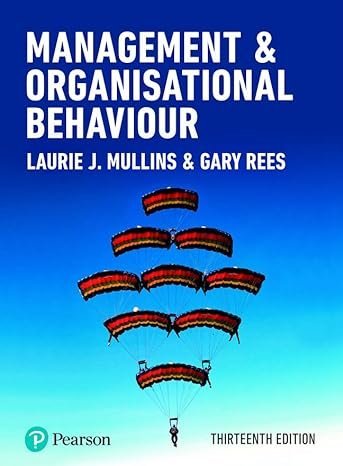
Management and Organisational Behaviour 13th Edition by Laurie J. Mullins, ISBN-13: 978-1292422381
Original price was: $50.00.$14.99Current price is: $14.99.
Safe & secure checkout
Description
Description
Management and Organisational Behaviour 13th Edition by Laurie J. Mullins, ISBN-13: 978-1292422381
[PDF eBook eTextbook]
- Publisher: Pearson; 13th edition
- Language: English
- 652 pages
- ISBN-10: 1292422386
- ISBN-13: 978-1292422381
Gain insight into people-organisational relationships and interrelated influences on human behaviour.
Ranked as one of the Top Ten most influential texts in business and management in the world – According to the Financial Times’ Teaching Power Rankings, 2021 (research by Open Syllabus)
Management and Organisational Behaviour 13th edition, by Mullins and Rees, provides an in-depth study guide that helps you understand the relationship between people and professional organisations, shedding new light on the understanding, prediction, and control of human behaviour at work. This widely popular text examines the environments of the individual, the group, workplace, and organisational structure, explaining organisational behaviour by applying theoretical frameworks to practice and developing critical thinking.
This new edition addresses recent contextual issues, such as the impact of Covid-19 on the workplace. It also offers greater international perspective on organisational behaviour, with the addition of several case studies from around the world and related video cases by expert speakers. Featuring conceptual mind maps of complex topics to aid your understanding and revision, its ‘personal skills’ and ’employability’ sections help you develop your social and work-based skills in preparation for life beyond the classroom.
This comprehensive textbook is ideal for undergraduate and postgraduate study, as well as for professionals training for management roles.
Table of Contents:
Half Title
Title Page
Copyright Page
Contents in brief
Contents in detail
In acknowledgement and appreciation
About the authors
0 Your study of management and organisational behaviour
Overview topic map: Chapter 0 – Your study of organisational behaviour
About this book: Management and organisational behaviour
What is organisational behaviour (OB)?
Underlying features of your study
Topics in OB are not entirely free-standing
What is the relevance of theory?
Organisational metaphors
The importance of organisational behaviour
OB, personal skills and employability
The ‘SCARF’ model
People management and social skills
Making yourself more employable
Personal skills and employability exercise
Structure of the book
Notes and references
Part 1 Organisational behaviour and work
1 The people-organisation relationship
Overview topic map: Chapter 1 – The people-organisation relationship
Integrating the individual and the organisation
Organisational analysis
A multidisciplinary perspective
Positive organisational behaviour (POB)
Interrelated influences on behaviour
A framework of study
Social exchange theory
Organisational theory
The organisation as an open system
Organisation and management systems
Contribution of Human Resource Management (HRM)
The psychological contract
Nature and extent of expectations
Globalisation and the international context
The cultural environment
Is organisational behaviour culture-bound?
Summary – Chapter 1 ‘The people-organisation relationship’
Group discussion activities
Organisational behaviour in action case study
Chapter 1 – Personal skills and employability exercise
Notes and references
2 The work environment
Overview topic map: Chapter 2 – the work environment
Work as a central life issue
Orientations to work and work ethic
Emotional labour
Work and the organisational setting
Private and public sector organisations
Social enterprise organisations
Common features of organisations
Formal and informal organisations
Friendships and relationships at work
Work/life balance
Changing nature of work organisations
Different generations and age groups
The future of the workplace
Summary – Chapter 2 ‘The work environment’
Group discussion activities
Organisational behaviour in action case study
Chapter 2 – Personal skills and employability exercise
Notes and references
3 Organisational conflict and stress
Overview topic map: Chapter 3 – organisational conflict and stress
Work, health and well-being
What is organisational conflict?
Potential sources of conflict
Broader interpretations of conflict
The management of conflict
Conflict resolution in the workplace
What is organisational stress?
Potential causes of work stress
Is stress necessarily to be avoided?
Coping with stress
HSE Management Standards
Bullying and harassment
Frustration-induced behaviour
Summary – Chapter 3 ‘Organisational conflict and stress’
Group discussion activities
Organisational behaviour in action case study
Chapter 3 – Personal skills and employability exercise
Notes and references
Part 2 Focus on the individual
4 Personality and diversity
Overview topic map: Chapter 4 – Personality and diversity
Recognition of individuality
Understanding personality
Personality traits and types
Uniqueness and similarities
Sigmund Freud – a psychodynamic perspective
Nomothetic approaches
Idiographic approaches
Personality and stress at work
The Big Five personality factors
Personality ‘tests’ and assessments
Applications in the workplace
Emotional intelligence (EI)
Recognition of diversity
Diversity in the workplace
Diversity and stereotyping
Criticisms and limitations
Summary – Chapter 4 ‘Personality and diversity’
Group discussion activities
Chapter 4 – Personal skills and employability exercise
Notes and references
5 Learning and development
Overview topic map: Chapter 5 – Learning and development
The nature and importance of learning
Behaviourist and cognitive views of learning
Behaviourist theories of learning
Cognitive perspective of learning
Socialisation
How do we learn?
Action learning
Learning preferences
E-learning
Knowledge management
Creativity
Mentoring and coaching
Applications of learning theory
Summary – Chapter 5 ‘Learning and development’
Group discussion activities
Organisational behaviour in action case study
Chapter 5 – Personal skills and employability exercise
Notes and references
6 Perception and communication
Overview topic map: Chapter 6 – perception and communication
The importance of the study of perception
The perceptual process
Internal characteristics
External influences
Perceptual illusions
Making judgements about other people
Difficulties in perceiving other people
Perceptual distortions and errors
Attribution theory
The importance of language and communication
Non-verbal communication and body language
Impression management
Perception and interpersonal communications
Understanding the organisational process
Summary – Chapter 6 ‘Perception and communication’
Group discussion activities
Organisational behaviour in action case study
Chapter 6 – Personal skills and employability exercise
Notes and references
7 Work motivation and satisfaction
Overview topic map: Chapter 7 – ‘work motivation and satisfaction’
The significance of motivation
Needs and expectations at work
Money as a motivator
Extrinsic and intrinsic motivation
Three-fold classification for review of motivation
Competing theories of motivation
Content theories of motivation
Maslow’s hierarchy of needs theory
Alderfer’s modified need hierarchy model
Nohria’s four drives model of motivation
Herzberg’s two-factor theory
McClelland’s achievement motivation theory
Process theories of motivation
Vroom’s expectancy theory
Implications of expectancy theory
Equity theory of motivation
Goal theory
Relevance today of motivation theories
Organisational behaviour modification
Motivation of knowledge workers
Job satisfaction
Comprehensive model of job enrichment
Summary – Chapter 7 ‘Work motivation and satisfaction’
Group discussion activities
Organisational behaviour in action case study
Chapter 7 – Personal skills and employability exercise
Notes and references
Part 3 Focus on groups and leadership
8 Working in groups and teams
Overview topic map: Chapter 8 – ‘working in groups and teams’
Importance and significance of groups
Formal and informal groups
Group values and norms
Expectations and benefits of group membership
Group cohesiveness and performance
Membership
Work environment
Organisational
Group development and maturity
Social identity theory
Characteristics of effective work groups
Virtual teams
Interactions among group members
Analysis of individual behaviour
Individual and group performance
Building successful teams
Autonomous working groups
Summary – Chapter 8 ‘Working in groups and teams’
Group discussion activities
Organisational behaviour in action case study
Chapter 8 – Personal skills and employability exercise
Notes and references
9 Leadership in work organisations
Overview topic map: Chapter 9 – Leadership in work organisations
The significance of leadership
Approaches to the study of leadership
Qualities or traits approach
Functional (or group) approach
Styles of leadership
Continuum of leadership behaviour
Contingency theories of leadership
Fiedler’s contingency model
Vroom and Yetton contingency model
Path-goal theory
Readiness of the followers or group
Transformational leadership
Inspirational or visionary leadership
Servant leadership
Alternative views of leadership
The leadership relationship
Culture: A contingent factor?
Leadership effectiveness
Leadership development
Summary – Chapter 9 ‘Leadership in organisations’
Group discussion activities
Organisational behaviour in action case study
Chapter 9 – Personal skills and employability exercise
Notes and references
10 Managing people at work
Overview topic map: Chapter 10 – Managing people at work
The management of people
What is management?
Management in public sector organisations
Responsibility for the work of other people
Managing with and through people
A looser approach to managing
Importance of managerial style
Theory X and Theory Y management
The Managerial/Leadership grid®
Human resource management
Partnership with line managers
Investors in People
Performance management (PM)
Managerial effectiveness
Measures of effectiveness
Summary – Chapter 10 ‘Managing people at work’
Group discussion activities
Organisational behaviour in action case study
Chapter 10 – Personal skills and employability exercise
Notes and references
Part 4 Focus on the workplace
11 Organisational theory and structure
Overview topic map: Chapter 11 – Organisation theory and structure
Developments in organisational behaviour
The classical approach
Administrative theory
Scientific management
Bureaucracy
Evaluation of bureaucracy
Human relations approach
Evaluation
Socio-technical approach
Contingency approach
Other approaches to the study of organisations
Decision theory
Social action
Action theory
Postmodernism (Post bureaucratic)
Relevance to study of organisational behaviour
Summary – Chapter 11 ‘Organisational theory and structure’
Group discussion activities
Organisational behaviour in action case study
Notes and references
12 Patterns of structure and workplace design
Overview topic map: Chapter 12 – Patterns of structure and workplace design
Purpose and importance of structure
Levels of organisation
Underlying dimensions of structure
Task and element functions
Division of work and grouping of people
Centralisation and decentralisation
Design principles of organisation
Formal organisational relationships
Project teams and matrix organisation
Role structure of the organisation
Role conflict
Boundaryless organisation
Organisation charts
Contingency approach
Technology and structure
Woodward – structure and production technology
Perrow – major dimensions of technology
Uncertain external environment
Burns and Stalker – mechanistic and organic structures
Lawrence and Lorsch – differentiation and integration
Organisation structure and culture
Changing face of the workplace
Outsourcing
Demand for flexibility
Structure and organisational behaviour
Summary – Chapter 12 ‘Patterns of structure and workplace design’
Group discussion activities
Organisational behaviour in action case study
Chapter 12 – Personal skills and employability exercise
Notes and references
13 Organisational control and power
Overview topic map: Chapter 13 – Organisational control and power
The essence of control
Improvement in performance
Elements of organisational control
Other forms of control
Strategies of control in organisations
Power and management control
Power and leadership influence
Pluralistic approaches to power
Financial and accounting systems of control
Behavioural factors of organisational control
The concept of empowerment and delegation
The manager–subordinate relationship
Systematic approach to delegation
Control versus autonomy
Summary – Chapter 13 ‘Organisational control and power’
Group discussion activities
Organisational behaviour in action case study
Chapter 13 – Personal skills and employability exercise
Notes and references
Part 5 Focus on organisational environment
14 Organisational culture and change
Overview topic map: Chapter 14 – Organisational culture and change
Adapting to change
What is organisational culture?
Types of organisation culture
Levels of culture
Influences on development of culture
Culture and organisation control
Importance of culture
National and international culture
Case study – Brazil
Organisational climate
Organisational change
Resistance to change
Do people welcome change?
Managing change
Getting people to accept change
Summary – Chapter 14 ‘Organisational culture and change’
Group discussion activities
Organisational behaviour in action case study
Chapter 14 – Personal skills and employability exercise
Notes and references
15 Strategy, corporate responsibility and ethics
Overview topic map: Chapter 15 – Strategy, social responsibility and ethics
The importance of strategy
Organisational ideologies and principles
Vision and mission statements
Management of opportunities and risks
Organisational goals
Corporate social responsibilities (CSR)
Organisational stakeholders
The UN global compact
Values and ethics
Ethics and corporate social responsibility
Business ethics
Codes of business conduct (or ethics)
An integrated approach
Human rights in business
Summary – Chapter 15 ‘Strategy, corporate responsibility and ethics’
Group discussion activities
Organisational behaviour in action case study
Chapter 15 – Personal skills and employability exercise
Notes and references
16 Organisational performance and effectiveness
Overview topic map: Chapter 16 – Organisational performance and effectiveness
Organisational performance and management
Employee engagement and commitment
The nature of organisational effectiveness
The learning organisation
Total quality management (TQM)
The balanced scorecard
The EFQM Excellence Model
Attributes and qualities of a manager
Effective use of time
Management development
Building productivity in the UK
Organisational capabilities
Successful organisations and people
Summary – Chapter 16 ‘Organisational performance and effectiveness’
Group discussion activities
Organisational behaviour in action case study
Chapter 16 – Personal skills and employability exercise
Notes and references
Appendix Review of developing your personal skills and employability
Index
Publisher’s acknowledgements
Back Cover
What makes us different?
• Instant Download
• Always Competitive Pricing
• 100% Privacy
• FREE Sample Available
• 24-7 LIVE Customer Support



Reviews
There are no reviews yet.