

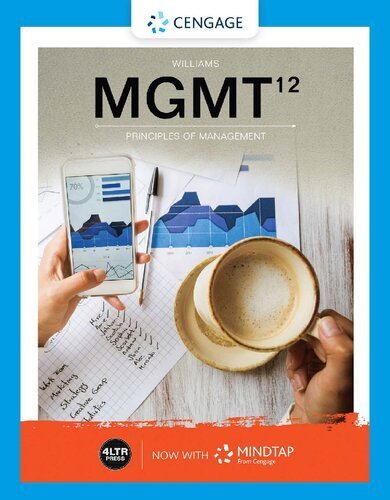
MGMT 12th Edition by Chuck Williams, ISBN-13: 978-0357137727
Original price was: $50.00.$19.99Current price is: $19.99.
Safe & secure checkout
Description
Description
MGMT 12th Edition by Chuck Williams, ISBN-13: 978-0357137727
[PDF eBook eTextbook]
- Publisher: South-Western College Publishing; 12th edition (January 22, 2021)
- Language: English
- ISBN-10: 0357137728
- ISBN-13: 978-0357137727
Learn MANAGEMENT YOUR Way with MGMT! Extensively updated to reflect the latest research in the field, MGMT makes concepts and theories accessible and relevant with timely, interesting examples of their applications at real businesses. Now available with MindTap, the digital learning solution designed to help you think and act like a manager. MGMT’s easy-reference, textbook presents course content through visually engaging chapters as well as Chapter Review Cards that consolidate the best review material into a ready-made study tool.
Table of Contents:
Brief Contents
Contents
Chapter 1: Management
1-1: Management Is . . .
1-2: Management Functions
1-3: Kinds of Managers
1-4: Managerial Roles
1-5: What Companies Look for in Managers
1-6: Mistakes Managers Make
1-7: The Transition to Management: The First Year
1-8: Competitive Advantage through People
Chapter 2: The History of Management
2-1: The Origins of Management
2-2: Scientific Management
2-3: Bureaucratic and Administrative Management
2-4: Human Relations Management
2-5: Operations, Information, Systems, and Contingency Management
Chapter 3: Organizational Environments and Cultures
3-1: Changing Environments
3-2: General Environment
3-3: Specific Environment
3-4: Making Sense of Changing Environments
3-5: Organizational Cultures: Creation, Success, and Change
Chapter 4: Ethics and Social Responsibility
4-1: Workplace Deviance
4-2: US Sentencing Commission Guidelines Manual for Organizations
4-3: Influences on Ethical Decision-Making
4-4: Practical Steps to Ethical Decision-Making
4-5: To Whom Are Organizations Socially Responsible?
4-6: For What Are Organizations Socially Responsible?
4-7: Responses to Demands for Social Responsibility
4-8: Social Responsibility and Economic Performance
Chapter 5: Planning and Decision-Making
5-1: Benefits and Pitfalls of Planning
5-2: How to Make a Plan That Works
5-3: Planning from Top to Bottom
5-4: Steps and Limits to Rational Decision-Making
5-5: Using Groups to Improve Decision-Making
Chapter 6: Organizational Strategy
6-1: Sustainable Competitive Advantage
6-2: Strategy-Making Process
6-3: Corporate-Level Strategies
6-4: Industry-Level Strategies
6-5: Firm-Level Strategies
Chapter 7: Innovation and Change
7-1: Why Innovation Matters
7-2: Managing Innovation
7-3: Organizational Decline: The Risk of Not Changing
7-4: Managing Change
Chapter 8: Global Management
8-1: Global Business, Trade Rules, and Trade Agreements
8-2: Consistency or Adaptation?
8-3: Forms for Global Business
8-4: Finding the Best Business Climate
8-5: Becoming Aware of Cultural Differences
8-6: Preparing for an International Assignment
Chapter 9: Designing Adaptive Organizations
9-1: Departmentalization
9-2: Organizational Authority
9-3: Job Design
9-4: Intraorganizational Processes
9-5: Interorganizational Processes
Chapter 10: Managing Teams
10-1: The Good and Bad of Using Teams
10-2: Kinds of Teams
10-3: Work Team Characteristics
10-4: Enhancing Work Team Effectiveness
Chapter 11: Managing Human Resource Systems
11-1: Employment Legislation
11-2: Recruiting
11-3: Selection
11-4: Training
11-5: Performance Appraisal
11-6: Compensation and Employee Separation
Chapter 12: Managing Individuals and a Diverse Workforce
12-1: Diversity: Differences That Matter
12-2: Surface-Level Diversity
12-3: Deep-Level Diversity
12-4: Managing Diversity
Chapter 13: Motivation
13-1: Basics of Motivation
13-2: Equity Theory
13-3: Expectancy Theory
13-4: Reinforcement Theory
13-5: Goal-Setting Theory
13-6: Motivating with the Integrated Model
Chapter 14: Leadership
14-1: Leaders versus Managers
14-2: Who Leaders Are and What Leaders Do
14-3: Putting Leaders in the Right Situation: Fiedler’s Contingency Theory
14-4: Adapting Leader Behavior: Hersey and Blanchard’s Situational Leadership® Theory
14-5: Adapting Leader Behavior: Path-Goal Theory
14-6: Adapting Leader Behavior: Normative Decision Theory
14-7: Visionary Leadership
Chapter 15: Managing Communication
15-1: Perception and Communication Problems
15-2: Kinds of Communication
15-3: Managing One-on-One Communication
15-4: Managing Organizationwide Communication
Chapter 16: Control
16-1: The Control Process
16-2: Control Methods
16-3: What to Control?
Chapter 17: Managing Information
17-1: Strategic Importance of Information
17-2: Characteristics and Costs of Useful Information
17-3: Capturing, Processing, and Protecting Information
17-4: Accessing and Sharing Information and Knowledge
Chapter 18: Managing Service and Manufacturing Operations
18-1: Productivity
18-2: Quality
18-3: Service Operations
18-4: Manufacturing Operations
18-5: Inventory
Endnotes
Index
Chuck Williams is currently Dean of the College of Business at Butler University: formerly the Dean of the Eberhardt School of Business at the University of the Pacific, and an Associate Professor of Management at the M.J. Neeley School of Business at Texas Christian University. Dr. Williams has also served as Associate Dean and Chair of Management. He has also taught at Michigan State University and Oklahoma State University. Dr. Williams received his B.A. in Psychology from Valparaiso University.
He specialized in Organizational Behavior, Human Resources, and Strategic Management while earning his M.B.A and Ph.D. in Business Administration from Michigan State University. His research interests include employee recruitment and turnover, performance appraisal, and employee training and goal-setting. Williams has published research in the Journal of Applied Psychology, the Academy of Management, Human Resource Management Review, Personnel Psychology, and the Organizational Research Methods Journal. He was a member of the Journal of Management’s editorial board, and serves as a reviewer for numerous other academic journals. He was also the webmaster for the Research Methods Division of the Academy of Management.
What makes us different?
• Instant Download
• Always Competitive Pricing
• 100% Privacy
• FREE Sample Available
• 24-7 LIVE Customer Support


Reviews
There are no reviews yet.