

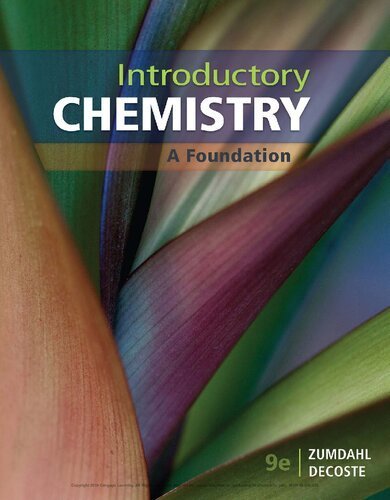
Introductory Chemistry: A Foundation 9th Edition by Steven S. Zumdahl, ISBN-13: 978-1337399425
Original price was: $50.00.$14.99Current price is: $14.99.
Safe & secure checkout
Description
Description
Introductory Chemistry: A Foundation 9th Edition by Steven S. Zumdahl, ISBN-13: 978-1337399425
[PDF eBook eTextbook]
- Publisher: Cengage Learning; 9th edition (January 1, 2018)
- Language: English
- 784 pages
- ISBN-10: 1337399426
- ISBN-13: 978-1337399425
Zumdahl and DeCoste’s best-selling INTRODUCTORY CHEMISTRY: A FOUNDATION, Ninth Edition, combines enhanced problem-solving structure with substantial pedagogy to enable students to become strong, independent problem solvers. Capturing student interest through early coverage of chemical reactions, accessible explanations and visualizations, and an emphasis on everyday applications, the authors explain chemical concepts starting with the basics and conclude by encouraging students to test their own understanding of the solution.
Table of Contents:
Brief Contents
Contents
Preface
Chapter 1: Chemistry: An Introduction
1.1 Chemistry: An Introduction
1.2 What Is Chemistry?
1.3 Solving Problems Using a Scientific Approach
1.4 The Scientific Method
1.5 Learning Chemistry
Chapter 1 Review
Chapter 2: Measurements and Calculations
2.1 Scientific Notation
2.2 Units
2.3 Measurements of Length, Volume, and Mass
2.4 Uncertainty in Measurement
2.5 Significant Figures
2.6 Problem Solving and Dimensional Analysis
2.7 Temperature Conversions: An Approach to Problem Solving
2.8 Density
Chapter 2 Review
Chapter 3: Matter
3.1 Matter
3.2 Physical and Chemical Properties and Changes
3.3 Elements and Compounds
3.4 Mixtures and Pure Substances
3.5 Separation of Mixtures
Chapter 3 Review
Cumulative Review Chapters 1-3
Chapter 4: Chemical Foundations: Elements, Atoms, and Ions
4.1 The Elements
4.2 Symbols for the Elements
4.3 Dalton’s Atomic Theory
4.4 Formulas of Compounds
4.5 The Structure of the Atom
4.6 Introduction to the Modern Concept of Atomic Structure
4.7 Isotopes
4.8 Introduction to the Periodic Table
4.9 Natural States of the Elements
4.10 Ions
4.11 Compounds That Contain Ions
Chapter 4 Review
Chapter 5: Nomenclature
5.1 Naming Compounds
5.2 Naming Binary Compounds That Contain a Metal and a Nonmetal (Types I and II)
5.3 Naming Binary Compounds That Contain Only Nonmetals (Type III)
5.4 Naming Binary Compounds: A Review
5.5 Naming Compounds That Contain Polyatomic Ions
5.6 Naming Acids
5.7 Writing Formulas from Names
Chapter 5 Review
Cumulative Review Chapters 4-5
Chapter 6: Chemical Reactions: An Introduction
6.1 Evidence for a Chemical Reaction
6.2 Chemical Equations
6.3 Balancing Chemical Equations
Chapter 6 Review
Chapter 7: Reactions in Aqueous Solutions
7.1 Predicting Whether a Reaction Will Occur
7.2 Reactions in Which a Solid Forms
7.3 Describing Reactions in Aqueous Solutions
7.4 Reactions That Form Water: Acids and Bases
7.5 Reactions of Metals with Nonmetals (Oxidation-Reduction)
7.6 Ways to Classify Reactions
7.7 Other Ways to Classify Reactions
Chapter 7 Review
Cumulative Review Chapters 6-7
Chapter 8: Chemical Composition
8.1 Counting by Weighing
8.2 Atomic Masses: Counting Atoms by Weighing
8.3 The Mole
8.4 Learning to Solve Problems
8.5 Molar Mass
8.6 Percent Composition of Compounds
8.7 Formulas of Compounds
8.8 Calculation of Empirical Formulas
8.9 Calculation of Molecular Formulas
Chapter 8 Review
Chapter 9: Chemical Quantities
9.1 Information Given by Chemical Equations
9.2 Mole-Mole Relationships
9.3 Mass Calculations
9.4 The Concept of Limiting Reactants
9.5 Calculations Involving a Limiting Reactant
9.6 Percent Yield
Chapter 9 Review
Cumulative Review Chapters 8-9
Chapter 10: Energy
10.1 The Nature of Energy
10.2 Temperature and Heat
10.3 Exothermic and Endothermic Processes
10.4 Thermodynamics
10.5 Measuring Energy Changes
10.6 Thermochemistry (Enthalpy)
10.7 Hess’s Law
10.8 Quality versus Quantity of Energy
10.9 Energy and Our World
10.10 Energy as a Driving Force
Chapter 10 Review
Chapter 11: Modern Atomic Theory
11.1 Rutherford’s Atom
11.2 Electromagnetic Radiation
11.3 Emission of Energy by Atoms
11.4 The Energy Levels of Hydrogen
11.5 The Bohr Model of the Atom
11.6 The Wave Mechanical Model of the Atom
11.7 The Hydrogen Orbitals
11.8 The Wave Mechanical Model: Further Development
11.9 Electron Arrangements in the First 18 Atoms on the Periodic Table
11.10 Electron Configurations and the Periodic Table
11.11 Atomic Properties and the Periodic Table
Chapter 11 Review
Chapter 12: Chemical Bonding
12.1 Types of Chemical Bonds
12.2 Electronegativity
12.3 Bond Polarity and Dipole Moments
12.4 Stable Electron Configurations and Charges on Ions
12.5 Ionic Bonding and Structures of Ionic Compounds
12.6 Lewis Structures
12.7 Lewis Structures of Molecules with Multiple Bonds
12.8 Molecular Structure
12.9 Molecular Structure: The VSEPR Model
12.10 Molecular Structure: Molecules with Double Bonds
Chapter 12 Review
Cumulative Review Chapters 10-12
Chapter 13: Gases
13.1 Pressure
13.2 Pressure and Volume: Boyle’s Law
13.3 Volume and Temperature: Charles’s Law
13.4 Volume and Moles: Avogadro’s Law
13.5 The Ideal Gas Law
13.6 Dalton’s Law of Partial Pressures
13.7 Laws and Models: A Review
13.8 The Kinetic Molecular Theory of Gases
13.9 The Implications of the Kinetic Molecular Theory
13.10 Gas Stoichiometry
Chapter 13 Review
Chapter 14: Liquids and Solids
14.1 Water and Its Phase Changes
14.2 Energy Requirements for the Changes of State
14.3 Intermolecular Forces
14.4 Evaporation and Vapor Pressure
14.5 The Solid State: Types of Solids
14.6 Bonding in Solids
Chapter 14 Review
Chapter 15: Solutions
15.1 Solubility
15.2 Solution Composition: An Introduction
15.3 Solution Composition: Mass Percent
15.4 Solution Composition: Molarity
15.5 Dilution
15.6 Stoichiometry of Solution Reactions
15.7 Neutralization Reactions
15.8 Solution Composition: Normality
Chapter 15 Review
Cumulative Review Chapters 13-15
Chapter 16: Acids and Bases
16.1 Acids and Bases
16.2 Acid Strength
16.3 Water as an Acid and a Base
16.4 The pH Scale
16.5 Calculating the pH of Strong Acid Solutions
16.6 Buffered Solutions
Chapter 16 Review
Chapter 17: Equilibrium
17.1 How Chemical Reactions Occur
17.2 Conditions That Affect Reaction Rates
17.3 The Equilibrium Condition
17.4 Chemical Equilibrium: A Dynamic Condition
17.5 The Equilibrium Constant: An Introduction
17.6 Heterogeneous Equilibria
17.7 Le Chatelier’s Principle
17.8 Applications Involving the Equilibrium Constant
17.9 Solubility Equilibria
Chapter 17 Review
Cumulative Review Chapters 16-17
Chapter 18: Oxidation-Reduction Reactions and Electrochemistry
18.1 Oxidation-Reduction Reactions
18.2 Oxidation States
18.3 Oxidation-Reduction Reactions between Nonmetals
18.4 Balancing Oxidation-Reduction Reactions by the Half-Reaction Method
18.5 Electrochemistry: An Introduction
18.6 Batteries
18.7 Corrosion
18.8 Electrolysis
Chapter 18 Review
Chapter 19: Radioactivity and Nuclear Energy
19.1 Radioactive Decay
19.2 Nuclear Transformations
19.3 Detection of Radioactivity and the Concept of Half-life
19.4 Dating by Radioactivity
19.5 Medical Applications of Radioactivity
19.6 Nuclear Energy
19.7 Nuclear Fission
19.8 Nuclear Reactors
19.9 Nuclear Fusion
19.10 Effects of Radiation
Chapter 19 Review
Chapter 20: Organic Chemistry
20.1 Carbon Bonding
20.2 Alkanes
20.3 Structural Formulas and Isomerism
20.4 Naming Alkanes
20.5 Petroleum
20.6 Reactions of Alkanes
20.7 Alkenes and Alkynes
20.8 Aromatic Hydrocarbons
20.9 Naming Aromatic Compounds
20.10 Functional Groups
20.11 Alcohols
20.12 Properties and Uses of Alcohols
20.13 Aldehydes and Ketones
20.14 Naming Aldehydes and Ketones
20.15 Carboxylic Acids and Esters
20.16 Polymers
Chapter 20 Review
Chapter 21: Biochemistry
21.1 Proteins
21.2 Primary Structure of Proteins
21.3 Secondary Structure of Proteins
21.4 Tertiary Structure of Proteins
21.5 Functions of Proteins
21.6 Enzymes
21.7 Carbohydrates
21.8 Nucleic Acids
21.9 Lipids
Chapter 21 Review
Appendix
Solutions to Self-Check Exercises
Answers to Even-Numbered End-of-Chapter Questions and Exercises
Answers to Even-Numbered Cumulative Review Exercises
Index and Glossary
Steve Zumdahl is the author of market-leading textbooks in introductory chemistry, general chemistry, honors-level chemistry, and high school chemistry. Recently retired from his long-time position as Director of Undergraduate Programs at the University of Illinois, he has received numerous awards for his contributions to chemical education. These include the National Catalyst Award in recognition of his contribution to chemical education, the University of Illinois Teaching Award, the UIUC Liberal Arts and Sciences Advising Award, and the School of Chemical Sciences Teaching Award (five times). He earned his B.S. in Chemistry from Wheaton College (IL), and his Ph.D. from the University of Illinois.
Donald J. DeCoste is Associate Director of General Chemistry at the University of Illinois, Urbana-Champaign and has been teaching chemistry at the high school and college levels for 26 years. He earned his BS in Chemistry and PhD from the University of Illinois, Urbana-Champaign. At UIUC he has developed chemistry courses for nonscience majors, preservice secondary teachers, and preservice elementary teachers. He teaches courses in introductory chemistry and the teaching of chemistry and has received the School of Chemical Sciences Teaching Award four times. Don has led workshops for secondary teachers and graduate student teaching assistants, discussing the methods and benefits of getting students more actively involved in class. When not involved in teaching and advising, Don enjoys spending time with his wife and three children.
What makes us different?
• Instant Download
• Always Competitive Pricing
• 100% Privacy
• FREE Sample Available
• 24-7 LIVE Customer Support
Reviews
There are no reviews yet.