

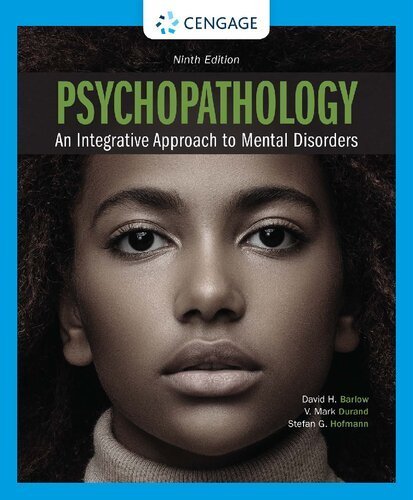
Psychopathology: An Integrative Approach to Mental Disorders 9th Edition by David H. Barlow, ISBN-13: 978-0357657843
Original price was: $50.00.$19.99Current price is: $19.99.
Safe & secure checkout
Description
Description
Psychopathology: An Integrative Approach to Mental Disorders 9th Edition by David H. Barlow, ISBN-13: 978-0357657843
[PDF eBook eTextbook]
- Publisher: Cengage Learning; 9th edition (August 9, 2022)
- Language: English
- 784 pages
- ISBN-10: 0357657845
- ISBN-13: 978-0357657843
Barlow/Durand/Hofmann’s PSYCHOPATHOLOGY: AN INTEGRATIVE APPROACH TO MENTAL DISORDERS, 9th edition, is the perfect text to help you succeed in your psychopathology or abnormal psychology course! The authors — all internationally recognized experts in the field — show you how psychological disorders are rooted in multiple factors: biological, psychological, cultural, social, familial and even political. Extremely student friendly, the text blends sophisticated research with an accessible, engaging writing style. Its groundbreaking integrative approach is the most modern, scientifically valid method for studying abnormal psychology. Text language promotes inclusivity, normalizes diversity and avoids cultural, gender, economic and other biases. In addition, you can test your understanding of key topics with built-in concept checks and chapter quizzes.
Table of Contents:
About the Authors
Brief Contents
Contents
Preface
Chapter 1: Psychopathology in Historical Context
Understanding Psychopathology
The Supernatural Tradition
The Biological Tradition
The Psychological Tradition
The Present: The Scientific Method and an Integrative Approach
Summary
Key Terms
Answers to Concept Checks
Chapter 2: An Integrative Approach to Psychopathology
One-Dimensional versus Multidimensional Models
Genetic Contributions to Psychopathology
Neuroscience and Its Contributions to Psychopathology
Behavioral and Cognitive Science
Emotions
Cultural, Social, and Interpersonal Factors
Life-Span Development
Conclusions
Summary
Key Terms
Answers to Concept Checks
Chapter 3: Clinical Assessment and Diagnosis
Assessing Psychological Disorders
Diagnosing Psychological Disorders
Summary
Key Terms
Answers to Concept Checks
Chapter 4: Research Methods
Examining Psychopathology
Types of Research Methods
Genetics and Behavior across Time and Cultures
Summary
Key Terms
Answers to Concept Checks
Chapter 5: Anxiety, Trauma- and Stressor-Related, and Obsessive-Compulsive and Related Disorders
The Complexity of Anxiety Disorders
Anxiety Disorders
Trauma and Stressor-Related Disorders
Obsessive-Compulsive and Related Disorders
Summary
Key Terms
Answers to Concept Checks
Chapter 6: Somatic Symptom and Related Disorders and Dissociative Disorders
Somatic Symptom and Related Disorders
Dissociative Disorders
Summary
Key Terms
Answers to Concept Checks
Chapter 7: Mood Disorders and Suicide
Understanding and Defining Mood Disorders
Prevalence of Mood Disorders
Causes of Mood Disorders
Treatment of Mood Disorders
Summary
Key Terms
Answers to Concept Checks
Chapter 8: Eating and Sleep-Wake Disorders
Major Types of Eating Disorders
Causes of Eating Disorders
Treatment of Eating Disorders
Obesity
Sleep-Wake Disorders: The Major Dyssomnias
Treatment of Sleep Disorders
Summary
Key Terms
Answers to Concept Checks
Chapter 9: Physical Disorders and Health Psychology
Psychological and Social Factors That Influence Health
Psychosocial Effects on Physical Disorders
Psychosocial Treatment of Physical Disorders
Summary
Key Terms
Answers to Concept Checks
Chapter 10: Sexual Dysfunctions, Paraphilic Disorders, and Gender Dysphoria
What Is “Normal” Sexuality?
An Overview of Sexual Dysfunctions
Causes and Treatment of Sexual Dysfunction
Paraphilic Disorders: Clinical Descriptions
Assessing and Treating Paraphilic Disorders
Gender Dysphoria
Summary
Key Terms
Answers to Concept Checks
Chapter 11: Substance-Related, Addictive, and Impulse-Control Disorders
Perspectives on Substance-Related and Addictive Disorders
Depressants
Stimulants
Opioid-Related Disorders
Cannabis-Related Disorders
Hallucinogen-Related Disorders
Other Commonly Misused Substances
Causes of Substance-Related Disorders
Treatment of Substance-Related Disorders
Gambling Disorder
Impulse-Control Disorders
Summary
Key Terms
Answers to Concept Checks
Chapter 12: Personality Disorders
An Overview of Personality Disorders
Cluster A Personality Disorders
Cluster B Personality Disorders
Cluster C Personality Disorders
Summary
Key Terms
Answers to Concept Checks
Chapter 13: Schizophrenia Spectrum and Other Psychotic Disorders
Perspectives on Schizophrenia
Clinical Description, Symptoms, and Subtypes
Prevalence and Causes of Schizophrenia
Treatment of Schizophrenia
Summary
Key Terms
Answers to Concept Checks
Chapter 14: Neurodevelopmental Disorders
Overview of Neurodevelopmental Disorders
Attention-Deficit/Hyperactivity Disorder
Specific Learning Disorder
Autism Spectrum Disorder
Intellectual Developmental Disorder (Intellectual Disability)
Prevention of Neurodevelopmental Disorders
Summary
Key Terms
Answers to Concept Checks
Chapter 15: Neurocognitive Disorders
Perspectives on Neurocognitive Disorders
Delirium
Major and Mild Neurocognitive Disorders
Summary
Key Terms
Answers to Concept Checks
Chapter 16: Mental Health Services: Legal and Ethical Issues
Perspectives on Mental Health Law
Civil Commitment
Criminal Commitment
Patients’ Rights and Clinical Practice Guidelines
Conclusions
Summary
Key Terms
Answers to Concept Checks
Appendix A: DSM-5 Classifications
Appendix B: DSM-5 Disorders for Further Study
Glossary
References
Name Index
Subject Index
David H. Barlow is an internationally recognized expert and leader in clinical psychology who has pioneered many treatments and investigations in anxiety and mood disorders. He is professor emeritus of psychology and psychiatry at Boston University as well as the founder and director emeritus of the Center for Anxiety and Related Disorders, one of the largest research clinics of its kind in the world. Previously, Dr. Barlow was a distinguished professor at State University of New York at Albany. From 1975 to 1979, he was professor of psychiatry and psychology at Brown University, where he also founded the clinical psychology internship program. From 1969 to 1975, he was professor of psychiatry at the University of Mississippi Medical Center, where he founded the Medical School psychology residency program. Dr. Barlow is the recipient of a Lifetime Achievement Award from the American Psychological Association as well as the James McKeen Cattell Fellow Award from the Association for Psychological Science, which honors individuals for their lifetime of significant intellectual achievements in applied psychological research. An American Psychological Association Presidential Citation noted: “He has had a far reaching impact on many psychologists of color and has shaped the future of the discipline in valuing and supporting the potential of all students.” Dr. Barlow received his B.A. from the University of Notre Dame, his M.A. from Boston College and his Ph.D. from the University of Vermont.
V. Mark Durand is known worldwide as an authority in the area of autism spectrum disorders. He is a professor of psychology at the University of South Florida St. Petersburg, where he was the founding dean of arts and sciences and vice chancellor for academic affairs. A fellow of the American Psychological Association, Dr. Durand has received over $4 million in federal funding to study the behavior problems in children with disabilities. Previously he served in a variety of leadership positions at the University at Albany, including founder of the Center for Autism and Related Disabilities. He received the University Award for Excellence in Teaching at SUNY Albany in 1991, followed by the Chancellor’s Award for Excellence in Research and Creative Scholarship at the University of South Florida St. Petersburg in 2007. Currently a member of the Professional Advisory Board for the Autism Society of America, Dr. Durand is co-editor of the JOURNAL OF POSITIVE BEHAVIOR INTERVENTIONS and has written 10 books and over 100 publications on functional communication, educational programming and behavior therapy. He developed a unique treatment for severe behavior problems that is used worldwide. Most recently he developed an innovative approach (Optimistic Parenting) to help families work with their challenging children. Dr. Durand was named a 2014 Princeton Lecture Series Fellow and received the 2015 Jacobson Award for Critical Thinking from the American Psychological Association for his body of work in the field of autism spectrum disorder. He received his B.A., M.A. and Ph.D. (all in psychology) at the State University of New York (SUNY) Stony Brook.
Stefan G. Hofmann is the Alexander von Humboldt Professor for Translational Clinical Psychology at the Philipps-University Marburg, Germany, and professor of psychology in the Department of Psychological and Brain Sciences at Boston University. He has an actively funded research program studying various aspects of emotional disorders with a particular emphasis on anxiety disorders and cognitive behavioral therapy. His many prestigious professional honors include the Alexander von Humboldt Research Award, the Humboldt Professorship (the highest German research award) and the Aaron T. Beck Award for Significant and Enduring Contributions to the Field of Cognitive Therapy by the Academy of Cognitive Therapy. Dr. Hofmann is a fellow of the AAAS, APA, APS and ABCT and served as president of various national and international professional societies, including the Association for Behavioral and Cognitive Therapies and the International Association for Cognitive Psychotherapy. He was also an adviser to the DSM-5 Development Process and a member of the DSM-5 Anxiety Disorder Sub-Work Group. For the past six years, Dr. Hofmann has been named a Highly Cited Researcher by Thomson Reuters. He is editor of COGNITIVE THERAPY AND RESEARCH and has published more than 400 peer-reviewed journal articles and 20 books, including AN INTRODUCTION TO MODERN CBT (Wiley-Blackwell) and EMOTION IN THERAPY (Guilford Press).
What makes us different?
• Instant Download
• Always Competitive Pricing
• 100% Privacy
• FREE Sample Available
• 24-7 LIVE Customer Support



Reviews
There are no reviews yet.