

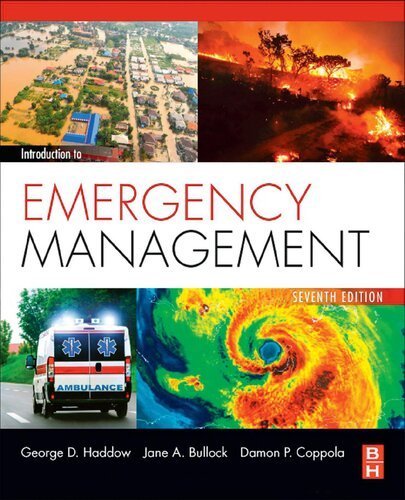
Introduction to Emergency Management 7th Edition by George D. Haddow, ISBN-13: 978-0128171394
Original price was: $50.00.$14.99Current price is: $14.99.
Safe & secure checkout
Description
Description
Introduction to Emergency Management 7th Edition by George D. Haddow, ISBN-13: 978-0128171394
[PDF eBook eTextbook]
- Publisher: Butterworth-Heinemann; 7th edition (April 28, 2020)
- Language: English
- 560 pages
- ISBN-10: 0128171391
- ISBN-13: 978-0128171394
Introduction to Emergency Management, Seventh Edition, sets the standard for excellence in the field and has educated a generation of emergency managers. This long-trusted resource provides a broad overview of the key aspects of the emergency management profession. Readers will gain an understanding of why the emergency management profession exists, what actions its professionals and practitioners are tasked with performing, and what achievements are sought through the conduct of these various efforts. Students and new professionals alike will further gain an enhanced understanding of key terminology and concepts that enable them to work with emergency management specialists.
Table of Contents:
Cover image
Title page
Table of Contents
Copyright
Dedication
Foreword
Acknowledgments
Introduction
Online Resources
Chapter 1. The Historical Context of Emergency Management
Introduction
Early History: 1800–1950
The Cold War and the Rise of Civil Defense: The 1950s
Changes to Emergency Management: The 1960s
Critical Thinking
The Call for a National Focus on Emergency Management: The 1970s
Civil Defense Reappears as Nuclear Attack Planning: The 1980s
An Agency in Trouble: 1989–92
The Witt Revolution: 1993–2001
Terrorism: 2001
The Department of Homeland Security: 2001–05
The Hurricane Katrina Debacle: 2005
The Steps Leading to the Katrina Debacle
Post-Katrina Changes
Critical Thinking
The Obama Administration’s Approach to Emergency Management
2016–Present
Conclusion
Important Terms
Self-Check Questions
Out-of-Class Exercises
Chapter 2. Natural and Technological Hazards and Risk Assessment
Introduction
Natural Hazards
Critical Thinking
Critical Thinking
Critical Thinking
Technological Hazards
Terrorism
Critical Thinking
Risk Management Technology
Social and Economic Risk Factors
Critical Thinking
Conclusion
Important Terms
Self-Check Questions
Out-of-Class Exercises
Chapter 3. The Disciplines of Emergency Management: Mitigation
Introduction
Mitigation Tools
Hazard Identification and Mapping
Design and Construction Applications
Land-Use Planning
Financial Incentives
Insurance
Structural Controls
Nonstructural Measures
Critical Thinking
Impediments to Mitigation
Federal Mitigation Programs
The Hazard Mitigation Grant Program
The Pre-Disaster Mitigation Program
Flood Mitigation Assistance Program
Severe Repetitive Loss Program
The National Earthquake Hazards Reduction Program
The Fire Prevention and Assistance Act
Critical Thinking
Hurricane Sandy: Building Sciences Mitigation Assessment Teams
Critical Thinking
Conclusion
Important Terms
Self-Check Questions
Out-of-Class Exercises
Chapter 4. Preparedness
Introduction
A Systems Approach: The Preparedness Cycle
Mitigation Versus Preparedness
Preparedness: The Emergency Operations Plan
FEMA’s Whole Community Concept
The National Preparedness System
Evacuation Planning
Critical Thinking
Emergency Planning for Access and Functional Needs Populations
Critical Thinking
Preparedness Equipment
Education and Training Programs
The FEMA Emergency Management Institute and National Fire Academy
Public Preparedness Education
Emergency Management Exercises
Evaluation and Improvement
Preparedness: A Whole Community Effort
Preparedness Grant Programs
Critical Thinking
Business Continuity Planning and Emergency Management
Conclusion
Case Studies
Important Terms
Self-Check Questions
Out-of-Class Exercises
Chapter 5. Crisis and Risk Communications
Introduction
Critical Thinking
Mission
Assumptions
Critical Thinking
Critical Thinking
Critical Thinking
Critical Thinking
A Communication Plan
Information Coming In
Information Going Out
Messengers
Staffing
Critical Thinking
Training and Exercises
Monitoring, Updating, and Adapting
Conclusion
Important Terms
Self-Check Questions
Key Terms
Chapter 6. The Disciplines of Emergency Management: Response
Introduction
The Local Response
Local Emergency Managers
The State Response
Volunteer Groups’ Response
The Incident Command System
The Federal Response
The Presidential Disaster Declaration Process
FEMA Declaration Criteria
Critical Thinking
The National Response Framework
Federal Assistance in Disaster Response
Organizing Support: The Emergency Support Function
National Response Framework Operations Coordination
Incident Level Coordination: The Joint Field Office
FEMA Incident Management Assistance Teams
Key Response Coordination Officials
Principal Federal Official
Critical Thinking
FEMA Community Lifelines
State-to-State Support: The Emergency Management Assistance Compact
Defense Support of Civil Authorities
Conclusion
Important Terms
Self-Check Questions
Out-of-Class Exercises
Chapter 7. Recovery
Introduction
Fundamentals of Disaster Recovery
Recovery Coordination and Leadership
Recovery Sectors
Federal Government Disaster Recovery Assistance
FEMA Recovery Assistance Programs
FEMA’s Individual Assistance Recovery Programs
Critical Thinking
FEMA’s Public Assistance Grant Programs
The Disaster Relief Fund
Other Federal Agency Disaster Recovery Funding
Small Business Administration
National Voluntary Relief Organizations
Recovery Planning Tools
Predisaster Recovery Planning
Critical Thinking
Conclusion
Important Terms
Self-Check Questions
Out-of-Class Exercises
Chapter 8. International Disaster Management
Introduction
Disasters in Developing Nations
International Disasters Defined
Important Issues Influencing the Response Process
Critical Thinking
United Nations Disaster Management Efforts
Critical Thinking
Nongovernmental Organizations
Critical Thinking
Assistance Provided by the US Government
Critical Thinking
The International Financial Institutions
Critical Thinking
Conclusion
Important Terms
Self-Check Questions
Out-of-Class Exercises
Chapter 9. Emergency Management and the Terrorist Threat
Introduction
Changes in Emergency Management and the War on Terrorism
The Terrorist Threat
Terrorist Actions
The Monumental Human, Economic, and Social Costs of the September 11th Attacks
Critical Thinking
Statutory Basis of Terror Threat Management
Homeland Security Organizations
Critical Thinking
Other Agencies Participating in Community-Level Funding
Funding for First Responders and Emergency Management
Communicating Threat Information to the American People
Conclusion
Important Terms
Self-Check Questions
Out-of-Class Exercises
Chapter 10. The Future of Emergency Management
Challenges Facing Emergency Management
Conclusion
Appendix A. Acronyms
Appendix B. Emergency Management Websites
Bibliography
Glossary
Index
Jane A. Bullock served more than 20 years in support of Federal emergency management efforts, culminating as the Chief of Staff at the Federal Emergency Management Agency (FEMA) for Director James Lee Witt. In this position Ms. Bullock served as principal advisor to the Director on all Agency programmatic and administrative activities, provided advice and recommendations to the Director on policies required to carry out the mission of the agency; managed the day-to-day operations of the Agency; directed, monitored, and evaluated Agency strategic and communication processes; and oversaw administration of the Agency’s resources, including the disaster relief fund. In 2001, Ms. Bullock co-founded the disaster management consulting firm Bullock & Haddow, LLC. She currently serves on the governing boards of the National Earthquake Hazards Program, the Earthquake Engineering Research Center, and others.
George Haddow currently serves as Senior Fellow at the Disaster Resilience Leadership Academy (DRLA) at Tulane University in New Orleans, LA and previously served as an Adjunct Faculty and Research Scientist, Institute for Crisis, Disaster and Risk Management, George Washington University in Washington, DC. at Prior to joining academia, Mr. Haddow worked for eight years in the Office of the Director of the Federal Emergency Management Agency (FEMA) as the White House Liaison and the deputy Chief of Staff. He is a founding partner of Bullock & Haddow LLC, a disaster management consulting firm.
Damon P. Coppola is the founder of Shoreline Risk LLC and a Partner with Bullock & Haddow LLC. He has extensive experience in disaster management capacity development, disaster risk management, and planning through his work with the United Nations; the World Bank Group; The US Federal Emergency Management Agency; and the US Army Corps of Engineers, among others. Mr. Coppola serves as a Senior Disaster Management Specialist at the Hawaii-based Pacific Disaster Center and is a faculty member at Loma Linda University and the University of Hawaii. He holds an M.E.M in Crisis, Emergency, and Risk Management from George Washington University and an A.R.M. from the American Institute for Chartered Property Casualty Underwriters.
What makes us different?
• Instant Downloa
• Always Competitive Pricing
• 100% Privacy
• FREE Sample Available
• 24-7 LIVE Customer Support



Reviews
There are no reviews yet.