

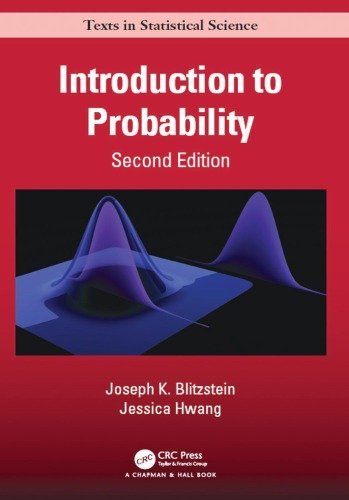
Introduction to Probability 2nd Edition by Joseph K. Blitzstein, ISBN-13: 978-1138369917
Original price was: $50.00.$14.99Current price is: $14.99.
Safe & secure checkout
Description
Description
Introduction to Probability 2nd Edition by Joseph K. Blitzstein, ISBN-13: 978-1138369917
[PDF eBook eTextbook]
- Publisher: Chapman and Hall/CRC; 2nd edition (February 8, 2019)
- Language: English
- 634 pages
- ISBN-10: 1138369918
- ISBN-13: 978-1138369917
Developed from celebrated Harvard statistics lectures, Introduction to Probability provides essential language and toolsfor understanding statistics, randomness, and uncertainty. The book explores a wide variety of applications and examples, ranging from coincidences and paradoxes to Google PageRank and Markov chain Monte Carlo (MCMC). Additional application areas explored include genetics, medicine, computer science, and information theory.
The authors present the material in an accessible style and motivate concepts using real-world examples. Throughout, they use stories to uncover connections between the fundamental distributions in statistics and conditioning to reduce complicated problems to manageable pieces.
The book includes many intuitive explanations, diagrams, and practice problems. Each chapter ends with a section showing how to perform relevant simulations and calculations in R, a free statistical software environment.
The second edition adds many new examples, exercises, and explanations, to deepen understanding of the ideas, clarify subtle concepts, and respond to feedback from many students and readers. New supplementary online resources have been developed, including animations and interactive visualizations, and the book has been updated to dovetail with these resources.
Supplementary material is available on Joseph Blitzstein’s website www. stat110.net. The supplements include:
– Solutions to selected exercises
– Additional practice problems
– Handouts including review material and sample exams Animations and interactive visualizations created in connection with the edX online version of Stat 110.
– Links to lecture videos available on ITunes U and YouTube There is also a complete instructor’s solutions manual available to instructors who require the book for a course.
Table of Contents:
Cover
Half Title
Title Page
Copyright Page
Dedication
Table of Contents
Preface
1 Probability and counting
1.1 Why study probability?
1.2 Sample spaces and Pebble World
1.3 Naive definition of probability
1.4 How to count
1.5 Story proofs
1.6 Non-naive definition of probability
1.7 Recap
1.8 R
1.9 Exercises
2 Conditional probability
2.1 The importance of thinking conditionally
2.2 Definition and intuition
2.3 Bayes’ rule and the law of total probability
2.4 Conditional probabilities are probabilities
2.5 Independence of events
2.6 Coherency of Bayes’ rule
2.7 Conditioning as a problem-solving tool
2.8 Pitfalls and paradoxes
2.9 Recap
2.10 R
2.11 Exercises
3 Random variables and their distributions
3.1 Random variables
3.2 Distributions and probability mass functions
3.3 Bernoulli and Binomial
3.4 Hypergeometric
3.5 Discrete Uniform
3.6 Cumulative distribution functions
3.7 Functions of random variables
3.8 Independence of r.v.s
3.9 Connections between Binomial and Hypergeometric
3.10 Recap
3.11 R
3.12 Exercises
4 Expectation
4.1 Definition of expectation
4.2 Linearity of expectation
4.3 Geometric and Negative Binomial
4.4 Indicator r.v.s and the fundamental bridge
4.5 Law of the unconscious statistician (LOTUS)
4.6 Variance
4.7 Poisson
4.8 Connections between Poisson and Binomial
4.9 *Using probability and expectation to prove existence
4.10 Recap
4.11 R
4.12 Exercises
5 Continuous random variables
5.1 Probability density functions
5.2 Uniform
5.3 Universality of the Uniform
5.4 Normal
5.5 Exponential
5.6 Poisson processes
5.7 Symmetry of i.i.d. continuous r.v.s
5.8 Recap
5.9 R
5.10 Exercises
6 Moments
6.1 Summaries of a distribution
6.2 Interpreting moments
6.3 Sample moments
6.4 Moment generating functions
6.5 Generating moments with MGFs
6.6 Sums of independent r.v.s via MGFs
6.7 *Probability generating functions
6.8 Recap
6.9 R
6.10 Exercises
7 Joint distributions
7.1 Joint, marginal, and conditional
7.2 2D LOTUS
7.3 Covariance and correlation
7.4 Multinomial
7.5 Multivariate Normal
7.6 Recap
7.7 R
7.8 Exercises
8 Transformations
8.1 Change of variables
8.2 Convolutions
8.3 Beta
8.4 Gamma
8.5 Beta-Gamma connections
8.6 Order statistics
8.7 Recap
8.8 R
8.9 Exercises
9 Conditional expectation
9.1 Conditional expectation given an event
9.2 Conditional expectation given an r.v.
9.3 Properties of conditional expectation
9.4 Geometric interpretation of conditional expectation
9.5 Conditional variance
9.6 Adam and Eve examples
9.7 Recap
9.8 R
9.9 Exercises
10 Inequalities and limit theorems
10.1 Inequalities
10.2 Law of large numbers
10.3 Central limit theorem
10.4 Chi-Square and Student-t
10.5 Recap
10.6 R
10.7 Exercises
11 Markov chains
11.1 Markov property and transition matrix
11.2 Classification of states
11.3 Stationary distribution
11.4 Reversibility
11.5 Recap
11.6 R
11.7 Exercises
12 Markov chain Monte Carlo
12.1 Metropolis-Hastings
12.2 Gibbs sampling
12.3 Recap
12.4 R
12.5 Exercises
13 Poisson processes
13.1 Poisson processes in one dimension
13.2 Conditioning, superposition, and thinning
13.3 Poisson processes in multiple dimensions
13.4 Recap
13.5 R
13.6 Exercises
A Math
A.1 Sets
A.2 Functions
A.3 Matrices
A.4 Difference equations
A.5 Differential equations
A.6 Partial derivatives
A.7 Multiple integrals
A.8 Sums
A.9 Pattern recognition
A.10 Common sense and checking answers
B R
B.1 Vectors
B.2 Matrices
B.3 Math
B.4 Sampling and simulation
B.5 Plotting
B.6 Programming
B.7 Summary statistics
B.8 Distributions
C Table of distributions
References
Index
Joseph K. Blitzstein, PhD, professor of the practice in statistics, Department of Statistics, Harvard University, Cambridge, Massachusetts, USA
Jessica Hwang is a graduate student in the Stanford statistics department.
What makes us different?
• Instant Download
• Always Competitive Pricing
• 100% Privacy
• FREE Sample Available
• 24-7 LIVE Customer Support
Reviews
There are no reviews yet.