

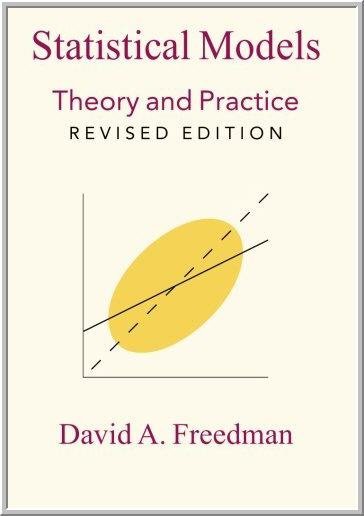
Statistical Models: Theory and Practice 2nd Edition by David A. Freedman, ISBN-13: 978-0521743853
Original price was: $50.00.$14.99Current price is: $14.99.
Safe & secure checkout
Description
Description
Statistical Models: Theory and Practice 2nd Edition by David A. Freedman, ISBN-13: 978-0521743853
[PDF eBook eTextbook]
- Publisher: Cambridge University Press; 2nd edition (April 27, 2009)
- Language: English
- 458 pages
- ISBN-10: 0521743850
- ISBN-13: 978-0521743853
Explains the basic ideas of association and regression, taking you through the current models that link these ideas to causality.
This lively and engaging textbook explains the things you have to know in order to read empirical papers in the social and health sciences, as well as the techniques you need to build statistical models of your own. The author, David A. Freedman, explains the basic ideas of association and regression, and takes you through the current models that link these ideas to causality. The focus is on applications of linear models, including generalized least squares and two-stage least squares, with probits and logits for binary variables. The bootstrap is developed as a technique for estimating bias and computing standard errors. Careful attention is paid to the principles of statistical inference. There is background material on study design, bivariate regression, and matrix algebra. To develop technique, there are computer labs with sample computer programs. The book is rich in exercises, most with answers. Target audiences include advanced undergraduates and beginning graduate students in statistics, as well as students and professionals in the social and health sciences. The discussion in the book is organized around published studies, as are many of the exercises. Relevant journal articles are reprinted at the back of the book. Freedman makes a thorough appraisal of the statistical methods in these papers and in a variety of other examples. He illustrates the principles of modeling, and the pitfalls. The discussion shows you how to think about the critical issues – including the connection (or lack of it) between the statistical models and the real phenomena.
Features of the book:
• authoritative guidance from a well-known author with wide experience in teaching, research, and consulting
• careful analysis of statistical issues in substantive applications
• no-nonsense, direct style
• versatile structure, enabling the text to be used as a text in a course, or read on its own • text that has been thoroughly class-tested at Berkeley
• background material on regression and matrix algebra
• plenty of exercises, most with solutions
• extra material for instructors, including data sets and code for lab projects (available from Cambridge University Press)
• many new exercises and examples
• reorganized, restructured, and revised chapters to aid teaching and understanding
Table of Contents:
Foreword to the Revised Edition xi
Preface xiii
1 Observational Studies and Experiments
1.1 Introduction 1
1.2 The HIP trial 4
1.3 Snow on cholera 6
1.4 Yule on the causes of poverty 9
Exercise set A 13
1.5 End notes 14
2 The Regression Line
2.1 Introduction 18
2.2 The regression line 18
2.3 Hooke’s law 22
Exercise set A 23
2.4 Complexities 23
2.5 Simple vs multiple regression 26
Exercise set B 26
2.6 End notes 28
3 Matrix Algebra
3.1 Introduction 29
Exercise set A 30
3.2 Determinants and inverses 31
Exercise set B 33
3.3 Random vectors 35
Exercise set C 35
3.4 Positive definite matrices 36
Exercise set D 37
3.5 The normal distribution 38
Exercise set E 39
3.6 If you want a book on matrix algebra 40
4 Multiple Regression
4.1 Introduction 41
Exercise set A 44
4.2 Standard errors 45
Things we don’t need 49
Exercise set B 49
4.3 Explained variance in multiple regression 51
Association or causation? 53
Exercise set C 53
4.4 What happens to OLS if the assumptions break down? 53
4.5 Discussion questions 53
4.6 End notes 59
5 Multiple Regression: Special Topics
5.1 Introduction 61
5.2 OLS is BLUE 61
Exercise set A 63
5.3 Generalized least squares 63
Exercise set B 65
5.4 Examples on GLS 65
Exercise set C 66
5.5 What happens to GLS if the assumptions break down? 68
5.6 Normal theory 68
Statistical significance 70
Exercise set D 71
5.7 The F-test 72
“The” F-test in applied work 73
Exercise set E 74
5.8 Data snooping 74
Exercise set F 76
5.9 Discussion questions 76
5.10 End notes 78
6 Path Models
6.1 Stratification 81
Exercise set A 86
6.2 Hooke’s law revisited 87
Exercise set B 88
6.3 Political repression during the McCarthy era 88
Exercise set C 90
6.4 Inferring causation by regression 91
Exercise set D 93
6.5 Response schedules for path diagrams 94
Selection vs intervention 101
Structural equations and stable parameters 101
Ambiguity in notation 102
Exercise set E 102
6.6 Dummy variables 103
Types of variables 104
6.7 Discussion questions 105
6.8 End notes 112
7 Maximum Likelihood
7.1 Introduction 115
Exercise set A 119
7.2 Probit models 121
Why not regression? 123
The latent-variable formulation 123
Exercise set B 124
Identification vs estimation 125
What if the Ui are N(μ, σ2)? 126
Exercise set C 127
7.3 Logit models 128
Exercise set D 128
7.4 The effect of Catholic schools 130
Latent variables 132
Response schedules 133
The second equation 134
Mechanics: bivariate probit 136
Why a model rather than a cross-tab? 138
Interactions 138
More on table 3 in Evans and Schwab 139
More on the second equation 139
Exercise set E 140
7.5 Discussion questions 141
7.6 End notes 150
8 The Bootstrap
8.1 Introduction 155
Exercise set A 166
8.2 Bootstrapping a model for energy demand 167
Exercise set B 173
8.3 End notes 174
9 Simultaneous Equations
9.1 Introduction 176
Exercise set A 181
9.2 Instrumental variables 181
Exercise set B 184
9.3 Estimating the butter model 184
Exercise set C 185
9.4 What are the two stages? 186
Invariance assumptions 187
9.5 A social-science example: education and fertility 187
More on Rindfuss et al 191
9.6 Covariates 192
9.7 Linear probability models 193
The assumptions 194
The questions 195
Exercise set D 196
9.8 More on IVLS 197
Some technical issues 197
Exercise set E 198
Simulations to illustrate IVLS 199
9.9 Discussion questions 200
9.10 End notes 207
10 Issues in Statistical Modeling
10.1 Introduction 209
The bootstrap 211
The role of asymptotics 211
Philosophers’ stones 211
The modelers’ response 212
10.2 Critical literature 212
10.3 Response schedules 217
10.4 Evaluating the models in chapters 7–9 217
10.5 Summing up 218
References 219
Answers to Exercises 235
The Computer Labs 294
Appendix: Sample MATLAB Code 310
Reprints
Gibson on McCarthy 315
Evans and Schwab on Catholic Schools 343
Rindfuss et al on Education and Fertility 377
Schneider et al on Social Capital 402
Index 431
David A. Freedman is Professor of Statistics at the University of California, Berkeley. He has also taught in Athens, Caracas, Jerusalem, Kuwait, London, Mexico City, and Stanford. He has written several previous books, including a widely used elementary text. He is one of the leading researchers in probability and statistics, with 200 papers in the professional literature. He is a member of the American Academy of Arts and Sciences. In 2003, he received the John J. Carty Award for the Advancement of Science from the National Academy of Sciences, recognizing his ‘profound contributions to the theory and practice of statistics’. Freedman has consulted for the Carnegie Commission, the City of San Francisco, and the Federal Reserve, as well as several departments of the US government. He has testified as an expert witness on statistics in law cases that involve employment discrimination, fair loan practices, duplicate signatures on petitions, railroad taxation, ecological inference, flight patterns of golf balls, price scanner errors, sampling techniques, and census adjustment.
What makes us different?
• Instant Download
• Always Competitive Pricing
• 100% Privacy
• FREE Sample Available
• 24-7 LIVE Customer Support

Reviews
There are no reviews yet.