

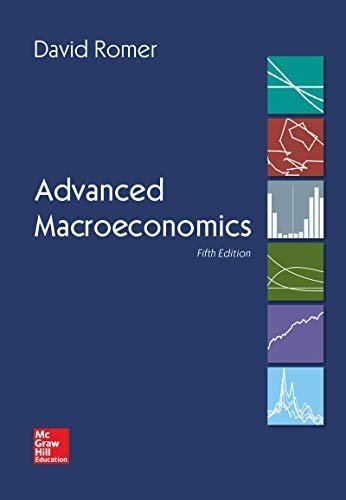
Advanced Macroeconomics 5th Edition by David Romer, ISBN-13: 978-1260185218
Original price was: $50.00.$14.99Current price is: $14.99.
Safe & secure checkout
Description
Description
Advanced Macroeconomics 5th Edition by David Romer, ISBN-13: 978-1260185218
[PDF eBook eTextbook]
- Publisher: McGraw Hill; 5th edition (February 19, 2018)
- Language: English
- 800 pages
- ISBN-10: 1260185214
- ISBN-13: 978-1260185218
The fifth edition of Romer’s Advanced Macroeconomics continues its tradition as the standard text and the starting point for graduate macroeconomics courses and helps lay the groundwork for students to begin doing research in macroeconomics and monetary economics. Romer presents the major theories concerning the central questions of macroeconomics. The theoretical analysis is supplemented by examples of relevant empirical work, illustrating the ways that theories can be applied and tested. In areas ranging from economic growth and short-run fluctuations to the natural rate of unemployment and monetary policy, formal models are used to present and analyze key ideas and issues.
The book has been extensively revised to incorporate important new topics and new research, eliminate inessential material, and further improve the presentation.
Table of Contents:
Preface to the Fifth Edition xvii
Introduction 1
Chapter 1 THE SOLOW GROWTH MODEL 6
1.1 Some Basic Facts about Economic Growth 6
1.2 Assumptions 10
1.3 The Dynamics of the Model 15
1.4 The Impact of a Change in the Saving Rate 18
1.5 Quantitative Implications 24
1.6 The Solow Model and the Central Questions of
Growth Theory 28
1.7 Empirical Applications 30
1.8 The Environment and Economic Growth 37
Problems 45
Chapter 2 INFINITE-HORIZON AND OVERLAPPINGGENERATIONS
MODELS 50
Part A THE RAMSEY CASS KOOPMANS MODEL 50
2.1 Assumptions 50
2.2 The Behavior of Households and Firms 53
2.3 The Dynamics of the Economy 59
2.4 Welfare 65
2.5 The Balanced Growth Path 66
2.6 The Effects of a Fall in the Discount Rate 67
2.7 The Effects of Government Purchases 72
Part B THE DIAMOND MODEL 76
2.8 Assumptions 76
2.9 Household Behavior 78
2.10 The Dynamics of the Economy 80
2.11 The Possibility of Dynamic Inefficiency 87
2.12 Government in the Diamond Model 90
Problems 91
Chapter 3 ENDOGENOUS GROWTH 99
3.1 Framework and Assumptions 100
3.2 The Model without Capital 102
3.3 The General Case 109
3.4 The Nature of Knowledge and the Determinants of the
Allocation of Resources to R&D 114
3.5 The Romer Model 121
3.6 Empirical Application: Time-Series Tests of Endogenous
Growth Models 132
3.7 Empirical Application: Population Growth and
Technological Change since 1 Million B.C. 137
3.8 Models of Knowledge Accumulation and the Central
Questions of Growth Theory 142
Problems 144
Chapter 4 CROSS-COUNTRY INCOME
DIFFERENCES 149
4.1 Extending the Solow Model to Include Human Capital 150
4.2 Empirical Application: Accounting for Cross-Country
Income Differences 155
4.3 Social Infrastructure 162
4.4 Empirical Application: Social Infrastructure and
Cross-Country Income Differences 164
4.5 Beyond Social Infrastructure 169
4.6 Differences in Growth Rates 178
Problems 183
Chapter 5 REAL BUSINESS CYCLE THEORY 188
5.1 Introduction: An Overview of Economic Fluctuations 188
5.2 An Overview of Business-Cycle Research 193
5.3 A Baseline Real-Business-Cycle Model 195
5.4 Household Behavior 197
5.5 A Special Case of the Model 201
5.6 Solving the Model in the General Case 207
5.7 Implications 211
5.8 Empirical Application: Calibrating a Real-Business-
Cycle Model 217
5.9 Empirical Application: Money and Output 220
5.10 Assessing the Baseline Real-Business-Cycle Model 227
Problems 233
Chapter 6 NOMINAL RIGIDITY 238
Part A EXOGENOUS NOMINAL RIGIDITY 239
6.1 A Baseline Case: Fixed Prices 239
6.2 Price Rigidity, Wage Rigidity, and Departures from Perfect
Competition in the Goods and Labor Markets 244
6.3 Empirical Application: The Cyclical Behavior of the Real
Wage 253
6.4 Toward a Usable Model with Exogenous Nominal Rigidity 255
Part B MICROECONOMIC FOUNDATIONS OF
INCOMPLETE NOMINAL ADJUSTMENT 268
6.5 A Model of Imperfect Competition and Price-Setting 269
6.6 Are Small Frictions Enough? 276
6.7 Real Rigidity 279
6.8 Coordination-Failure Models and Real Non-Walrasian
Theories 286
6.9 The Lucas Imperfect-Information Model 293
Problems 303
Chapter 7 DYNAMIC STOCHASTIC GENERALEQUILIBRIUM
MODELS OF
FLUCTUATIONS 309
7.1 Building Blocks of Dynamic New Keynesian Models 312
7.2 Predetermined Prices: The Fischer Model 316
7.3 Fixed Prices: The Taylor Model 320
7.4 The Calvo Model and the New Keynesian Phillips Curve 326
7.5 State-Dependent Pricing 329
7.6 Empirical Applications 335
7.7 Models of Staggered Price Adjustment with Inflation Inertia 341
7.8 The Canonical New Keynesian Model 350
7.9 The Forward Guidance Puzzle 354
7.10 Other Elements of Modern New Keynesian DSGE Models
of Fluctuations 360
Problems 365
Chapter 8 CONSUMPTION 368
8.1 Consumption under Certainty: The Permanent-Income
Hypothesis 369
8.2 Consumption under Uncertainty: The Random-Walk
Hypothesis 376
8.3 Empirical Application: Two Tests of the Random-Walk
Hypothesis 379
8.4 The Interest Rate and Saving 385
8.5 Consumption and Risky Assets 389
8.6 Beyond the Permanent-Income Hypothesis 398
8.7 A Dynamic-Programming Analysis of Precautionary Saving 407
Problems 413
Chapter 9 INVESTMENT 420
9.1 Investment and the Cost of Capital 421
9.2 A Model of Investment with Adjustment Costs 424
9.3 Tobin’s q 429
9.4 Analyzing the Model 431
9.5 Implications 435
9.6 Empirical Application: q and Investment 441
9.7 The Effects of Uncertainty 444
9.8 Kinked and Fixed Adjustment Costs 449
Problems 453
Chapter 10 FINANCIAL MARKETS AND
FINANCIAL CRISES 458
10.1 A Model of Perfect Financial Markets 460
10.2 Agency Costs and the Financial Accelerator 463
10.3 Empirical Application: Cash Flow and Investment 475
10.4 Mispricing and Excess Volatility 479
10.5 Empirical Application: Evidence on Excess Volatility 488
10.6 The Diamond Dybvig Model 491
10.7 Contagion and Financial Crises 501
10.8 Empirical Application: Microeconomic Evidence on the
Macroeconomic Effects of Financial Crises 508
Problems 514
Chapter 11 UNEMPLOYMENT 520
11.1 A Generic Efficiency-Wage Model 523
11.2 The Shapiro-Stiglitz Model 532
11.3 Contracting Models 543
11.4 Search and Matching Models 550
11.5 Implications 558
11.6 Empirical Applications 564
Problems 572
Chapter 12 MONETARY POLICY 578
12.1 Inflation, Money Growth, and Interest Rates 579
12.2 Monetary Policy and the Term Structure of Interest
Rates 583
12.3 The Microeconomic Foundations of Stabilization Policy 588
12.4 Optimal Monetary Policy in a Simple Backward-Looking
Model 596
12.5 Optimal Monetary Policy in a Simple Forward-Looking
Model 602
12.6 Some Additional Issues Concerning Interest-Rate Rules 607
12.7 The Zero Lower Bound on the Nominal Interest Rate 615
12.8 The Dynamic Inconsistency of Low-Inflation
Monetary Policy 630
12.9 Empirical Applications 637
12.10 Seignorage and Inflation 642
Problems 652
Chapter 13 BUDGET DEFICITS AND FISCAL POLICY 660
13.1 The Government Budget Constraint 662
13.2 Ricardian Equivalence 669
13.3 Tax-Smoothing 673
13.4 Political-Economy Theories of Budget Deficits 678
13.5 Strategic Debt Accumulation 681
13.6 Delayed Stabilization 691
13.7 Empirical Application: Politics and Deficits in
Industrialized Countries 696
13.8 The Costs of Deficits 700
13.9 A Model of Sovereign Debt Crises 704
Problems 710
References 715
Author Index 752
Subject Index 761
David Romer is the Royer Professor in Political Economy at the University of California, Berkeley, where he has been on the faculty since 1988. He is also co-director of the program in Monetary Economics at the National Bureau of Economic Research. He received his A.B. from Princeton University and his Ph.D. from the Massachusetts Institute of Technology. He has been a fellow of the American Academy of Arts and Sciences since 2006.
At Berkeley, he is a three-time recipient of the Graduate Economic Association’s distinguished teaching and advising awards; he received Berkeley’s Social Sciences Distinguished Teaching Award in 2013 2014. Much of his research focuses on monetary and fiscal policy; this work considers both the effects of policy on the economy and the determinants of policy. His other research interests include the foundations of price stickiness, empirical evidence on economic growth, and asset-price volatility. His most recent work is concerned with financial crises. He is married to Christina Romer, with whom he frequently collaborates. They have three children, Katherine, Paul, and Matthew.
What makes us different?
• Instant Download
• Always Competitive Pricing
• 100% Privacy
• FREE Sample Available
• 24-7 LIVE Customer Support


Reviews
There are no reviews yet.