

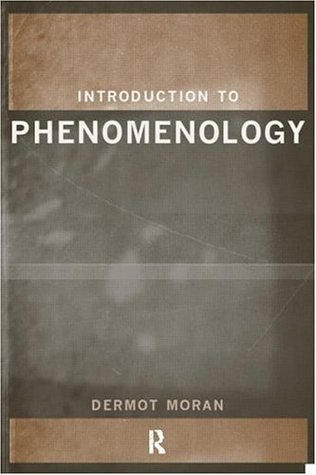
Introduction to Phenomenology 1st Edition by Dermot Moran, ISBN-13: 978-0415183734
Original price was: $50.00.$14.99Current price is: $14.99.
Safe & secure checkout
Description
Description
Introduction to Phenomenology 1st Edition by Dermot Moran, ISBN-13: 978-0415183734
[PDF eBook eTextbook]
- Publisher: Routledge; 1st edition (December 23, 1999)
- Language: English
- 592 pages
- ISBN-10: 0415183731
- ISBN-13: 978-0415183734
Introduction to Phenomenology is an outstanding and comprehensive guide to phenomenology. Dermot Moran lucidly examines the contributions of phenomenology’s nine seminal thinkers: Brentano, Husserl, Heidegger, Gadamer, Arendt, Levinas, Sartre, Merleau-Ponty and Derrida.
Written in a clear and engaging style, Introduction to Phenomenology charts the course of the phenomenological movement from its origins in Husserl to its transformation by Derrida. It describes the thought of Heidegger and Sartre, phenomonology’s most famous thinkers, and introduces and assesses the distinctive use of phenomonology by some of its lesser known exponents, such as Levinas, Arendt and Gadamer. Throughout the book, the enormous influence of phenomenology on the course of twentieth-century philosophy is thoroughly explored.
This is an indispensable introduction for all unfamiliar with this much talked about but little understood school of thought. Technical terms are explained throughout and jargon is avoided. Introduction to Phenomenology will be of interest to all students seeking a reliable introduction to a key movement in European thought.
Table of Contents:
Preface xiii
Acknowledgements xvii
List of abbreviations xix
Introduction 1
Phenomenology and twentieth-century European philosophy 1
What is phenomenology? 4
The origins of the term ‘phenomenology’ 6
Phenomenology in Brentano 7
The presuppositionless starting point 9
The suspension of the natural attitude 11
The life-world and being in the world 12
Phenomenology as the achievement of knowing 14
The structure of intentionality 16
Philosophy and history 17
Phenomenology in France 18
Conclusion 20
1 Franz Brentano: descriptive psychology and intentionality 23
Introduction: exact philosophy 23
The Brentano school 24
Brentano: life and writings (1838–1917) 26
Brentano’s philosophical outlook: empiricism 33
Brentano’s theory of wholes and parts 36
Brentano’s reform of logic 37
Descriptive psychology 39
Inner perception 41
Inner perception as additional awareness 43
The tripartite structure of mental life 45
Presentations and modifications of presentations 46
The intentional relation 47
Distinction between physical and psychical phenomena 52
Twardowski’s modification of Brentanian descriptive psychology 55
Brentano and Husserl 59
2 Edmund Husserl: founder of phenomenology 60
Introduction: an overview of Husserl and his philosophy 60
Husserl’s central problem: the mystery of subjectivity 60
Husserl as perpetual beginner 62
The stages of Husserl’s development 65
Husserl: life and writings (1859–1938) 67
A leader without followers 89
3 Husserl’s Logical Investigations (1900–1901) 91
Introduction 91
The composition of the Logical Investigations 91
The ideal of science as a system of evident cognitions 94
The Prolegomena (1900) 99
Psychologism 101
The six Investigations and the ‘breakthrough’ to pure
phenomenology 105
A brief survey of the six Investigations 109
The First Logical Investigation 110
The Fifth Logical Investigation 113
The Sixth Logical Investigation 118
Realism and idealism in the Logical Investigations 121
4 Husserl’s discovery of the reduction and transcendental
phenomenology 124
Introduction 124
Phenomenology as a presuppositionless science 126
Husserl’s principle of principles 127
The absolute self-givenness of our mental acts 129
Phenomenology an eidetic not a factual science 132
Eidetic seeing (Wesenerschauung) 134
Husserl’s transcendental turn 136
David Hume as a transcendental philosopher 139
The critique of naturalism 142
The epoché and the reductions 146
The epoché and scepticism 148
Breaking with actuality 152
Imaginative free variation 154
The noetic-noematic structure of experience 155
Problems with the reduction 160
The horizon 161
5 Husserl and the crisis of the European sciences 164
Introduction 164
The notion of constitution 164
Static and genetic constitution 166
The transcendental ego 168
Intersubjectivity and the experience of the other (Fremderfahrung) 175
The Crisis of European Sciences: the investigation of
the life-world 179
The life-world 181
The origin of geometry 186
Husserl’s achievement 186
6 Martin Heidegger’s transformation of phenomenology 192
The enigma of Heidegger 192
The question of being 195
Heidegger: life and writings (1889–1976) 200
The political implications of Heidegger’s philosophy 219
7 Heidegger’s Being and Time 222
Introduction: the road to Being and Time 222
The review of Karl Jaspers’ Psychology of World Views (c. 1921) 223
Heidegger’s Aristotle interpretation (1922) 225
Heidegger’s critical appropriation of Husserl 226
Readiness to hand (Zuhandenheit) and presence at hand
(Vorhandenheit) 233
Expression (Aussage) 234
Heidegger’s fusion of phenomenology with hermeneutics 234
The hermeneutical structure of the question 236
The hermeneutical circle 237
The nature of Dasein 238
Authenticity and inauthenticity 239
Anxiety and being-towards-death 240
Mood and state of mind (Befindlichkeit) 241
Mitsein 242
Transcendental homelessness 243
Heidegger’s influence 245
8 Hans-Georg Gadamer: philosophical hermeneutics 248
Introduction: an overview of Gadamer’s philosophy 248
The classical legacy 250
The tradition of understanding 252
Philosophy as dialogue 253
Hans-Georg Gadamer (1900–): life and writings 254
Gadamer on the Greeks and the Germans 268
The importance of language 269
The tradition of hermeneutics 271
Hermeneutics in Dilthey and Heidegger 276
Truth and Method (1960) 280
Language and world 282
Gadamer’s influence 283
9 Hannah Arendt: the phenomenology of the public sphere 287
Introduction: Hannah Arendt as philosopher 287
Arendt: life and writings (1906–1975) 292
The Human Condition 306
Arendt’s contribution 316
10 Emmanuel Levinas: the phenomenology of alterity 320
Introduction: ethics as first philosophy 320
Emmanuel Levinas: life and writings (1906–1995) 322
Levinas and phenomenology 327
The role of philosophy 329
The religious dimension of Levinas’s thought 330
Early writings 332
A defence of subjectivity 341
The face to face 347
Levinas’s influence 350
11 Jean-Paul Sartre: passionate description 354
Introduction: the engagé intellectual 354
Sartre’s philosophical outlook 356
Jean-Paul Sartre: life and writings (1905–1980) 363
Post-war politics 374
The Transcendence of the Ego (1936) 376
L’Imaginaire (1940): the phenomenology of imagining 379
Being and Nothingness (1943): phenomenological ontology 385
Sartre’s influence 390
12 Maurice Merleau-Ponty: the phenomenology of perception 391
Introduction: a philosophy of embodiment 391
Maurice Merleau-Ponty: life and writings (1908–1961) 391
A phenomenology of origins 401
Merleau-Ponty’s intellectual background 406
The critique of reductionism in The Structure of Behaviour (1942) 412
Phenomenology of Perception (1945) 417
The role of sensation in perception 420
One’s own body (Le corps propre) 423
The body as expression 425
Merleau-Ponty’s later philosophy 427
The metaphysics of contingency 430
Merleau-Ponty’s influence on contemporary philosophy 430
13 Jacques Derrida: from phenomenology to deconstruction 435
Introduction—neither philosophy nor literature 435
Jacques Derrida: life and writings (1930–) 437
Deconstruction and morality 442
Derrida and the end of philosophy 444
The critique of Husserl’s The Origin of Geometry 446
Logocentrism 448
Deconstruction: ‘more than one language’ 450
The world as text: “there is no outside-text” 453
Derrida’s engagement with Husserlian phenomenology 456
Derrida’s debt to Heidegger 461
The influence of structuralism: de Saussure and Lévi-Strauss 461
The nature of ‘différance’ 463
Sketch of a history of différance 467
Différence and the trace 469
Derrida and religion 469
Derrida’s contribution to twentieth-century philosophy 471
Notes 475
Bibliography 519
Index 550
Dermot Moran teaches Philosophy at the University College Dublin.
What makes us different?
• Instant Download
• Always Competitive Pricing
• 100% Privacy
• FREE Sample Available
• 24-7 LIVE Customer Support


Reviews
There are no reviews yet.