

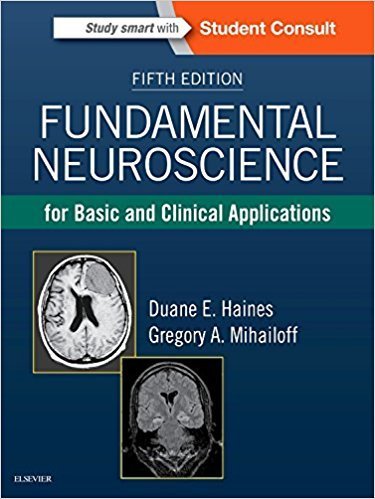
Fundamental Neuroscience for Basic and Clinical Applications 5th Edition, ISBN-13: 978-0323396325
Original price was: $50.00.$19.99Current price is: $19.99.
Safe & secure checkout
Description
Description
Fundamental Neuroscience for Basic and Clinical Applications 5th Edition by Duane E. Haines and Gregory A. Mihailoff, ISBN-13: 978-0323396325
[PDF eBook eTextbook]
528 pages
Publisher: Elsevier; 5 edition (October 27, 2017)
Language: English
ISBN-10: 9780323396325
ISBN-13: 978-0323396325
Using a rigorous yet clinically-focused approach, Fundamental Neuroscience for Basic and Clinical Applications, 5th Edition, covers the fundamental neuroscience information needed for coursework, exams, and beyond. It integrates neuroanatomy, pharmacology, and physiology, and offers a full section devoted to systems neurobiology, helping you comprehend and retain the complex material you need to know.
– Highlights clinical content in blue throughout the text, helping you focus on what you need to know in the clinical environment.
– Presents thoroughly updated information in every chapter, with an emphasis on new clinical thinking as related to the brain and systems neurobiology.
– Features hundreds of correlated state-of-the-art imaging examples, anatomical diagrams, and histology photos – nearly half are new or improved for this edition.
– Pays special attention to the correct use of clinical and anatomical terminology, and provides new clinical text and clinical-anatomical correlations.
Table of contents:
Front Cover……Page 1
IFC……Page 2
FUNDAMENTAL NEUROSCIENCE for Basic and Clinical Applications……Page 3
FUNDAMENTAL NEUROSCIENCE for Basic and Clinical Applications……Page 5
Copyright……Page 6
Contributors……Page 7
Preface……Page 9
Acknowledgments……Page 11
Contents……Page 13
I – ESSENTIAL CONCEPTS……Page 15
Neurons……Page 17
Spinal Cord……Page 18
Thalamus……Page 19
FUNCTIONAL SYSTEMS AND REGIONS……Page 20
CONCEPT OF AFFERENT AND EFFERENT……Page 21
CLINICAL IMAGES OF THE BRAIN AND SKULL……Page 22
Computed Tomography……Page 23
Magnetic Resonance Imaging……Page 24
Imaging of the Brain and Skull……Page 25
Sources and Additional Reading……Page 29
STRUCTURE OF NEURONS……Page 30
Cell Body……Page 31
Axons and Axon Terminals……Page 34
Axonal Transport as a Research Tool……Page 35
ELECTRICAL PROPERTIES OF NEURONS……Page 36
Chemical Synapses……Page 37
Disorders of Neurotransmitter Metabolism……Page 39
ASTROCYTES……Page 40
Astrocytes at the Blood-Brain Barrier……Page 41
CONTROL OF LOCAL BLOOD FLOW WITHIN THE CENTRAL NERVOUS SYSTEM……Page 42
OLIGODENDROCYTES……Page 43
Glia-Derived Tumors……Page 44
SUPPORTING CELLS OF THE PERIPHERAL NERVOUS SYSTEM……Page 46
DEGENERATION AND REGENERATION……Page 47
Sources and Additional Reading……Page 49
Forces Due to Concentration Gradients……Page 50
Electrical Forces……Page 52
Membrane Potential……Page 53
Fluid Transport: Pumps and Channels……Page 54
Pain and a Syndrome of Periodic Paralysis……Page 55
Microbial Attacks: Antibiotics……Page 56
Generator Potentials……Page 57
Receptor Binding and Channel Gating……Page 58
Calculation of the End Plate Potential by Ohm’s Law……Page 59
Compound Action Potentials……Page 60
Cable Properties of Nerve Processes……Page 61
Sodium Channel Activated by Depolarization……Page 62
Threshold Voltage……Page 63
Gating, Selectivity, and the Structure of the Sodium Channel……Page 64
Tetany……Page 65
Controlling Excitability……Page 66
NEURONAL ACTIVITY AS INFORMATION……Page 68
Sources and Additional Reading……Page 70
Synthesis and Storage……Page 71
GLUTAMATE RECEPTORS: THE TETRAMERIC EXCITATORY IONOTROPIC RECEPTORS……Page 72
AMPA Receptors and Milliseconds of Excitation……Page 73
CYS-LOOP RECEPTORS: THE PENTAMERIC MULTIFUNCTIONAL IONOTROPIC RECEPTORS……Page 76
Neuromuscular Junction Structure and Transmitter Release……Page 77
Synaptic Vesicles: Transmitter Storage and Release……Page 78
Tetanus……Page 80
Serotonin (5-HT) and Emesis……Page 81
G Proteins Have Receptors as Exchange Factors……Page 82
THE BIOGENIC AMINES MODULATE SYNAPTIC ACTIVITY……Page 83
Catechol Synthesis and Storage……Page 84
Serotonin Synthesis and Functions……Page 85
Psychotropic Drugs and the Uptake and Delivery of Catecholamines……Page 86
RETROGRADE TRANSMISSION……Page 87
CODA……Page 88
Sources and Additional Reading……Page 89
DEVELOPMENT OF THE NEURAL TUBE: GENERAL CONCEPTS……Page 90
BRAIN DEVELOPMENT……Page 91
Congenital Nervous System Defects of Primary Neurulation……Page 92
Secondary Neurulation……Page 93
Diencephalon and Cerebral Hemispheres……Page 94
Infectious Diseases Causing Congenital Nervous System Defects……Page 96
Neural Crest……Page 97
Basic Features……Page 98
Spinal Cord……Page 99
Brainstem……Page 100
Cerebellum……Page 102
Cerebral Cortex……Page 103
Abnormalities of Cortical Development……Page 104
Overproduction of Neurons and Apoptosis……Page 105
Plasticity and Competition……Page 106
Myelination……Page 107
Sources and Additional Reading……Page 109
II –
REGIONAL NEUROBIOLOGY……Page 110
DEVELOPMENT……Page 112
Formation of the Choroid Plexus……Page 113
Third Ventricle……Page 115
Cerebral Aqueduct……Page 116
Ependyma……Page 117
Ependymomas……Page 118
Choroid Plexus……Page 119
Cerebrospinal Fluid in Health and Disease……Page 120
Cerebrospinal Fluid Production and Circulation……Page 122
Obstructive Hydrocephalus……Page 123
Communicating Hydrocephalus……Page 124
Normal-Pressure Hydrocephalus……Page 125
Sources and Additional Reading……Page 126
DEVELOPMENT OF THE MENINGES……Page 127
OVERVIEW OF THE MENINGES……Page 128
Dural Border Cell Layer……Page 129
Dural Infoldings and Sinuses……Page 130
Compartments and Herniation Syndromes……Page 131
Arachnoid Barrier Cell Layer……Page 132
Arachnoid Villi……Page 133
General Histologic Features……Page 134
Symptoms and Treatment……Page 135
Pia Mater……Page 136
Subarachnoid Hemorrhage……Page 138
Meningitis……Page 139
Sources and Additional Reading……Page 142
Aneurysm……Page 143
Arteriovenous Malformation……Page 144
Internal Carotid Artery……Page 145
Middle Cerebral Artery……Page 146
Vertebral Artery……Page 148
Posterior Inferior Cerebellar Artery……Page 149
Posterior Cerebral Artery……Page 150
VEINS AND VENOUS SINUSES OF THE BRAIN……Page 151
Basal Aspect of the Brain……Page 153
Internal Veins of the Hemisphere……Page 154
Cerebral Venous Thrombosis……Page 156
BLOOD-BRAIN BARRIER……Page 157
Neural Plate……Page 160
Neural Tube Defects……Page 161
Spinal Meninges……Page 162
Gray Matter……Page 163
Sacral Levels……Page 164
Sensory Components of the Spinal Nerve……Page 166
Deafferentation Pain and the Posterior (Dorsal) Root Entry Zone Procedure……Page 167
SPINAL REFLEXES……Page 168
Flexor Reflex……Page 169
Polyneuropathy……Page 170
Functions of Ascending Tracts……Page 171
Functions of Descending Tracts……Page 172
Acute Central Cervical Spinal Cord Syndrome……Page 173
Sources and Additional Reading……Page 174
Midbrain……Page 175
VENTRICULAR SPACES OF THE BRAINSTEM……Page 176
CRANIAL NERVE NUCLEI AND THEIR FUNCTIONAL COMPONENTS……Page 177
Motor……Page 179
Sensory……Page 180
Central Herniation……Page 181
Tonsillar Herniation……Page 182
Anterior Medulla……Page 183
Vasculature……Page 185
Caudal Medulla: Level of the Motor Decussation……Page 186
Caudal Medulla: Level of the Sensory Decussation……Page 187
Midmedullary Level……Page 188
Rostral Medulla and Pons-Medulla Junction……Page 190
Reticular and Raphe Nuclei……Page 192
TONSILLAR HERNIATION……Page 193
Cerebellum……Page 195
Cerebellum……Page 196
Vasculature of the Pons and Cerebellum……Page 197
Caudal Pontine Level……Page 198
Rostral Pontine Level……Page 200
Reticular and Raphe Nuclei……Page 201
VASCULAR SYNDROMES OF THE PONS……Page 202
Cerebellar Cortex……Page 203
Vasculature of the Cerebellum……Page 204
Sources and Additional Reading……Page 205
Anterior (Ventral) Midbrain……Page 206
Posterior (Dorsal) Midbrain……Page 207
Summary of Descending Pathways……Page 208
Caudal Midbrain Levels……Page 209
Rostral Midbrain Levels……Page 210
Reticular and Raphe Nuclei……Page 214
VASCULAR SYNDROMES OF THE MIDBRAIN……Page 215
HERNIATION SYNDROMES RELATED TO THE MIDBRAIN……Page 216
Sources and Additional Reading……Page 217
Sources and Additional Reading……Page 218
MOTOR CELL COLUMNS AND NUCLEI……Page 219
SENSORY CELL COLUMNS AND NUCLEI……Page 220
Accessory Nerve……Page 221
Vagus Nerve……Page 223
Glossopharyngeal Nerve……Page 225
Syndromes of the Jugular Foramen……Page 226
Vestibulocochlear Nerve……Page 227
Facial Nerve……Page 229
Abducens Nerve……Page 230
CRANIAL NERVE OF THE PONS……Page 231
Trigeminal Nerve……Page 232
Trochlear Nerve……Page 233
Oculomotor Nerve……Page 234
Sources and Additional Reading……Page 235
Sources and Additional Reading……Page 236
DEVELOPMENT OF THE DIENCEPHALON……Page 237
BASIC ORGANIZATION……Page 239
Medial Thalamic Nuclei……Page 240
Lateral Thalamic Nuclei……Page 241
Summary of Thalamic Organization……Page 244
Lateral Hypothalamic Zone……Page 245
Medial Hypothalamic Zone……Page 246
EPITHALAMUS……Page 247
VASCULATURE OF THE DIENCEPHALON……Page 248
Sources and Additional Reading……Page 249
Sources and Additional Reading……Page 250
DEVELOPMENT……Page 251
Developmental Defects……Page 252
Frontal Lobe……Page 253
Parietal Lobe……Page 254
Insular Lobe……Page 256
Vasculature of the Cerebral Cortex……Page 257
Association Fibers……Page 258
Projection Fibers: The Internal Capsule……Page 259
Vasculature of the Internal Capsule……Page 260
Nucleus Accumbens and Substantia Innominata……Page 261
Subthalamic Nucleus and Substantia Nigra……Page 262
Major Connections of the Basal Nuclei……Page 263
HIPPOCAMPUS AND AMYGDALA……Page 264
Sources and Additional Reading……Page 265
Sources and Additional Reading……Page 267
III –
SYSTEMS NEUROBIOLOGY……Page 268
Peripheral Mechanoreceptors……Page 270
Spinal Cord and Brainstem……Page 272
Primary Somatosensory (SI) Cortex……Page 275
Additional Cortical Somatosensory Regions……Page 277
Trigeminal Nerve……Page 278
Peripheral Receptors……Page 279
Plasticity and Reorganization in the Primary Somatosensory Cortex……Page 281
Anterior Spinocerebellar Tract……Page 282
Rostral Spinocerebellar Tract……Page 283
Sources and Additional Reading……Page 284
Sources and Additional Reading……Page 285
ANTEROLATERAL SYSTEM……Page 286
Cutaneous Nociceptors and Primary Neurons……Page 287
Pain Receptors in Muscles, Joints, and Viscera……Page 288
Central Pathways from the Body……Page 289
Primary Neurons……Page 296
Central Pathways from the Face and Oral Cavity……Page 298
CHRONIC AND NEUROPATHIC PAIN AND THE THALAMUS……Page 301
IMAGING OF THE PAIN PATHWAY……Page 303
Sources and Additional Reading……Page 305
Sources and Additional Reading……Page 306
VISCEROSENSORY RECEPTORS……Page 307
ASCENDING PATHWAY FOR SYMPATHETIC AFFERENTS……Page 308
Referred Pain……Page 309
Angina……Page 310
Sacral Parasympathetic Afferents……Page 311
Cranial Parasympathetic Afferents……Page 312
VISCERAL INPUT TO THE RETICULAR ACTIVATING SYSTEM……Page 313
Sources and Additional Reading……Page 314
Sources and Additional Reading……Page 315
Chambers of the Eye……Page 316
Lens……Page 317
NEURAL RETINA AND PIGMENT EPITHELIUM……Page 318
Rods……Page 319
Cones……Page 320
Bipolar Cells……Page 321
Ganglion Cells……Page 322
Retinogeniculate Projections……Page 324
Optic Nerve, Chiasm, and Tract……Page 325
LATERAL GENICULATE NUCLEUS……Page 326
Magnocellular and Parvocellular Layers……Page 327
OPTIC RADIATIONS……Page 328
PRIMARY VISUAL CORTEX……Page 329
Receptive Field Properties of Cortical Neurons……Page 331
Orientation Columns……Page 332
Ocular Dominance Columns……Page 333
OTHER VISUAL CORTICAL AREAS……Page 334
Sources and Additional Reading……Page 335
Sources and Additional Reading……Page 336
PROPERTIES OF SOUND WAVES AND HEARING……Page 337
Inner Ear: Structure of the Cochlea……Page 338
Mechanoelectrical Transduction……Page 340
Sensorineural Deafness……Page 341
OVERVIEW OF CENTRAL AUDITORY PATHWAYS……Page 342
Vascular Supply of the Auditory Brainstem and Cortex……Page 343
Cochlear Nuclei……Page 344
Superior Olivary Complex……Page 345
Inferior Colliculus……Page 346
AUDITORY AND RELATED ASSOCIATION CORTICES……Page 348
MIDDLE EAR REFLEX……Page 349
Sources and Additional Reading……Page 350
Sources and Additional Reading……Page 351
PERIPHERAL VESTIBULAR LABYRINTH……Page 352
Vestibular Receptor Organs……Page 353
Hair Cell Morphology……Page 354
Hair Cell Transduction……Page 355
SEMICIRCULAR CANALS AND OTOLITH ORGANS……Page 356
Function of Semicircular Canals……Page 357
Vestibular Afferent Inputs……Page 358
Cerebellar Connections……Page 359
Commissural Connections……Page 360
Rotational Vestibuloocular Reflex……Page 361
Nystagmus……Page 362
Vestibular Thalamus……Page 363
Navigation……Page 364
Sources and Additional Reading……Page 365
Sources and Additional Reading……Page 366
OLFACTORY RECEPTORS……Page 367
Olfactory Bulb……Page 369
Olfactory Bulb Projections……Page 371
Disorders of the Olfactory System……Page 372
TASTE RECEPTORS……Page 373
TASTE TRANSDUCTION……Page 374
PERIPHERAL TASTE PATHWAYS……Page 376
Disorders of the Gustatory System……Page 377
Sources and Additional Reading……Page 378
Sources and Additional Reading……Page 379
Neuromuscular Junction……Page 380
Size Principle……Page 382
Muscle Spindles……Page 383
Gamma Loop……Page 384
Reflex Circuits……Page 385
Vestibulospinal Tracts……Page 386
Rubrospinal Tract……Page 387
Decerebration……Page 388
Posterior (Dorsal) Root Section……Page 389
Cerebellar Anterior Lobe Section……Page 391
Decortication……Page 392
Sources and Additional Reading……Page 393
Sources and Additional Reading……Page 394
Upper Motor Neuron Signs……Page 395
Origin……Page 396
Course……Page 397
Termination……Page 402
Origin……Page 403
Termination……Page 404
Corticopontine System……Page 408
Supplementary Motor Cortex……Page 409
HIERARCHICAL ORGANIZATION VERSUS PARALLEL DISTRIBUTED PROCESSING IN THE MOTOR SYSTEM……Page 410
Sources and Additional Reading……Page 411
Sources and Additional Reading
……Page 412
COMPONENTS OF THE BASAL NUCLEI……Page 413
Striatal Complex……Page 414
Pallidal Complex……Page 416
Nigral Complex……Page 418
DIRECT AND INDIRECT PATHWAYS OF BASAL NUCLEAR ACTIVITY……Page 419
Balance Between Inhibition and Disinhibition as the Primary Mode of Basal Nuclear Function……Page 420
Motivational Loop……Page 421
Disease Implications of Topography of Basal Nuclear Circuits……Page 422
Integrated Function of the Basal Nuclei……Page 423
Huntington Disease……Page 425
Parkinson Disease……Page 426
Wilson Disease……Page 428
Sources and Additional Reading……Page 429
Sources and Additional Reading……Page 430
Cerebellar Lobes, Lobules, and Zones……Page 431
Cerebellar Nuclei……Page 433
Purkinje Cell Layer……Page 434
Granule Cell Layer……Page 436
Cerebellar Afferent Fibers……Page 439
Synaptic Interactions in the Cerebellar Cortex……Page 440
Vestibulocerebellar Module……Page 442
Spinocerebellar Module……Page 443
Pontocerebellar Module……Page 445
Pontocerebellar Dysfunction……Page 447
CEREBELLAR INFLUENCE ON VISCEROMOTOR FUNCTIONS……Page 448
important aspects of motor learning…….Page 449
Sources and Additional Reading……Page 450
OVERVIEW……Page 451
Extraocular Muscles……Page 452
Edinger-Westphal Complex……Page 453
Sympathetic Supply to the Orbit……Page 454
Extraocular Muscle Motor Neurons……Page 456
Horizontal and Vertical Gaze Centers……Page 458
Supranuclear Control……Page 459
Smooth Pursuit……Page 461
Vergence Movements and the Near Triad……Page 462
Optokinetic Eye Movements……Page 463
Pupillary Light Reflex……Page 464
Blinking and Other Lid Movements……Page 466
Sources and Additional Reading……Page 467
Sources and Additional Reading……Page 468
General Features of Peripheral Visceral Motor Outflow……Page 469
Postganglionic Visceral Motor Neurons……Page 470
Sympathetic Preganglionic Neurons……Page 471
Sympathetic Ganglia……Page 472
Internal Organization of Sympathetic Ganglia……Page 474
Receptor Types in Sympathetic Targets……Page 475
Preganglionic and Postganglionic Neurons……Page 476
ENTERIC NERVOUS SYSTEM……Page 477
REGULATION OF VISCERAL MOTOR OUTFLOW……Page 478
Cardiovascular System……Page 479
Sources and Additional Reading……Page 480
Sources and Additional Reading……Page 481
HYPOTHALAMUS AND PITUITARY……Page 482
DIVISIONS OF THE HYPOTHALAMUS……Page 483
Medial Zone……Page 484
FEEDING MOTIVATION……Page 486
Amygdalohypothalamic Fibers……Page 487
Descending Projections……Page 488
Supraopticohypophysial Tract……Page 490
PITUITARY TUMORS……Page 491
Adrenocorticotropic Hormone–Secreting Tumors (Cushing Disease)……Page 492
Gonadotropin-Secreting Tumors……Page 493
REGIONAL FUNCTIONS OF THE HYPOTHALAMUS……Page 494
Temperature Regulation Reflex……Page 495
Sources and Additional Reading……Page 496
Sources and Additional Reading……Page 497
CYTOARCHITECTURAL DEFINITIONS OF THE LIMBIC CORTEX……Page 498
EARLY FUNCTIONAL CONCEPTS……Page 499
HIPPOCAMPAL FORMATION……Page 500
Structure……Page 501
Complete Circuit of Papez……Page 502
LONG-TERM POTENTIATION AND MEMORY……Page 503
Efferent Fibers……Page 504
SEPTAL REGION……Page 505
LIMBIC SYSTEM AND BEHAVIOR……Page 506
LIMBIC SYSTEM AND COGNITIVE FUNCTION……Page 507
Sources and Additional Reading……Page 508
Sources and Additional Reading……Page 509
LAYERS OF THE CEREBRAL CORTEX……Page 510
Pyramidal Cells……Page 512
Intrinsic Circuitry of the Cerebral Cortex……Page 513
Cytoarchitecture……Page 514
COLUMNAR ORGANIZATION……Page 515
SYNOPSIS OF THALAMOCORTICAL RELATIONSHIPS……Page 516
HIGHER CORTICAL FUNCTIONS……Page 517
Wernicke Aphasia and Broca Aphasia……Page 518
Parietal Association Cortex: Space and Attention……Page 519
Apraxia and Agnosia……Page 520
Sources and Additional Reading……Page 521
Sources and Additional Reading……Page 522
EVALUATION VERSUS EXAMINATION……Page 523
Cranial Nerve II……Page 524
Cranial Nerves III, IV, and VI……Page 526
Cranial Nerve V……Page 528
Cranial Nerve VIII……Page 529
Cranial Nerve XII……Page 530
MOTOR EXAMINATION……Page 531
Muscle Stretch Reflexes……Page 532
SENSORY EXAMINATION……Page 533
Sources and Additional Reading……Page 536
Sources and Additional Reading
……Page 537
CHAPTER 15……Page 538
CHAPTER 32……Page 539
A……Page 540
B……Page 541
C……Page 542
E……Page 545
F……Page 546
H……Page 547
I……Page 548
L……Page 549
M……Page 550
N……Page 551
O……Page 552
P……Page 553
S……Page 555
T……Page 558
V……Page 559
Z……Page 560
IBC……Page 561
What makes us different?
• Instant Download
• Always Competitive Pricing
• 100% Privacy
• FREE Sample Available
• 24-7 LIVE Customer Support



Reviews
There are no reviews yet.